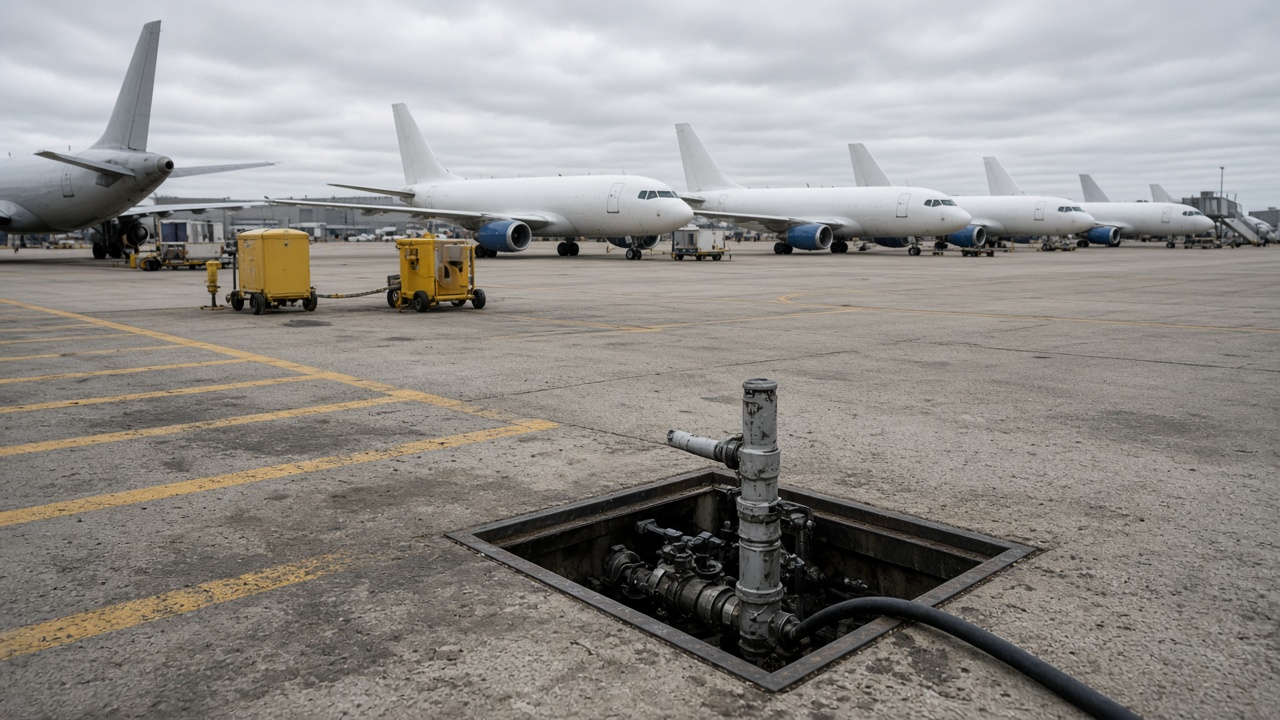
Airline stocks led industrials lower Wednesday as jet fuel differentials tracked the same middle-distillate scarcity that has lifted diesel at truck stops. United Airlines and Delta Air Lines, which disclose quarterly hedge positions, faced analyst questions about mark-to-market losses on contracts struck when crude traded nearer $70. Southwest Airlines, largely unhedged in recent years, fell on a different fear: no accounting cushion when spot jet rallies bite operating margin directly.
Who led and by how much
The NYSE Arca Airline Index dropped 3.1 percent by midday, with United off 4.4 percent and Delta down 3.7 percent. Southwest slipped 2.9 percent despite having avoided the hedge footnote drama. The mechanism was visible in Gulf Coast jet fuel quotes, which traders said widened against WTI by more than $12 a barrel since the September 13 strikes near the Strait of Hormuz, echoing diesel’s outperformance chronicled in energy desks’ Saudi outage coverage.
Sell-side models of third-quarter fuel expense at the four largest U.S. network carriers, using Monday’s spot curve, put the spread between hedged and unhedged outcomes above $180 million collectively for a ten-dollar-a-barrel miss—money investors had not fully embedded because jet had lagged diesel for much of August.
Why jet is riding diesel’s coattails
Refineries can tilt cat crackers and hydrocrackers toward diesel when ULSD margins explode. Jet fuel, another middle distillate, competes for the same molecules and logistics. When the East-West pipeline outage removed Saudi barrels and traders priced Yanbu storage at five to seven days of cover, as Reuters reported, the prompt market bid up distillates first. Gasoline cracks followed, but jet moved with diesel because export arbitrage and military logistics demand soaked up kerosene-range product.
Hedging programs at United and Delta historically use WTI or heating oil swaps as proxies. When the correlation breaks—diesel premium without a matching crude move—those proxies underperform. Mark-to-market losses flow through other comprehensive income until contracts settle, but conference call audiences treat them as a signal of management foresight.
What the street already had in the number
Second-quarter earnings calls already lowered full-year margin guides when Brent first crossed $90. Sell-side models assumed roughly $95 Brent for the second half. Few desks carried $105-plus sustained into October before the Saudi attack headlines. Hedge losses are therefore incremental to a forecast that was already tightening.
What would falsify the bear case by Friday? A credible reopening of Yanbu loadings, a ceasefire headline that collapses war-risk insurance on tankers, or a U.S. SPR release aimed at middle distillates rather than crude. Without one of those, jet differentials likely stay sticky while passengers still book fall travel—a recipe for margin compression without fare hikes, because carriers fear demand elasticity after two years of inflation fatigue.
Balance sheets and unhedged bets
American Airlines, with lighter hedge coverage than United, traded down in sympathy even though its near-term cash hedge is smaller. The market’s message: in a distillate-led rally, being unhedged is not obviously safer. Southwest’s leadership has argued that hedging is an expensive insurance policy; this week’s move tested that philosophy with brute force.
Lessor stocks and airport REITs barely moved, confirming investors view the story as fuel expense timing, not a demand collapse. Cargo yields, however, may complicate the picture if military charters and Gulf evacuations soak up wide-body lift, tightening supply for holiday freight.
Operating responses investors watch
Carriers can defer nonessential flying, push older inefficient tails to desert storage, and raise fuel surcharges on corporate contracts that allow pass-through. None of those levers flip overnight. United’s operations chief told staff in a Tuesday note reviewed by InfoHandle to expect “tankering” reviews on transcontinental routes—carrying extra fuel from cheaper hubs—a tactic that saves money only when price spreads exceed burn penalties.
For shareholders, the actionable split is between accounting noise and cash fuel bills. Hedge losses reverse when curves normalize; spot jet does not. This week’s price action says the cash bill is the one that matters for September quarter guidance revisions likely arriving in October.