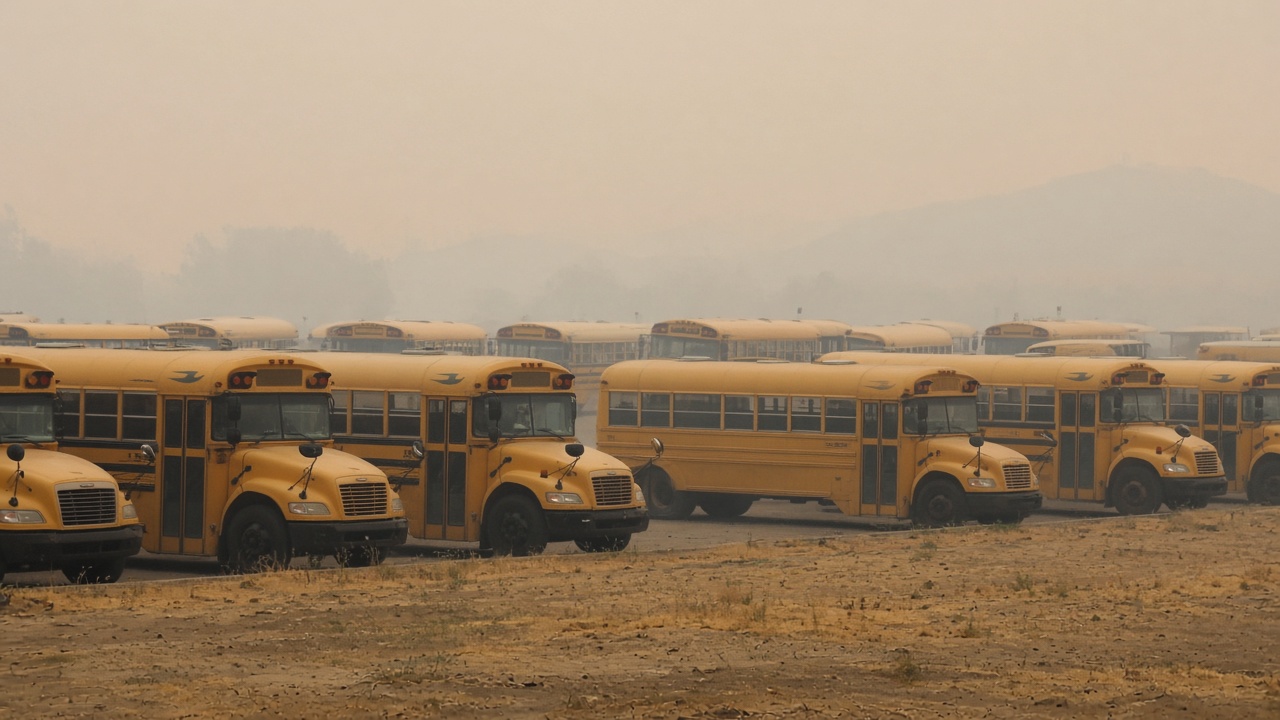
Central Valley school superintendents leaned on California’s wildfire smoke guidance and live AirNow maps this week to stagger in-person classes as fine particulate matter from Sierra Nevada fires drifted into Fresno, Kern, and Tulare counties.
Where the smoke landed
On the map readers can pull up at fire.airnow.gov, plumes showed PM2.5 concentrations crossing the “unhealthy for sensitive groups” band by Tuesday morning, even where flames remained dozens of miles east. CAL FIRE incident reports listed multiple active wildfires under wind advisories, with containment lines progressing slowly in steep terrain.
Ground-level monitors at school sites—not just regional averages—drove decisions. Districts own low-cost sensors near athletic fields where students would otherwise practice outdoors.
Measurable physical change
Nurses tracked rising visits for asthma inhaler use when air quality index readings stayed above 150 for three consecutive hours. Agricultural workers in adjacent towns reported ash on orchard rows, a visible sign that smoke was not only an urban freeway problem.
EPA-aligned thresholds treat children as a sensitive population; state education guidance urges moving recess indoors or canceling bus routes that require students to wait outside without shelter.
Local air districts posted hourly readings that diverged from satellite-only estimates, underscoring why superintendents waited for ground-truth monitors before announcing closures on social media.
Who lives and works there
Central Valley classrooms already balance heat, drought, and pesticide drift concerns; smoke adds another layer for families without home air filtration. Bus drivers’ unions asked for N95 stockpiles after last year’s prolonged September haze.
Small districts cannot always flip to remote instruction on short notice because broadband gaps persist in rural attendance boundaries. Several called “asynchronous learning days” instead, sending paper packets home when smoke, not fire, posed the primary risk.
Youth sports leagues postponed evening practices when portable monitors near fields showed sustained unhealthy readings, even on days when campuses stayed open for classroom instruction—a split policy that frustrated parents until officials explained differing exposure times outdoors.
Next season, not rhetoric
County offices of education said they are pre-negotiating substitute teacher pools for smoke weeks the way they once reserved snow-day staff in the Sierra foothills. Public health departments plan October clinics for HEPA filter distribution in Title I schools.
Parents can check district alert apps, but officials stressed verifying AirNow before assuming closures—morning winds can clear corridors by afternoon, or push smoke back in after sunset when drainage flows stall.
California Department of Education staff said they are updating a shared spreadsheet of district decisions so neighboring counties do not send conflicting messages when the same smoke plume crosses county lines—a coordination step that became routine after 2020 wildfire seasons but still lags in the smallest rural districts.
Fire meteorologists expect shifting winds through the weekend, so districts warned families that Friday’s open campuses may not predict Monday’s schedule without a fresh map check.