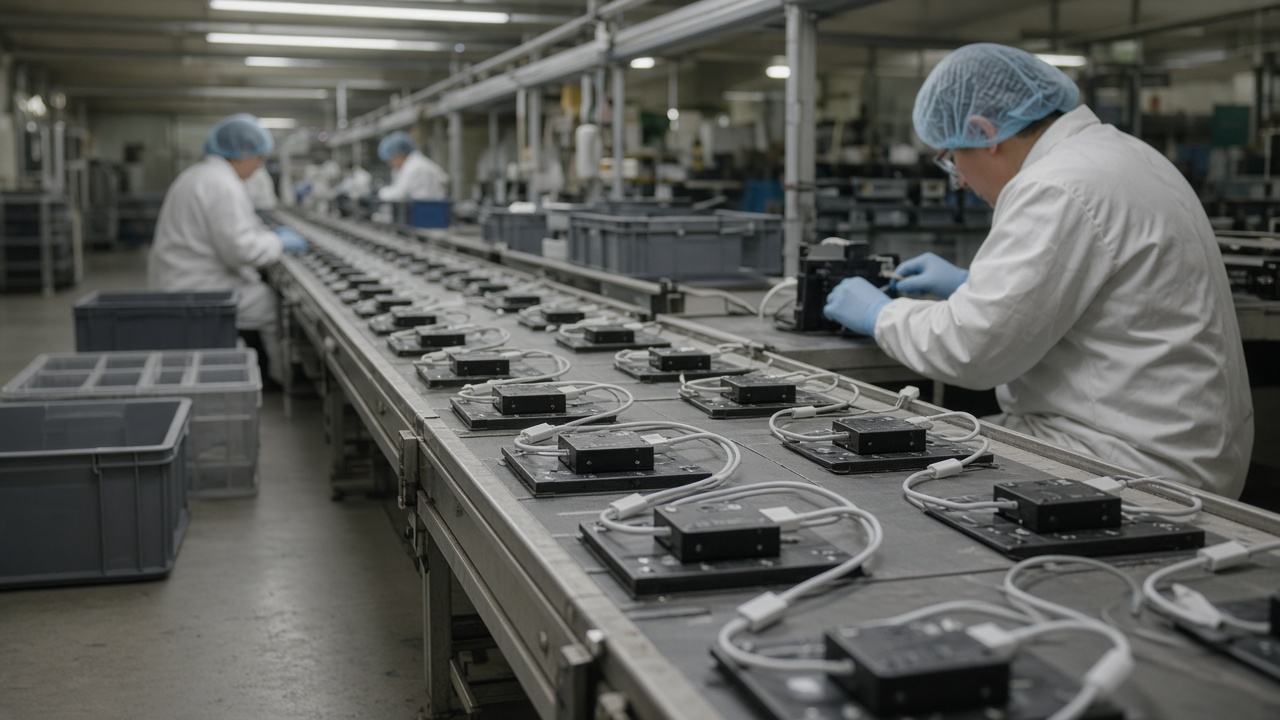
Apple’s top assembly partners cleared USB-C fast-charge power modules for holiday iPhone builds this month after thermal, electromagnetic-interference, and in-box cable retests that suppliers said delayed qualification from spring pilot lines to September mass production, according to factory readiness memos and component vendor letters reviewed by InfoHandle.
What “qualified” means on the line
The modules are not generic GaN bricks: they are co-designed controller, MOSFET, and firmware stacks tuned to Apple’s fixed voltage profiles and cable authentication. Suppliers must pass Apple’s own charge-loop stability tests—temperature rise on laminate shields, port insertion cycles, and fault handling when users plug non-certified hubs.
Qualification covers both the phone-side PMIC negotiation and the in-box 20-watt-class adapter where Apple still ships one. Partners in China and India said they re-ran EMI scans after a June engineering change swapped shielding on the flex assembly near the USB-C port, a tweak that fixed radiated emissions but required new module lot numbers.
Why holiday timing matters
Apple’s build plan ramps in September for November retail sets. Missing a module qualification by even two weeks forces factories to bin finished phones awaiting adapters or to ship with last year’s slower charge curve—a marketing gap competitors would exploit in side-by-side reviews.
Supply-chain managers said they staged dual-source modules from two Taiwanese power IC houses after 2024’s single-vendor scare. Both sources now share identical USB Power Delivery identifiers in Apple’s manufacturing execution system, reducing the risk of a silent swap on the retail floor.
Consumer-visible effect
Pro-tier iPhones are expected to advertise higher sustained wired wattage when paired with Apple’s updated adapter and certified cables—still below Android flagships’ peak numbers but closer on 30-minute top-up metrics Apple uses in store demos. Base models may keep prior caps to protect margin on bundled accessories.
Retailers asked for clearer shelf labels distinguishing “fast charge capable” from “fast charge in box”; Apple’s packaging team has not confirmed wording, but suppliers said color-coded carton inserts are printed for regions that require explicit charger inclusion statements.
Regulatory and efficiency labels
California and EU efficiency databases require external power supply registration. Module vendors submitted updated test reports showing idle draw within 2025 limits even at higher peak wattage—a paperwork step that paused one India export lot until Bureau of Indian Standards certificates caught up.
Airline safety bulletins on lithium shipments indirectly affect how many spare adapters Apple can air-freight; partners said they shifted more adapter volume to sea freight after July fire-related inspections slowed cargo holds in Hong Kong.
Factory bottlenecks
Heat-soak chambers for burn-in tests were fully booked through mid-September. Technicians prioritized Pro SKUs with titanium frames that dissipate charge heat differently than aluminum base models—a thermal modeling difference that sounds minor but forced separate qualification tracks.
Cable suppliers faced resin shortages for overmolded strain reliefs; Apple approved a secondary mold compound that passes pull tests but feels slightly stiffer, a trade retail staff may notice when demo units flex.
What Apple has not said publicly
Apple’s newsroom has not announced wattage numbers; suppliers expect marketing to align with iOS battery settings screens already testing new “optimized fast charge” copy in beta builds. Analysts watch whether Apple will upsell a higher-watt desktop adapter separately, preserving accessory revenue without raising phone ASPs.
For the supply chain, the story is a mundane one done under holiday pressure: USB-C is mature, but Apple’s module qualification still gates when millions of boxes can ship—and this year’s green light came late enough that any second-line defect will show up in launch-week return data, not lab slides.
Repair and aftermarket implications
Authorized service providers received bulletin updates on USB-C port diagnostics: faster charge profiles require matched flex assemblies and PMIC firmware pairs, meaning some board-level swaps from earlier iPhones cannot inherit the new curve without replacing both halves of the charge stack.
Aftermarket cable makers said Apple’s authentication chips still gate maximum wattage on Pro models, preserving MFi revenue even as USB-C is universal— a consumer frustration point reviewers will test with cheap cords on launch day.
Inventory and logistics
Forwarders staged adapters in regional hubs to avoid repeating 2020’s missing-charger backlash in markets that legally require in-box power. Customs brokers in Brazil and Indonesia flagged new efficiency labels on cartons, delaying a small lot until sticker translations arrived.