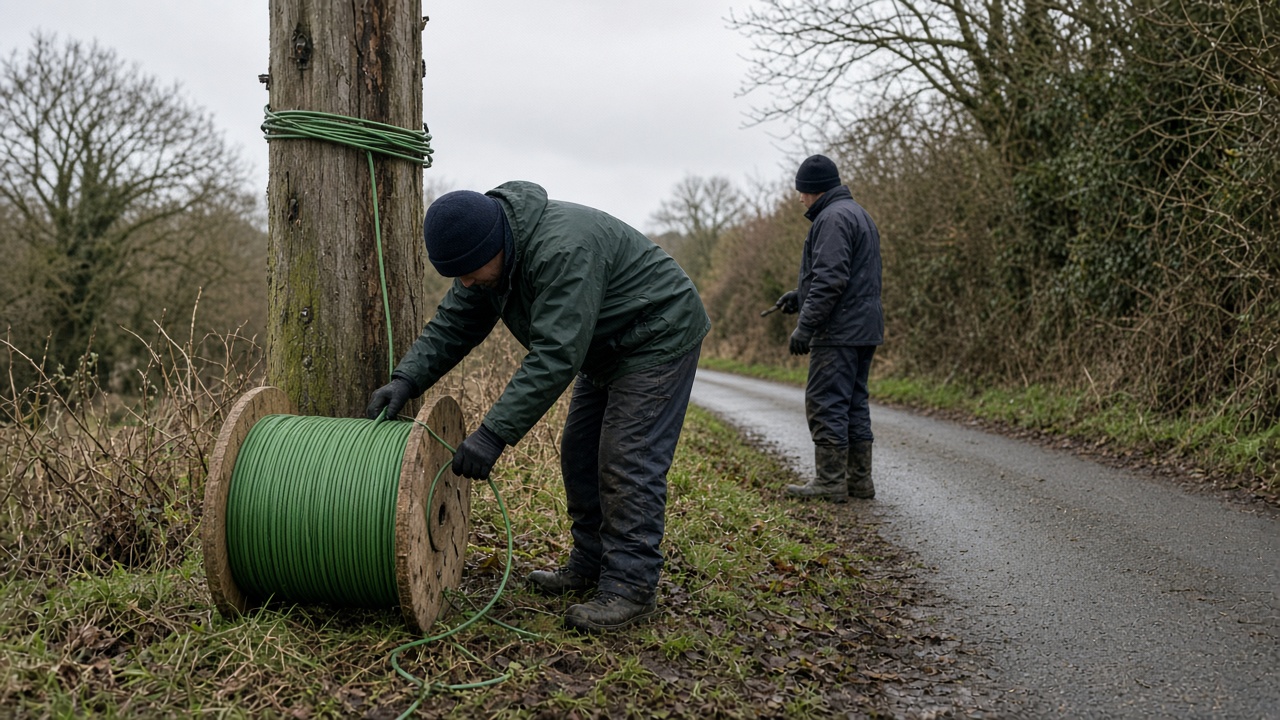
Openreach said Thursday it has made gigabit-capable fibre available to more than 80,000 homes and businesses across Devon and Cornwall under contracts tied to the government’s Project Gigabit programme, a milestone the company argues shows rural England can catch up without waiting for commercial returns alone. The update focuses on exchanges that still relied on long copper tails into moorland villages—places where planners once assumed wireless or satellite would have to suffice.
What changed in Devon
The build combines Openreach’s own capital with subsidies routed through Building Digital UK. Engineers have been laying spine fibre along A-road corridors, then branching into lanes where poles still carry legacy copper pairs. Openreach’s public coverage maps now show full fibre within reach of most premises in mid-Devon market towns, while the final tranche targets hamlets above Dartmoor where winter storms regularly snap overhead lines.
County councils said the milestone matters because previous “superfast” programmes often stopped at cabinets on main roads, leaving farm offices on dial-up-grade sync speeds. Tenant farmers and holiday lets in Cornwall told InfoHandle that upload symmetry—not just headline download—determines whether they can run booking systems without paying for a second mobile router.
Subsidy mechanics
Project Gigabit rules require bidders to hit take-up thresholds before claiming the last tranche of public money. Openreach must publish quarterly progress against those targets; BDUK can claw back funds if premises remain unserved after agreed dates. Rival alt-nets argued in consultation responses that pole-access disputes slowed Devon schedules, though Openreach counters that Ofcom’s revised Physical Infrastructure Access code cut average wayleave negotiations from months to weeks in pilot exchanges.
Smaller providers still question whether a single national incumbent should absorb most rural lots. Welsh and Scottish programmes run parallel procurements; England’s Devon lot was among the first to combine multiple county boundaries so contractors could batch trenching across council lines.
What residents should expect
Availability on a map does not mean a live service. Households must still order from retail ISPs that use Openreach’s network—BT, Sky, TalkTalk, Zen, and dozens of others. Install dates slip when ducts are blocked or when listed buildings need heritage consent for new entry points. Openreach’s appointment portal shows four-hour windows; engineers told us they carry spare fibre lengths because Devon stone walls rarely match standard bore paths.
Renters should check whether landlords permit router placement; full fibre often terminates in a small ONT that needs power and ventilation. Social landlords in Plymouth said they are bulk-ordering installs before winter damp worsens copper faults.
Competition and backhaul
CityFibre and other investors continue overbuilding parts of Exeter and Plymouth on separate ducts. Where two fibre networks coexist, consumer prices have fallen in prior Ofcom studies, though rural overlap remains rare. Mobile operators remind subscribers that 5G home broadband is not a substitute for fixed gigabit if operators cap video uploads during peak evening hours.
Backhaul from coastal Cornwall to London still rides diverse routes after a 2024 cable scare; Openreach said it added a third path through Bristol exchanges for traffic heading to cloud regions in Wales.
Politics and next lots
MPs representing moorland constituencies pressed ministers this summer to extend gigabit vouchers for businesses that missed earlier deadlines. The Department for Science, Innovation and Technology said the next Devon extensions will prioritize community halls and GP surgeries that anchor village connectivity. Openreach pledged to leave spare duct capacity for future alt-nets even where it wins exclusivity periods under subsidy law—a concession regulators demanded after prior monopoly complaints.
For households still on the wrong side of the 80,000 count, the company publishes an address checker tied to its public where-and-when timetable. If the tool still shows copper, councils advise logging cases with BDUK’s rural gigabit inquiry line so unserved premises stay on the next procurement slice rather than disappearing from maps when partial builds complete.
Engineering notes
Field teams said Devon’s granite verges dull trenching blades faster than chalk counties, so maintenance budgets now include more frequent tool swaps. That operational detail rarely appears in press releases but shapes how quickly the next ten thousand premises flip from “in build” to “ready to order” on retail ISP sites.