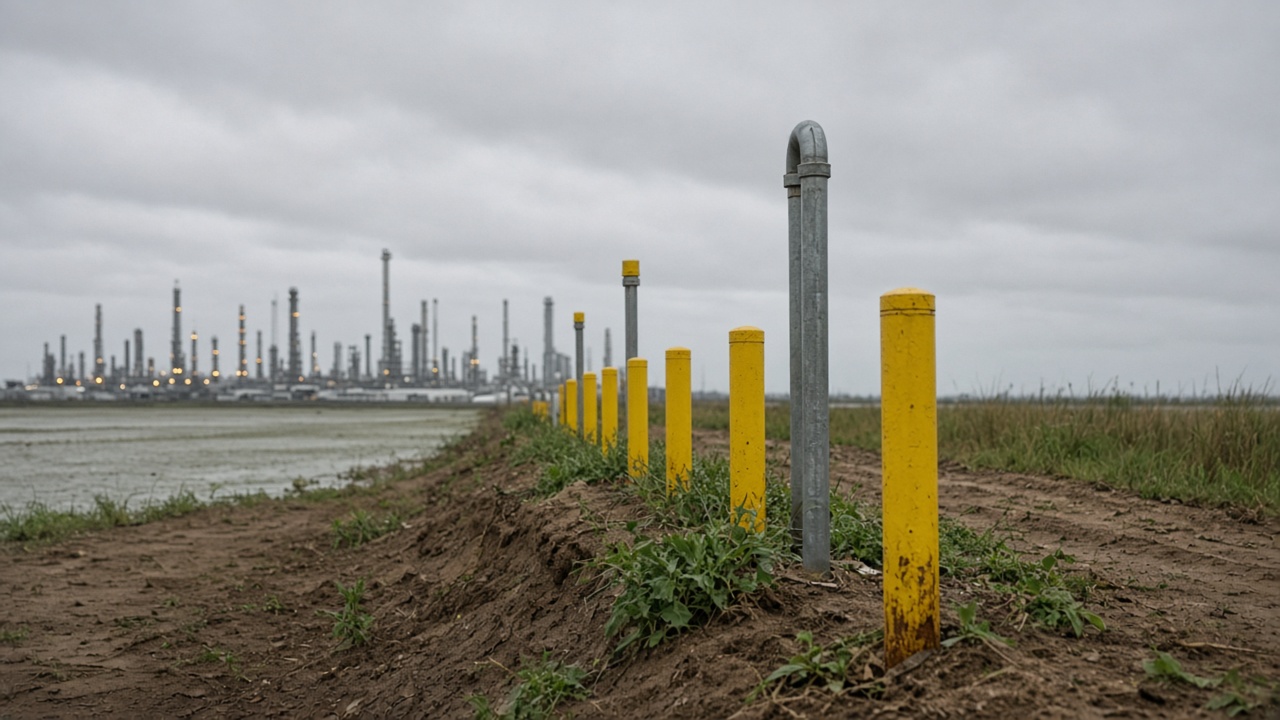
The Federal Energy Regulatory Commission on Thursday opened a formal inquiry into pressure anomalies reported on several Gulf Coast natural gas and liquids pipelines, telling operators to preserve SCADA logs and field notes from the past 72 hours while traders still price war-risk premiums on Middle East barrels.
What triggered the review
Commission staff said at least four interstate carriers filed unusual operating reports describing brief pressure dips and recoveries that did not align with scheduled maintenance or weather-related demand swings. The filings landed as Gulf Coast rack markets absorbed diesel tightness tied to Saudi pipeline repairs and Hormuz transit anxiety—conditions that increase simultaneous pulls on gas-fired power and distillate logistics, but do not by themselves explain isolated telemetry gaps.
FERC’s Office of Energy Infrastructure Security joined the inquiry, a signal that investigators have not ruled out malicious or human-factor causes. The commission has not accused any company of wrongdoing and has not ordered curtailments.
Which assets are in scope
Public docket summaries redact operator names, but people familiar with the filings said the cluster spans a Louisiana-to-Texas gas artery and two liquids lines feeding Houston-area terminals. Those corridors move molecules that also feed export docks strained by insurer surcharges on Red Sea routings. Even a short-lived pressure excursion can trip compressor stations designed to protect downstream neighborhoods.
Pipeline trade groups emphasized that automatic shutdowns worked as designed. Environmental advocates countered that repeated near-miss events deserve public timelines, not only after-the-fact compliance letters.
Confirmed versus claimed
Operators confirmed the telemetry events and cooperative data holds. Cybersecurity vendors circulating anonymous claims of a coordinated attack have not supplied hashes or indicators that FERC has validated. PHMSA, which shares jurisdiction on safety incidents, said it received parallel notifications but has not elevated a unified incident level.
Insurance brokers told InfoHandle that business-interruption riders on midstream assets are already repricing Gulf exposure; absent a named cause, underwriters may still demand broader logging requirements in renewals due in October.
What operators must do now
The order requires retention of historian databases, valve timing records, and contractor access logs for control rooms that touched the affected segments. Companies must brief commission staff within ten business days on root-cause hypotheses, including third-party maintenance crews and remote-access sessions.
Downstream utilities said they saw no customer outages, but several notified state regulators of precautionary fuel-switch plans if gas nominations wobble during peak cooling load. Louisiana parish emergency offices said they were not asked to shelter-in-place.
Market and legal tail
Futures traders treated the headline as background against Brent holding above $104. Physical gas cash prices at the Henry Hub moved modestly, suggesting the market views the inquiry as procedural unless FERC issues a notice of proposed penalty. Historically, pressure anomalies tied to configuration errors have produced compliance settlements without throughput caps.
If investigators trace the swings to cyber intrusion, the case could intersect with Transportation Security Administration pipeline security directives updated after Colonial Pipeline. Operators would face parallel disclosure obligations to investors holding midstream master limited partnerships.
What shippers should watch
Industrial gas buyers along the Houston Ship Channel should confirm alternate receipt points in nomination systems and verify that force majeure clauses in transport contracts distinguish regulatory holds from weather events. Liquids shippers booking September loadings should ask terminals whether line pack management could delay barge windows even without a formal force majeure.
FERC chair nominees have pledged faster public summaries when multiple operators report similar signatures. Thursday’s inquiry is the first test of that promise during an energy shock that already has Congress debating war powers and governors asking about gasoline reserves.
Until staff publishes findings, the responsible posture is neither panic nor dismissal: pressure anomalies on congested Gulf infrastructure are common enough to be mundane, yet clustered reports during a geopolitical oil spike are exactly when control rooms cannot afford silent retries.
Commission staff said they will hold a technical conference if operators disagree on whether shared third-party SCADA vendors explain the pattern. Such conferences rarely make evening news, but they produce the record state utility commissions cite when setting reliability fines.
Natural gas marketers advising power plants said they are building extra line-pack assumptions into September nominations, a hedge that costs money even if the inquiry closes without enforcement. That quiet tax on electricity buyers is another reason transparency beats rumor in tight fuel markets.