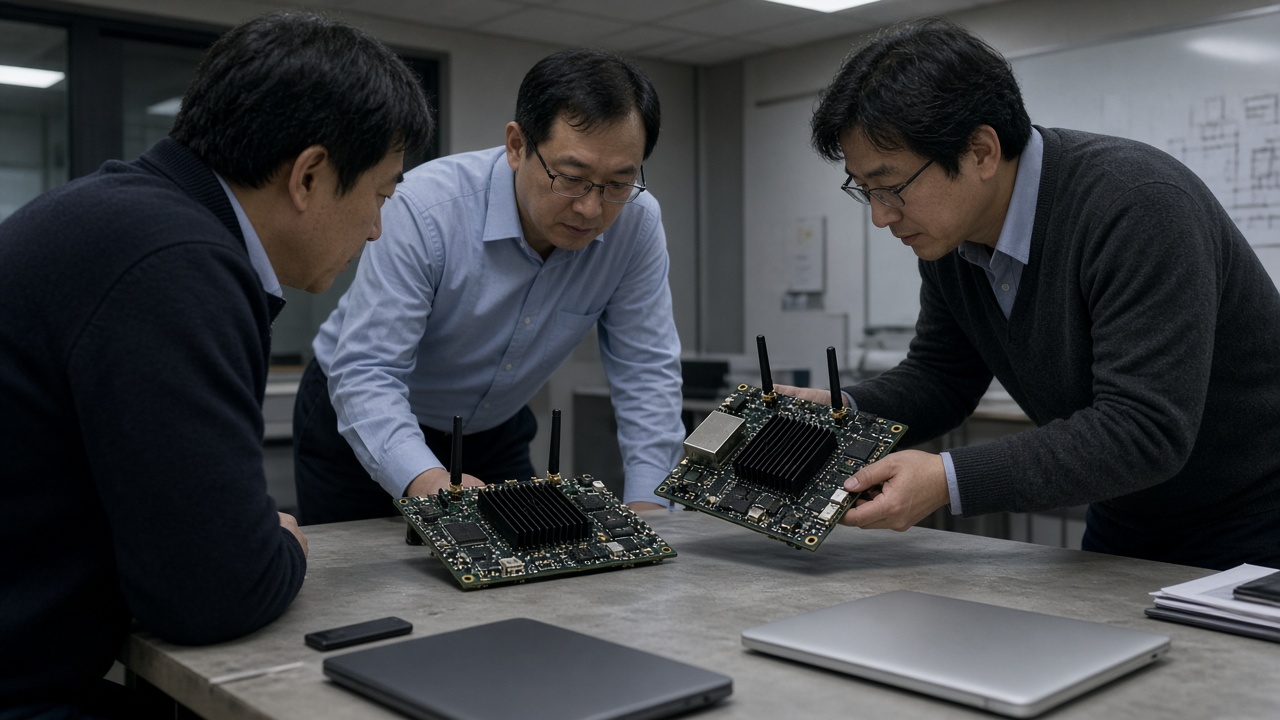
MediaTek convened a closed-door reference-board session with Taiwan router and residential-gateway OEMs in Hsinchu this week, showing early Wi-Fi 8 silicon on production-style PCBs and asking partners to tune firmware for deterministic latency on factory Wi-Fi and dense apartment blocks—not just peak throughput slides, according to attendees and briefing materials reviewed by InfoHandle.
What shipped on the table
The boards pair MediaTek’s next-generation MAC/PHY combo with the same switch-fabric blocks the company uses in broadband gateway chips. Engineers said the demo focused on sub-millisecond jitter for time-sensitive traffic classes, a requirement raised by machine-vision vendors that lost frames when consumer routers treated every packet as best-effort.
OEMs received Gerber stacks sized for their existing plastic chassis so Golden Week factory lines would not need retooling. One Taoyuan gateway maker said it could drop the board into a housing already certified for Wi-Fi 7, swapping only the RF front-end shield and thermal pad.
Why Taiwan OEMs care now
Taiwan brands supply a large share of retail routers sold in North America and Southeast Asia, but margin pressure pushed them to differentiate on software QoS and parental controls rather than silicon logos. Wi-Fi 8’s scheduled-access features give them a story that survives Costco shelf comparisons: fewer dropped video calls when teenagers stream and parents join Teams meetings on the same 5 GHz radio.
Industrial buyers are the sharper edge. Several attendees serve semiconductor fabs that run handheld scanners on Wi-Fi instead of pulling new Ethernet drops across clean-room ceilings. They asked MediaTek for documented latency histograms under 200-device loads, not marketing curves at three meters in an anechoic chamber.
Firmware and certification path
MediaTek said it would ship a reference SDK with hooks for per-station airtime scheduling and explicit feedback from access points to clients—a pattern Wi-Fi Alliance certification tracks under its evolving Wi-Fi 8 program. Taiwan OEMs expect pre-certification labs in Hsinchu to open booking slots in October, though final logos may lag silicon by a quarter.
Regulatory filings in Taiwan still route through the National Communications Commission; engineers said they are reusing Wi-Fi 7 antenna patterns where spectrum masks unchanged, accelerating type-approval for holiday retail builds.
Competitive read
Qualcomm and Broadcom continue to court the same OEMs with integrated gateway SoCs. MediaTek’s pitch is price-performance on the RF chain and tighter integration with its Filogic broadband chips already designed in Taiwan ODM bills of materials. None of the OEMs at the session described exclusive deals; they treat Wi-Fi 8 as a second-source insurance policy after supply shocks during the pandemic.
Support after launch
Router makers pressed MediaTek on long-term firmware CVE response. MediaTek pointed to its existing security bulletin cadence and promised a dedicated channel for OEMs serving enterprise Wi-Fi, where customers demand 48-hour patch SLAs. Consumer brands said they would push critical fixes through app stores faster than full FCC re-filings when possible.
What buyers should watch
Retail Wi-Fi 8 badges may appear before apartment dwellers feel a difference. The meaningful tests are sticky-client behavior on 6 GHz when neighbors deploy new mesh nodes, and whether scheduled access actually protects factory AMRs from guest-network traffic. Taiwan OEMs said they will publish open-source QoS profiles for education and hospitality verticals once certification clears—giving systems integrators something to audit besides box art.
ODM paperwork and timelines
Attendees left Hsinchu with homework: thermal photos at 35°C ambient, DFS radar coexistence logs for markets that share 6 GHz with weather services, and mesh backhaul tests with three-hop topologies common in Taiwanese townhouses. MediaTek scheduled a follow-up webinar after Mid-Autumn Festival for OEMs that miss the first certification window.
Retail buyers in Taipei said they will not market Wi-Fi 8 until firmware stabilizes roaming between APs sold a year apart—a pain point that hurt early Wi-Fi 6 mesh bundles. MediaTek promised backward-compatible steering profiles so living-room and bedroom units negotiate without factory resets.
For MediaTek, the win is not a keynote slide but a stack of signed ODM worksheets before Golden Week production windows close.