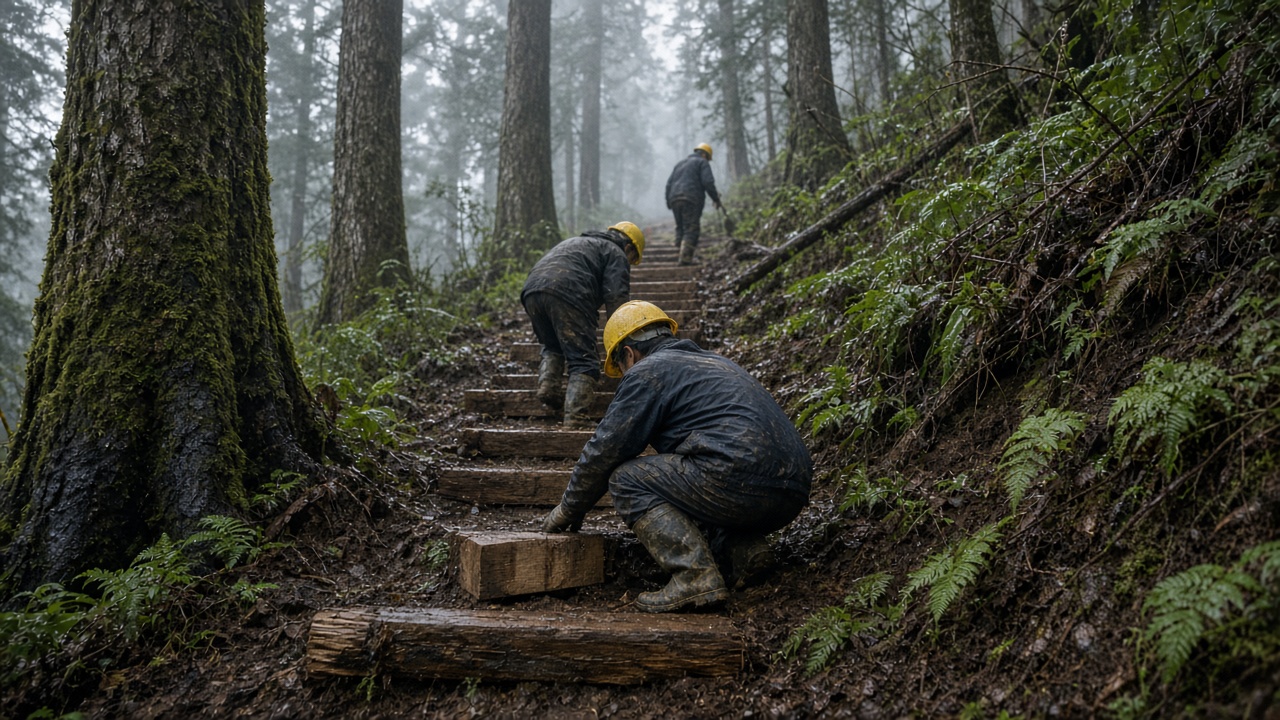
Trail maintenance crews in the Alishan National Scenic Area rebuilt switchbacks and log steps this week after September downpours stripped hillside paths, aiming to keep sunrise shuttle routes and cedar-grove boardwalks open before Mid-Autumn domestic tourism peaks.
Damage on the ground
Forestry and Nature Conservation Agency rangers documented four serious erosion scars along the Giant Tree Trail loop and the lower Zhu Mountain approach after three consecutive nights of heavy rain slid granite grit across drainage channels. No injuries were reported—hikers were turned back when sensors flagged rising stream crossings—but one 40-meter section lost its timber edging, leaving a waist-deep gully where families usually pose for photos beside mossy railings.
Crews airlifted crushed stone by cable pallet where truck access cannot reach, then pinned coconut-fiber matting on slopes above the washouts. Chiayi County engineers said the work is temporary until a hydrology study finishes in November; permanent culverts need approval because the area sits inside landslide-sensitive zoning.
Tourism timing
Alishan’s pre-dawn train tickets for September weekends were already scarce; scenic area administrators did not want to cap entries without trying repairs first. Shuttle buses now drop visitors at a revised midpoint when fog plus mud slow the upper loop; staff hand out QR-linked maps showing which segments require hiking boots, not hotel slippers. Homestay owners in Shizhuo village reported cancellations when social media photos showed brown water on lower paths—officials countered with daily trail-status posts in Traditional Chinese and English.
Environmental groups asked whether foot traffic should thin after storms; agency responders said closing entire groves hurts local guides who already lost income during past typhoon shutdowns. Instead, rangers doubled permit checks for camping off-trail, a common source of secondary erosion when tents compact rain-soaked duff.
What hikers should expect
Workers will remain on-site through October 1, meaning occasional one-lane delays and the smell of wet cedar sawdust. Weather radios at visitor centers still broadcast afternoon thunderstorm warnings—September heat does not mean stable soils. If another tropical system brushes Taiwan’s east coast, administrators may close the upper loop again within hours; hikers should carry cash for bus refunds and avoid relying on mobile signal under dense canopy.
Local guides and ecology
Licensed Alishan guides rerouted sunrise tours to boardwalk segments that stayed dry, explaining erosion science to tourists who expected pristine Instagram backdrops. Forestry teams seeded native bracken on one scar to stabilize soil without importing nonlocal grasses that could choke understory plants red tree voles rely on. Chiayi County tourism bureau offered voucher extensions for hikers who postponed trips, a small cushion for homestays that already ordered extra breakfast buns for the holiday week.
Long-term, agency planners may elevate raised walkways in the wettest 200 meters of the Giant Tree loop, a capital project awaiting budget hearings after typhoon season ends. Until then, crews measure tread depth weekly and post numbers at trailheads so visitors know when mud risk outweighs sunrise ambition.