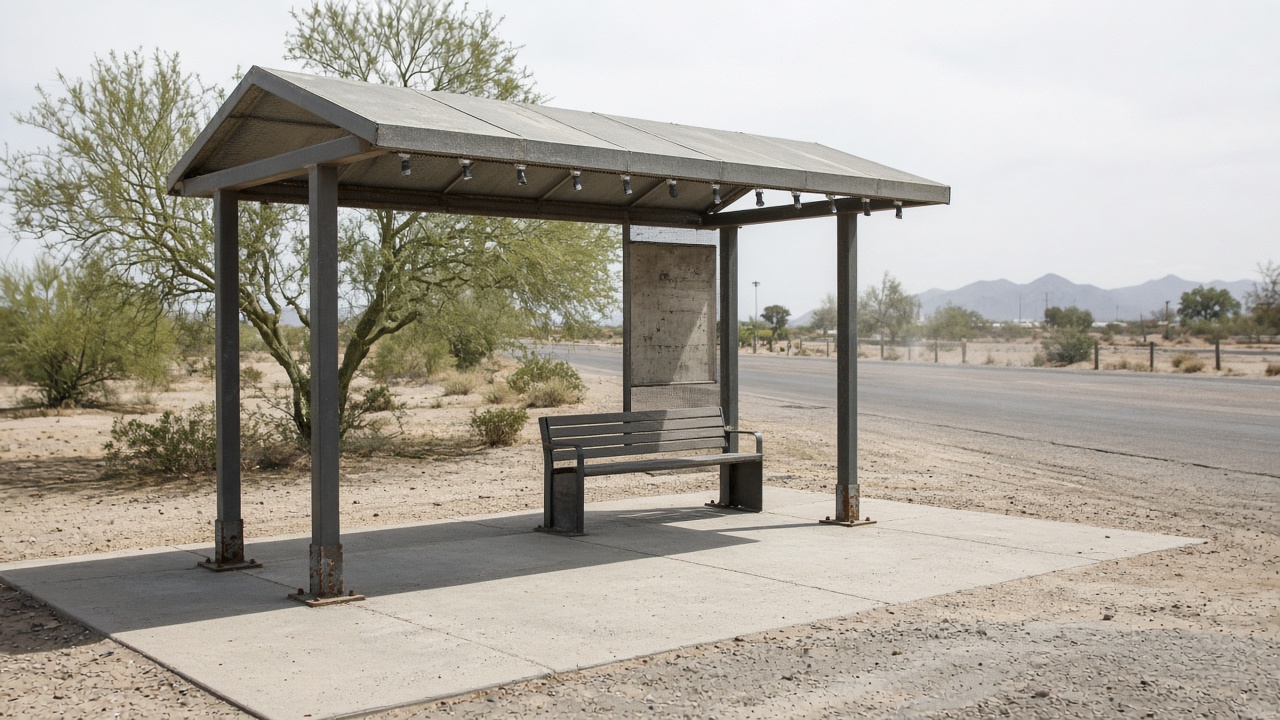
Arizona Public Service and Valley Metro began installing pilot shade canopy arrays at a dozen Phoenix bus stops this month, pairing perforated steel roofs with low-flow misters timed to afternoon peak heat—a project utilities frame as grid-aware comfort infrastructure rather than a full network retrofit.
Where on the map
Sites cluster along Roosevelt Street and lower Grand Avenue corridors where riders wait on asphalt pads without tree cover. Each stop sits within APS’s service territory and connects to routes with all-day frequency, chosen because ridership surveys flagged 20-minute waits during 110-degree afternoons as a top complaint.
Maricopa Association of Governments heat vulnerability maps guided placement; neighborhoods with high elderly ridership and limited sidewalk shade scored first.
What physical change is measurable
Engineers instrumented three prototypes with black-globe thermometers and passenger surveys. Early data shared with city council staff show shaded pad temperatures roughly 18 to 22 degrees Fahrenheit lower than unshaded asphalt at 4 p.m., though misters add humidity that can feel sticky when monsoon moisture is already high.
Canopies use desert-toned powder-coated steel and tensioned shade mesh rated for dust storms; foundations are drilled to avoid uprooting future street trees if the city plants them later.
Who lives and works there
Transit-dependent workers—hospitality staff, warehouse pickers, students—make up most boardings at the pilot stops. Drivers interviewed while transferring at Roosevelt said shade mattered more than real-time arrival apps when phones overheat and screens dim.
Small businesses along the corridor report fewer riders loitering inside shops for air conditioning, a secondary effect owners appreciate even as they worry about construction lane closures.
Policy on dirt, not rhetoric
APS is funding canopy hardware through a tariff rider earmarked for urban heat mitigation pilots; regulators approved the rider last spring with reporting requirements on energy draw from mister pumps. Critics at public hearings wanted money redirected to rooftop solar on low-income homes; proponents argued bus-stop shade delivers immediate relief for people who cannot wait years for building retrofits.
Valley Metro’s board must decide by December whether to scale the design citywide or limit it to heat-exposure hotspots. Maintenance crews already flagged mesh cleaning after haboob dust events as a recurring cost.
Next season, not next century
If October stays warm, misters will run on shortened cycles to conserve water under Phoenix drought contingency stages. Riders will get QR-linked feedback forms—not to replace formal comment periods, but to tell operators whether the shade actually changed boarding behavior before next summer’s budget vote.
Utility engineers said they will compare pump electricity use against estimates filed with the Arizona Corporation Commission; if misters draw more than modeled during back-to-back heat domes, the pilot could shift to passive shade only at half the stops.