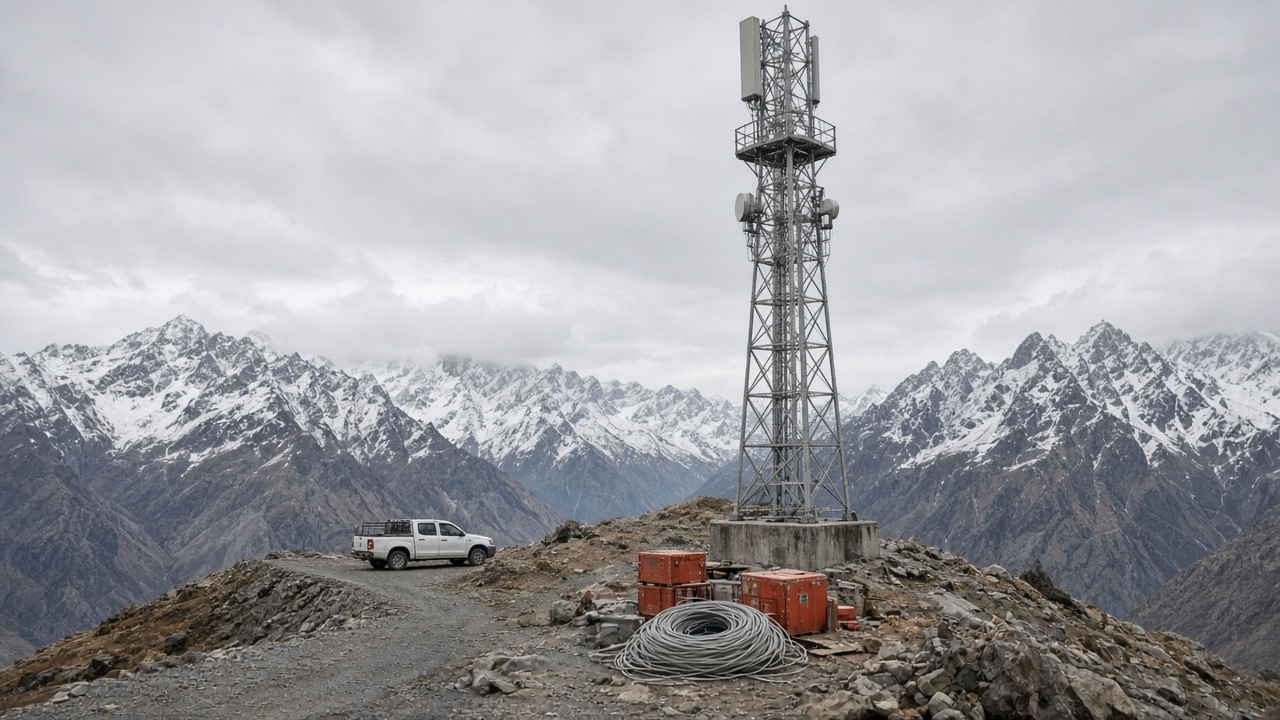
Bharat Sanchar Nigam Limited activated 38 additional 4G base stations along the Leh–Kargil highway corridor this week, completing a pre-winter push that field teams said was timed to beat road closures on the Zoji La pass and to keep Army and Indo-Tibetan Border Police camps on data before temperatures plunge, according to internal rollout trackers reviewed by InfoHandle and corroborated by Ladakh administration briefings on the 4G saturation programme.
What actually went live
The new sites span Drass approaches, Nimmu junction feeders, and upland hamlets that previously relied on 2G voice or satellite backhaul. BSNL’s Leh circle reported that 31 towers now run on the operator’s indigenous 4G core stack, while seven hybrid sites remain on legacy packet cores until software cutovers scheduled for October. Civil subscribers in Durbuk and Khalsi sub-divisions began seeing LTE attach rates above 80 percent in drive tests conducted Thursday, though upload speeds on contended sectors still lagged download during evening peaks.
Unlike urban rollouts, each activation required diesel genset commissioning, solar-battery sizing, or both. Power Development Department crews had already energised 163 sanctioned locations in Leh district; BSNL engineers said 12 corridor sites depended entirely on solar arrays with lithium backup sized for 72-hour autonomy—a design Ladakh advisors insisted on after last winter’s multi-day grid outages.
Why the calendar mattered
Advisor Pawan Kotwal’s November review had directed agencies to stock spares before snow blocked truck convoys from Srinagar. BSNL’s mobile directorate mirrored that instruction nationally, but Ladakh’s narrow construction season made September the practical deadline. Convoys escorted by Ladakh Police moved microwave dishes and battery packs over Zoji La in daylight windows; any slip would have pushed integration into sub-zero weeks when tower crews work shortened shifts.
Army signal officers from HQ 14 Corps attended coordination calls where 35 dedicated military locations and 32 ITBP sites overlapped with civil saturation targets. Thirteen shared compounds received dual-sector antennas so uniformed users and villagers draw from the same mast without separate civil backhaul leases—a cost compromise BSNL finance teams accepted to avoid duplicate fibre trenches in wildlife-sensitive allotments.
Indigenous stack in a harsh environment
The corridor activations ride the same Tata Consultancy Services–supported 4G radio access network BSNL deployed across Jammu and Kashmir and Ladakh in its 2025 indigenous launch. Field technicians said software images for the new sites were staged in Leh before monsoon landslides complicated uplink repairs. When a microwave hop failed near Lamayuru last month, traffic failed over to a spare link within four hours—an improvement circle managers credited to pre-positioned spares kits mandated after the 2024 saturation delays.
Subscriber impact—and limits
Tourist traffic on the Srinagar–Leh route and local merchants preparing for winter inventory runs are the immediate beneficiaries. BSNL retail counters in Leh reported a spike in SIM swaps as users traded legacy 3G handsets for LTE-capable devices. Still, handset affordability remains a bottleneck in remote grazing settlements where feature phones dominate; voice-over-LTE quality on fringe cells can degrade when users roam outside optimized antenna patterns.
Backhaul capacity is the longer worry. Fibre routes laid under the saturation project remain vulnerable to rockfalls; microwave chains add latency for cloud workloads. Startups pitching ed-tech and telemedicine to Ladakh colleges said they would pilot services only on towers with redundant backhaul—a smaller subset than the headline site count suggests.
Regulatory and funding context
The rollout sits inside the Union government’s 4G saturation and Digital Bharat Nidhi-funded tower programmes, which Ladakh officials said originally sanctioned 241 BTS locations for uncovered villages. Department of Telecommunications monitoring cells track progress weekly during the campaigning season. USOF reimbursements hinge on proof-of-service metrics; BSNL cannot book revenue recognition on paper-only sites, which is why circle managers pushed teams to accept traffic before the fiscal half closes.
What breaks next winter
Engineers flagged three failure modes: frozen battery electrolyte on poorly insulated cabinets, diesel theft at unmanned solar hybrids, and icing on microwave dishes that misalign links. Maintenance contracts now require Leh-based crews to visit solar-only sites monthly through March. Spare parts—rectifiers, surge protectors, and fibre patch cords—are cached at BSNL’s Leh warehouse under the advisor’s stocking order.
If pass closures extend beyond historical averages, overland resupply may require Indian Air Force sorties—the same contingency planners used during the 2024 tower surge. BSNL said it would not publish corridor-level uptime guarantees until spring thaw drive tests validate winter performance.
Competitive silence
Private operators remain absent on most forward routes; satellite broadband trials by other providers target enterprise camps, not mass prepaid subscribers. For Ladakh’s civil administration, BSNL’s September push is less about market share than about keeping schools, tourism operators, and border-area families on usable data until the next construction window opens—a policy outcome Delhi telegraphed when it prioritised Army and ITBP sites in saturation planning meetings.