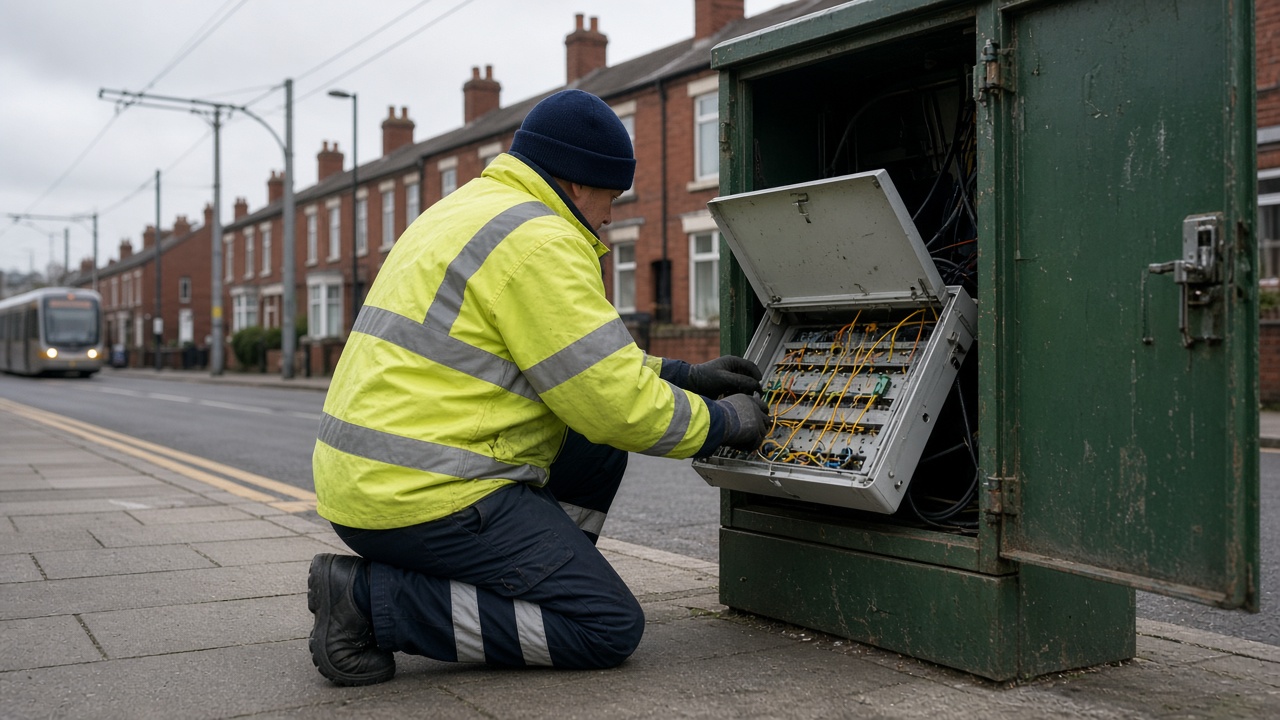
Openreach started 10-gigabit passive optical network pilots this month from three Manchester exchange cabinets, feeding a mix of social-housing blocks and converted cotton mills where landlords want symmetric upload for video surveillance without leasing separate business lines, according to planning notices filed with Manchester City Council and a technical brief shared with retail ISPs.
What 10G PON changes
Today’s mass-market fibre mostly uses GPON at 2.5 Gbps down and asymmetric splits. XGS-PON and newer 10G EPON variants raise the ceiling on a shared PON segment, letting Openreach bond capacity for wholesale customers that resell to flats and small offices. The Manchester pilots do not upgrade every subscriber overnight; they reserve dedicated wavelengths for sites that opt in through ISP ordering portals.
Engineers are reusing existing splices where loss budgets allow, rather than pulling new backbone fibre through city ducts already congested with 5G small-cell power. That constraint matters in Ancoats and New Islington, where developers buried multiple ducts during the residential boom and now fight for space when heat-pump installers request the same trenches.
Who ordered first
A housing association with towers near Piccadilly Station signed as anchor tenant, citing door-entry cameras that upload continuously to cloud NVRs. Two creative agencies in refurbished mills asked Zen Internet and TalkTalk for trial circuits after client shoots exceeded 1 Gbps upload during colour grading sessions. Openreach’s brief caps pilot ports at 120 per cabinet to keep fault isolation manageable if optics fail.
Retail ISPs must pass Ofcom’s fairness rules when pricing premium symmetric tiers; none have published consumer tariffs yet, focusing on business and “prosumer” packages with static IPs.
Regulatory context
Ofcom’s wholesale fixed access review this autumn asks whether incumbents must offer 10G PON on equal terms to alt-nets that rent slices of the passive network. CityFibre, which overbuilds parts of central Manchester on separate ducts, said pilots on Openreach plant do not excuse slow rural schedules elsewhere—a familiar split-screen argument in UK telecom politics.
DSIT ministers cite gigabit coverage percentages in parliamentary answers; symmetric multi-gig in city cores helps the narrative even when villages still wait on BDUK lots. Manchester’s digital strategy team treats the pilots as a test bed for smart-traffic camera backhaul along Oxford Road corridors, though transport cameras are not on the first port list.
Installation pain points
Tenants in listed mill conversions report engineers need heritage consent to surface-mount new ONTs on exposed brick. Openreach’s trial playbook includes a low-profile indoor unit that hides behind existing skirting trays where landlords permit. Power backup remains the customer’s problem; housing blocks with single lift shafts cannot host battery cabinets without fire officer sign-off.
Tram works on Rochdale Road delayed one cabinet energisation by a fortnight when street closures blocked crane access. Openreach logged the slip in its public where-and-when tool so ISPs could defer install appointments rather than no-show customers.
What success looks like
Technicians will measure error rates and temperature drift on optics through a wet Manchester winter—salt spray from gritted roads is harder on cabinet seals than lab datasheets suggest. If loss stays within spec, Openreach plans to extend the pilot to Salford Quays media campuses where outside broadcast trucks park for Premier League weekends.
Households on standard 1 Gbps tiers see no automatic boost; the pilots are additive capacity, not a free upgrade. Subscribers curious about eligibility should ask ISPs for “10G PON trial” product codes rather than watching generic fibre maps, which still paint entire postcodes green without distinguishing wavelength availability.
Competition
Hyperoptic and Community Fibre already market symmetric gigabit in pockets of Greater Manchester on their own ducts. Openreach’s gamble is that wholesale 10G on incumbent fibre keeps Zen, Sky, and Vodafone in the city without them funding duplicate trenches. If optics underperform, alt-nets will recycle the same marketing line they used during early FTTP delays: independence from Openreach schedules is worth the build premium.
Wholesale account managers said they will publish monthly optic fault tickets to ISPs during the pilot so marketing teams do not overpromise symmetric speeds before winter maintenance windows close.