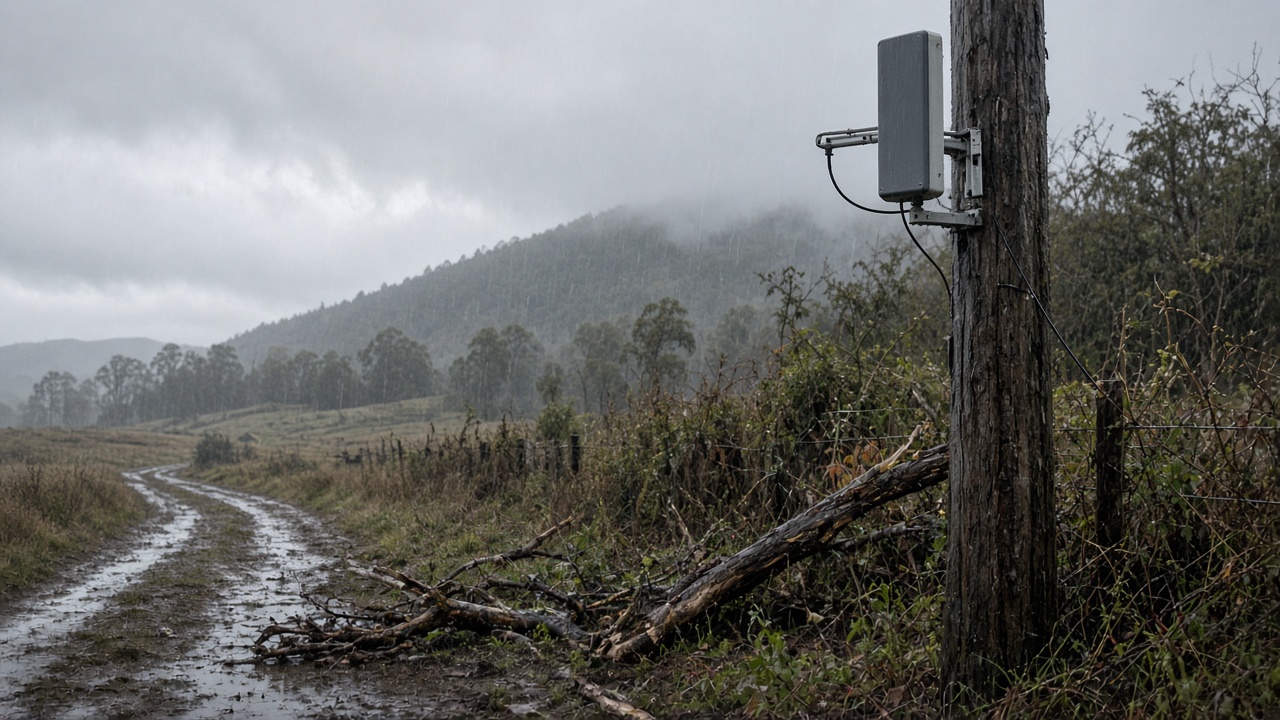
Optus is upgrading fixed-wireless backhaul and radio heads across rural Tasmanian corridors that lost power and backhaul simultaneously during winter storms, targeting households that still depend on NBN fixed wireless or Optus wholesale LTE where fibre will not arrive before the next blackout season.
Where the upgrades land
Engineering teams focused on the Midlands Highway fringe, parts of the Huon Valley, and north-east dairy country where TasNetworks outage maps showed repeated multi-day failures in July and August. Optus wholesale partners requested higher committed information rates after retail ISPs reported customers dropping to sub-10-megabit speeds whenever microwave backhaul to nbn towers failed. The carrier is not replacing NBN Co’s access network; it is strengthening Optus-operated cells that ISPs resell as home wireless broadband where address checks show fixed wireless as the only nbn technology.
At six sites, crews swapped older sector antennas for 4x4 MIMO panels and added battery strings sized for 12-hour autonomy—long enough to bridge most storm repairs on rural feeders. Two additional sites received containerised diesel generators on monthly test schedules coordinated with TasNetworks field managers, who must isolate lines before telco crews enter easements.
Why blackouts hit broadband twice
Rural Tasmania’s topology means power and backhaul often share poles. When a tree takes out a span, households lose lights and the wireless antenna loses its upstream microwave hop. NBN Co’s fixed wireless product delivers wholesale speeds up to 25 megabits per second on paper, but retailers cannot restore service until both power and backhaul return. Optus’s parallel fixed-wireless footprint gives some ISPs a second path if they have dual-SIM or dual-technology plans, yet most households still subscribe to a single nbn retailer.
Wholesale documents Optus published for Spark partners describe fixed wireless as a margin-friendly alternative where nbn migration is costly. In Tasmania, that pitch collides with storm reality: without onsite power, any wireless technology fails. Hence the generator trials—controversial with neighbours worried about noise, but popular with farms running automatic milking when grid power flickers.
Retail impact
End users will not see an Optus logo unless they buy Optus home internet directly. For Aussies on regional ISPs reselling Optus fixed wireless, September field work should lift evening throughput on congested cells. ISPs said they need written notice before speed claims change; Optus is sharing drive-test summaries under NDA. NBN retailers without a wholesale Optus agreement are unaffected but still press nbn for faster tower power upgrades.
Competition watchdogs continue to monitor whether dual-stack wireless offerings confuse buyers who think they are on “the NBN” when part of their failover rides mobile spectrum. Optus argues transparency sits with retailers; consumer groups want standard labels on invoices when backup paths exist.
Coordination with nbn and power utilities
NBN Co’s Tasmania expansion statements emphasise fixed wireless for low-density communities; construction timelines do not include gensets. Optus upgrades therefore fill a gap nbn does not fund. TasNetworks said it will share storm prioritisation lists with critical infrastructure customers, including telcos, but cannot guarantee same-day restoration on forestry roads.
Emergency services raised concerns about VoLTE fallback when both power and IP backhaul die; satellite phones remain the last resort in the deepest corridors. Optus said it is testing SMS broadcast reachability on upgraded cells once batteries engage, mirroring lessons from mainland bushfire seasons.
Metrics and timelines
Optus will measure mean time to restore service on upgraded cells against a 2024 baseline where some sites needed 36 hours post-storm. Success means keeping wholesale throughput above 25 megabits per second for 90 percent of peak hours even when one backhaul link is impaired. All September deployments should be on-air before the October long weekend, when holiday traffic surges along the east coast.
If generators prove reliable, Optus may extend the playbook to mainland Victorian border communities with similar pole-sharing risks. For now, Tasmania’s blackout corridors get sturdier antennas, fatter batteries, and—in a few fields—a humming diesel box that keeps wireless alive while line crews rebuild the grid.
Dairy co-ops along the north-east coast said they will track upload stability for overnight tank telemetry; if jitter drops, more farms may drop second satellite links that cost thousands per year. Optus wholesale account managers plan a November webinar with regional ISPs to translate drive-test PDFs into customer-facing support scripts.