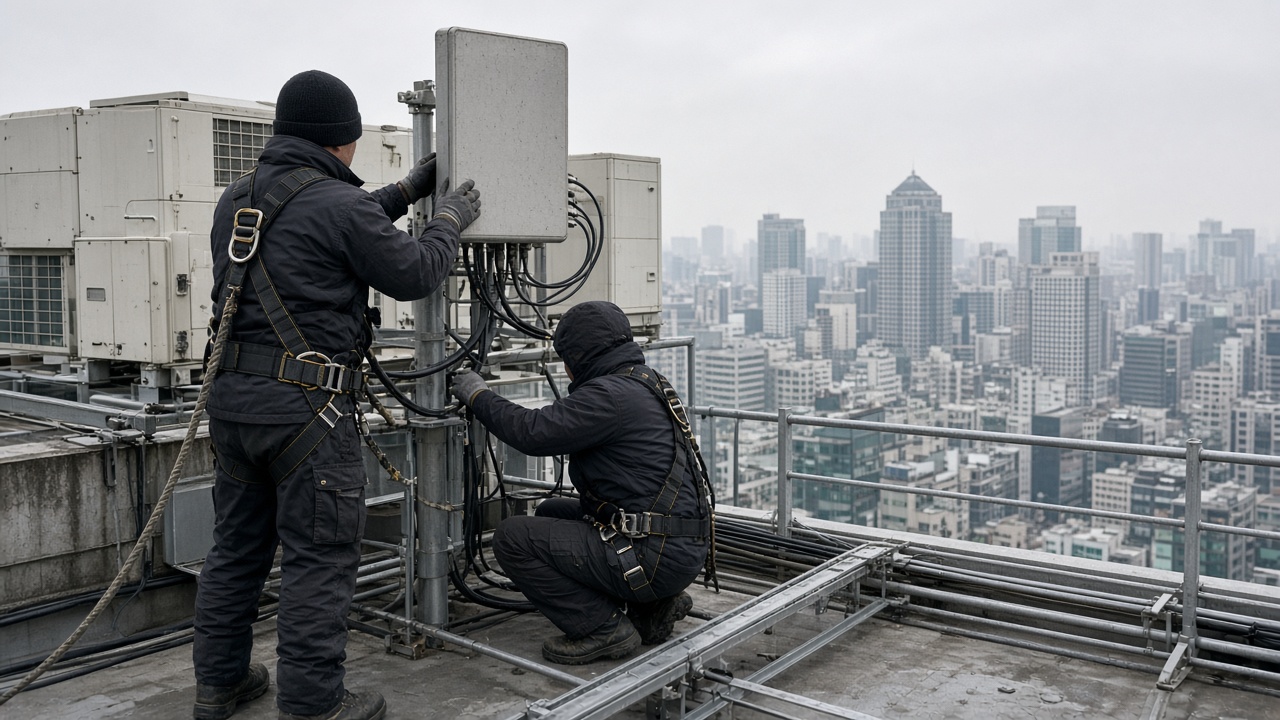
SK Telecom Co. has begun rooftop trials of 28GHz millimeter-wave small cells on two Grade-A office towers in Gangnam-gu, letting enterprise tenants benchmark indoor throughput and latency before Chuseok lease renewals, according to building managers and a deployment checklist SKT shared with anchor tenants this month.
What the trial installs
Each site pairs a street-facing macro relay with in-building distributed antenna units fed by a tenant-owned edge gateway. SKT engineers said the radios use commercial 28.9–29.3GHz channels allocated under Korea’s private-5G framework, not the national 28GHz concession the Ministry of Science and ICT cancelled after SKT missed its public rollout quota. That distinction matters for legal teams: the pilot runs as a building-managed private network with SKT as systems integrator rather than as a renewed national mmWave push.
Tenants on the upper floors—asset managers, boutique law firms, and a game-studio back office—get dedicated SIMs that authenticate against a localized 5G core sitting in a basement meet-me room. Speed tests shared with InfoHandle showed downlink bursts above 1.2 Gbps near windows and roughly 420 Mbps in core corridors where low-emissivity glass attenuates signals, numbers SKT cautioned vary with weather and elevator shaft leakage.
Why Gangnam office stock
Seoul’s premium office market faces empty-floor discounts as hybrid work persists. Landlords competing for financial and media tenants are bundling connectivity upgrades into rent packages. The two towers in the pilot sit within walking distance of Teheran-ro trading desks; building owners said they chose mmWave because existing Cat6A retrofits could not guarantee symmetric uploads for video research feeds during market opens.
SKT’s enterprise unit pitched the trial after MSIT expanded private-5G approvals for multi-tenant buildings in guidance issued earlier this year. Rival integrators, including KT’s affiliate MOS and Naver Cloud’s campus networks, have marketed similar packages; SKT is using Gangnam visibility to show it can still monetize high-band gear despite losing nationwide 28GHz rights.
Integration and limits
Install crews worked overnight to minimize disruption to lobby access control. Fiber backhaul from the rooftop radios lands on dual 10G links already used by carrier-neutral operators in the buildings. SKT said it will not merge tenant traffic with its public 5G core; security reviewers at one participating fund asked for packet capture proofs that guest Wi-Fi stays isolated from the private slice.
Limitations surfaced quickly. Elevator rides still drop sessions when phones cling to outdoor macros. Rain fade on September test days cut throughput by nearly a third, prompting SKT to recommend window-adjacent desks for traders who need stable streams. The carrier also warned that handset support for standalone private profiles remains uneven on imported devices.
Commercial path
If throughput reports satisfy tenants before November lease deadlines, the landlord consortium plans a paid rollout on three additional floors and a shared pricing sheet per square meter. SKT executives told anchor tenants they may productize the stack as “Building Edge 28” with optional on-prem MEC for low-latency access to the carrier’s cloud gaming and video APIs, though those services are not enabled in the current pilot contract.
Regulators have not signed off on cross-building roaming; users who walk to nearby cafes fall back to SKT’s sub-6 network automatically. MSIT officials said they will watch interference reports from neighboring hospitals that operate telemetry links in adjacent bands.
What tenants watch next
Enterprise IT leads said their go/no-go criteria include failover when the localized core reboots and clarity on who owns logged traffic if Korea’s telecommunications retention rules tighten. Unionized building staff asked for radiation disclosure sheets; SKT posted Korean-language power-density measurements in lobby notice boards as required for indoor small cells.
For SKT, the Gangnam pilot is a reputational test after national mmWave setbacks. For landlords, it is a bet that premium connectivity can fill floors without deep rent cuts. Both sides will publish joint metrics after Chuseok, when trading desks return to full staffing and monsoon humidity tests the rooftop enclosures again.
Handset desk and logging
SKT opened a weekday service desk in one tower where tenant IT staff swap SIM profiles and download drive-test apps that log per-floor heat maps. Loaner phones vetted for private-network attach are available after several imported models failed during the first trial week, and building engineers archive weekly power readings for MSIT compliance folders.