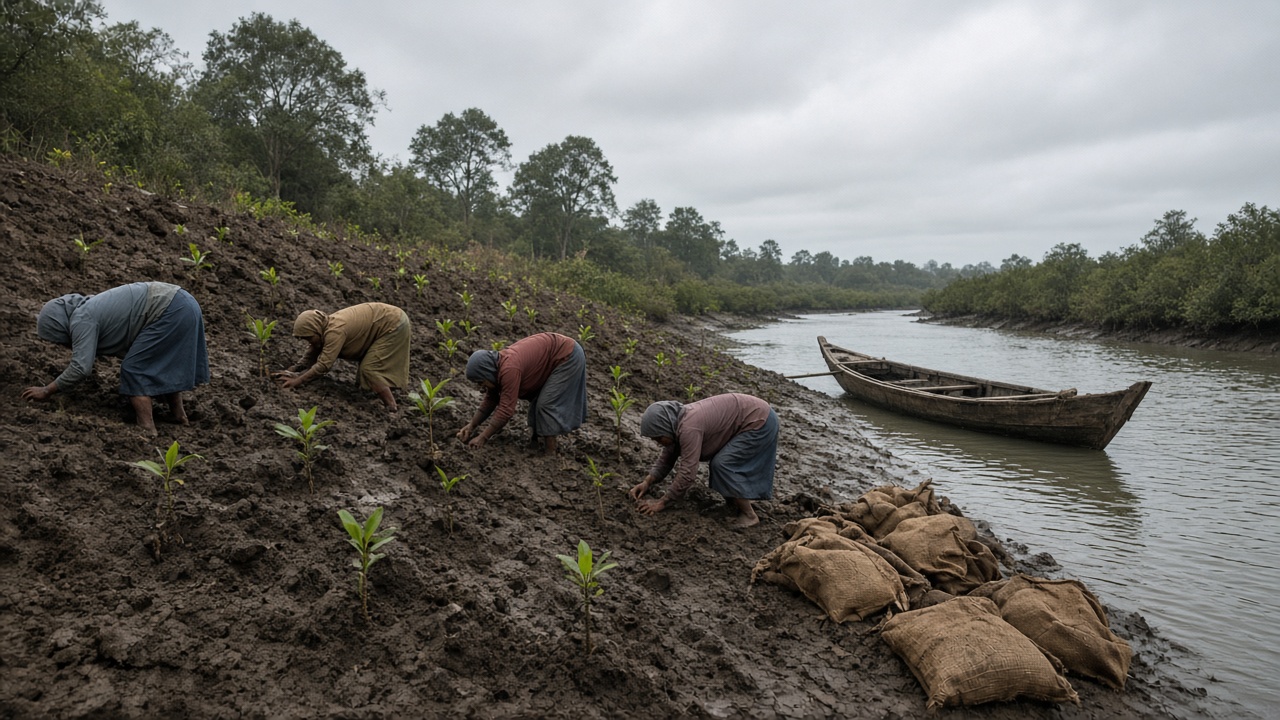
Fisherfolk in the Indian Sundarbans began planting Rhizophora mangrove sprouts along cracked village embankments this week, responding to late-season salinity spikes that pushed brackish water into homestead ponds and left mudflats too salty for juvenile prawns.
What the salinity spike did
Block-level aquaculture officers recorded conductivity readings two to three times September norms after suppressed monsoon flows let Bay of Bengal salt wedge farther inland. Pond gates that usually freshen with river input stayed brackish; gill nets came up light. Rhizophora, the stilt-rooted mangrove common on outer creeks, does not fix ponds overnight, but villagers said mature roots slow embankment breaches when cyclone remnants coincide with high tide.
West Bengal forest range staff supplied nursery-grown sprouts—20-centimeter seedlings bagged in coir—and asked crews to map GPS pins for a state climate adaptation ledger. Planting is limited to legally permitted embankment toes, not core protected forest, to avoid clearance fights.
Who is doing the work
Women’s cooperatives that normally sort dried fish switched to dawn planting shifts before heat haze sets in. Men repaired bamboo fencing to keep goats from browsing tender leaves. Youth volunteers ferried sprouts by country boat when road embankments flooded at neap tide.
NGO partners trained teams on spacing—about two meters apart on seaward faces—so roots can knit without choking drainage sluices. Fisherfolk emphasized they are not abandoning ponds; they are buffering the mud walls that keep salt out during the next surge.
Climate money on the line
District planners linked the planting push to mangrove restoration lines in state disaster funds—villages with GPS-tagged plots score higher when requesting culvert repairs after cyclones. That incentive nudged even skeptical pond owners to lend labor, though some worry forest department maps could later restrict boat routes they use today.
Coastal police issued advisories for planting crews to avoid night tides after a boat capsized near a similar embankment last year; life jackets borrowed from fisher cooperatives now sit in each volunteer kit.
What regulators track
State forest officials will revisit plots in six months to count survival rates; compensation schemes for storm damage sometimes favor villages with documented green belts. Scientists caution Rhizophora needs periodic tidal wetting; entirely freshwater stretches may need mixed species later.
Block aquaculture officers left handheld refractometers with two cooperatives so weekly pond readings feed a simple spreadsheet shared with Kolkata planners; spikes trigger SMS warnings to open sluice gates when freshwater pulses allow.
Researchers from a Kolkata university attached sediment cores near planting sites to see whether Rhizophora roots lower pore-water salt over seasons—a science question villagers frame more bluntly as whether prawns will return next Poila Boishakh.
For families eating into savings after a thin catch month, the sprouts are insurance with muddy knees attached—cheap compared with concrete revetments, slow compared with a good monsoon, but visible on the map when salinity spikes again.