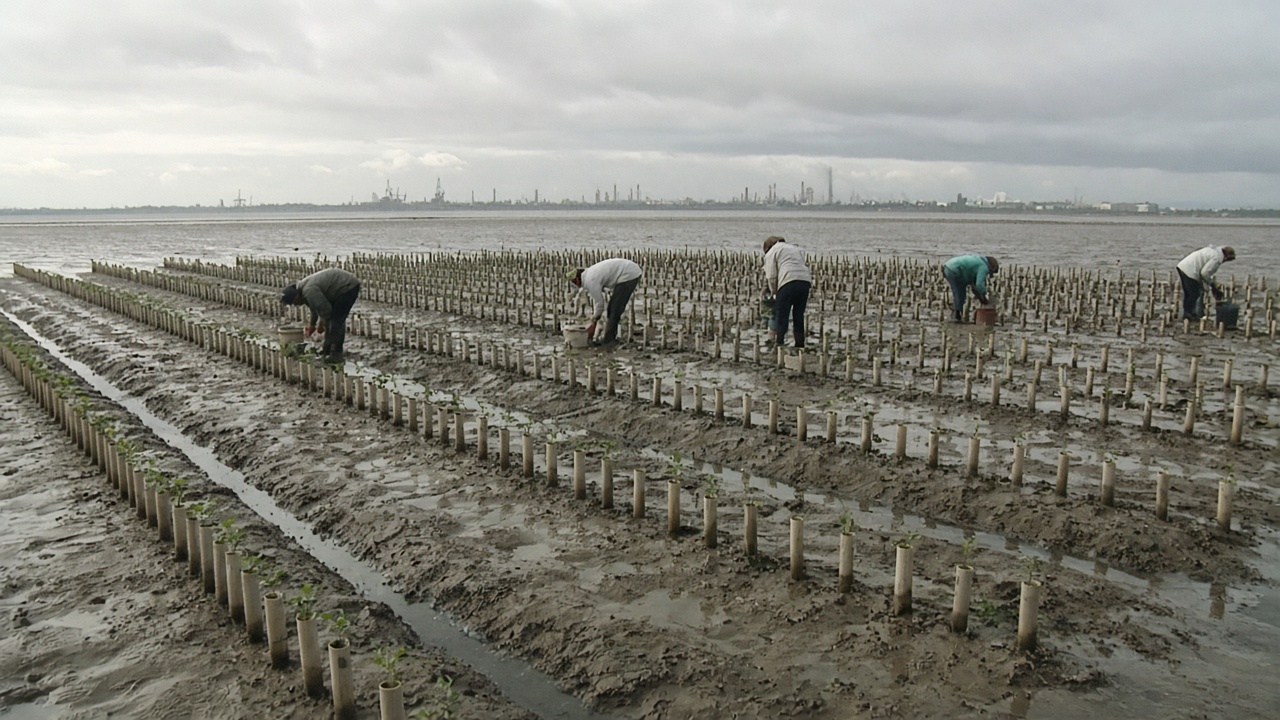
Consortia linked to Ulsan refineries agreed this month to fund mangrove nursery pilots on Yeongam tidal flats in South Jeolla, planting test plots where brackish channels meet mudflats that absorb storm surges along Korea’s southern industrial coast.
Where on the map
Yeongam’s flats sit west of Mokpo Bay, downstream from shipping lanes that serve petrochemical exports from Ulsan and Yeosu. Nursery beds occupy 4.2 hectares leased from village fisheries cooperatives, with channels dredged lightly to let propagules take hold without draining adjacent clam racks. Ministry of Oceans and Fisheries staff said the site was chosen because salinity gradients mimic future climate scenarios—higher autumn tides, warmer shallow water—documented in Korea Hydrographic and Oceanographic Agency monitoring.
Seedlings start in shade houses on the Ulsan side, then transplant after monsoon runoff settles. Refinery backers—SK geo-centric units and S-Oil community foundations—frame the spend as coastal resilience offsets, not direct pollution remediation; no court order triggered the project.
Who regulates and what is in the water
Regional fisheries offices set catch moratoriums within 200 meters of nursery stakes during transplant weeks to keep trawlers from uprooting young roots. Water-quality logs this week show typical late-September chlorophyll bumps from algal blooms, but heavy-metal readings stayed within bathing-grade limits at upstream intakes. Environmental groups asked for independent sediment cores before planting; consortia agreed to publish quarterly metals tables through a Jeonnam provincial portal.
Mangrove species here are cold-tolerant hybrids approved by forest service nurseries, not tropical Rhizophora stands seen in Southeast Asia. Survival targets are modest—60 percent after one typhoon season—because Korean winters test root systems unlike equatorial pilots.
Shellfish neighbors and blue-carbon claims
Clam harvesters worried nursery fences would shrink workable flats; negotiators drew GPS boundaries leaving main lease grids untouched. In return, cooperatives receive equipment stipends and training stipends for youth who might otherwise leave for Ulsan factory jobs. Blue-carbon accounting remains preliminary; Korea’s national greenhouse-gas inventory does not yet credit mangrove soil the way Indonesia’s does, so refineries cannot book formal offsets this year.
Instead, companies cite voluntary ESG disclosures and insurance models that price storm-surge risk along petrochemical jetties. Pilots that stabilize sediment may protect pipeline corridors as much as fishing villages—a dual rationale that keeps finance departments interested if survival rates beat targets.
Next monitoring steps
Researchers from a Ulsan national university will tag plots with sediment elevation tables and drone LIDAR after each spring tide cycle. If seedlings fail, consortia may shift to saltmarsh grasses already proven on nearby Saemangeum margins. Success would expand nurseries toward Yeosu, but Yeongam remains the reference plot for how industrial donors coexist with intertidal food production.
Public tours stay limited during transplant months to avoid trampling; after Chuseok, provincial guides will run boardwalk visits explaining how mangrove roots filter runoff without promising instant carbon miracles.