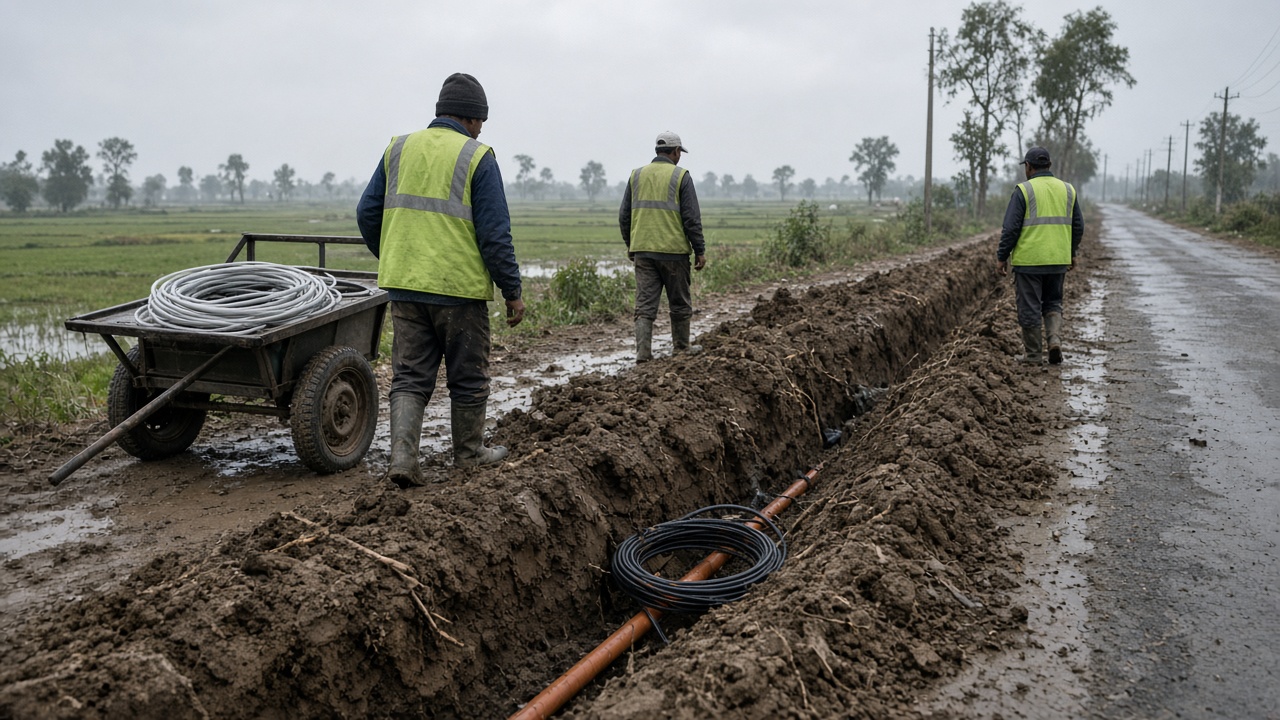
Contractor crews working BharatNet Phase III Package-14 in Assam resumed open trenching along state highways and panchayat roads this week after district engineers cleared a monsoon pause, reopening a middle-mile build that BSNL and Pratap Technocrats must finish under a ₹831.61 crore design-build-operate-maintain mandate covering rural blocks that still lack redundant fibre.
Why the pause lifted now
BSNL’s Assam circle told InfoHandle that water tables in Goalpara and Barpeta corridors dropped enough for geotechnical teams to sign off on trench walls that had collapsed during July-August squalls. The operator had halted mechanical excavation when embankments softened, leaving orange HDPE conduit staged at hub yards rather than buried—a delay that pushed splice schedules but did not cancel gram panchayat handover targets for the quarter.
Pratap Technocrats, which signed the broader ₹8,025 crore Phase III pact spanning Rajasthan, Haryana and Assam in March, deployed additional plate compactors and sand bedding crews before restarting. Field supervisors said they are limiting daily trench length to what quality auditors can photograph for the BharatNet project management unit, a slower rhythm than pre-monsoon weeks but one BSNL said it would accept if splice pits pass pressure tests.
What crews are actually laying
Package-14 work is middle-mile fibre meant to feed last-mile operators and village Wi-Fi hotspots, not household drops in every home on day one. Crews are pulling 24-fibre counts through roadside ducts where older BharatNet phases left spare chambers, and cutting new trenches only where right-of-way agreements with tea estates and flood-plain farmers were renewed after the monsoon.
Union representatives on two sites said night shifts are banned until October 15 because of elephant movement alerts from the forest department—a constraint unique to Assam that does not appear in Haryana schedules on the same corporate contract. BSNL confirmed it is routing traffic for already-lit segments through existing microwave backhaul while new spans stay dark.
BSNL oversight and splice discipline
Circle engineers reopened a joint inspection lane with Pratap Technocrats quality teams: each splice pit must show desiccant packs, fusion loss readings under 0.05 dB on test sheets, and GPS stamps matching the BharatNet geographic information system. Two pits failed first inspection Tuesday for standing water; crews pumped and re-lined them before fibre pulls continued.
Telecom Department dashboards list Assam among states where Phase III must close the digital divide before the 2028 nationwide target chairman Robert J Ravi outlined to trade press. Missing a splice audit does not stop trenching, but it does block billing milestones—an incentive both sides cited to keep documentation strict even when villagers ask for faster connectivity before Durga Puja fairs.
Local stakes beyond speed tests
District e-district kiosks in western Assam still ride VSAT or 4G dongles for land-record printouts; clerks said even a lit middle-mile span would cut queue times if last-mile partners attach within weeks. Tea-garden managers want symmetric uploads for auction leaf samples, a use case BSNL’s retail team is pitching once backhaul diversity improves.
Opposition legislators in the state assembly asked whether Phase III duplicates ducts funded earlier under Universal Service Obligation programs. BSNL’s written reply, shared with InfoHandle, said new routes target panchayats left off prior maps after boundary redraws—not a full rebuild of every legacy span.
Risks still on the ledger
Heavy truck traffic on NH-17 sections can collapse fresh backfill if rain returns early; meteorologists flagged a late September depression risk in the Bay of Bengal. Pratap Technocrats has not published a revised completion date, and BSNL would not say whether financial penalties apply for monsoon extensions covered under force-majeure clauses.
Fibre theft remains a worry on unlit reels stored near markets; circle security added GPS-tagged spools and night patrols. Until OTDR traces green-light each segment, villages on the map as “connected” will remain in paperwork only—a gap Assam’s information technology department said it will highlight in weekly video reviews with BSNL.
What happens next
Crews aim to close trenching on the Barpeta-Alipurduar spur before state elections crowd highways with campaign convoys, then shift to aerial lashings where river crossings forbid digging. Last-mile integrators must still bid for Wi-Fi access points; middle-mile alone does not light homes.
For residents, the practical signal is orange conduit appearing beside familiar bus stops—a visible marker that Phase III is finally moving after years of BharatNet slips. Whether that translates to stable broadband before 2028 depends on splice discipline through the next wet season, not just how many kilometres of trench open this month.