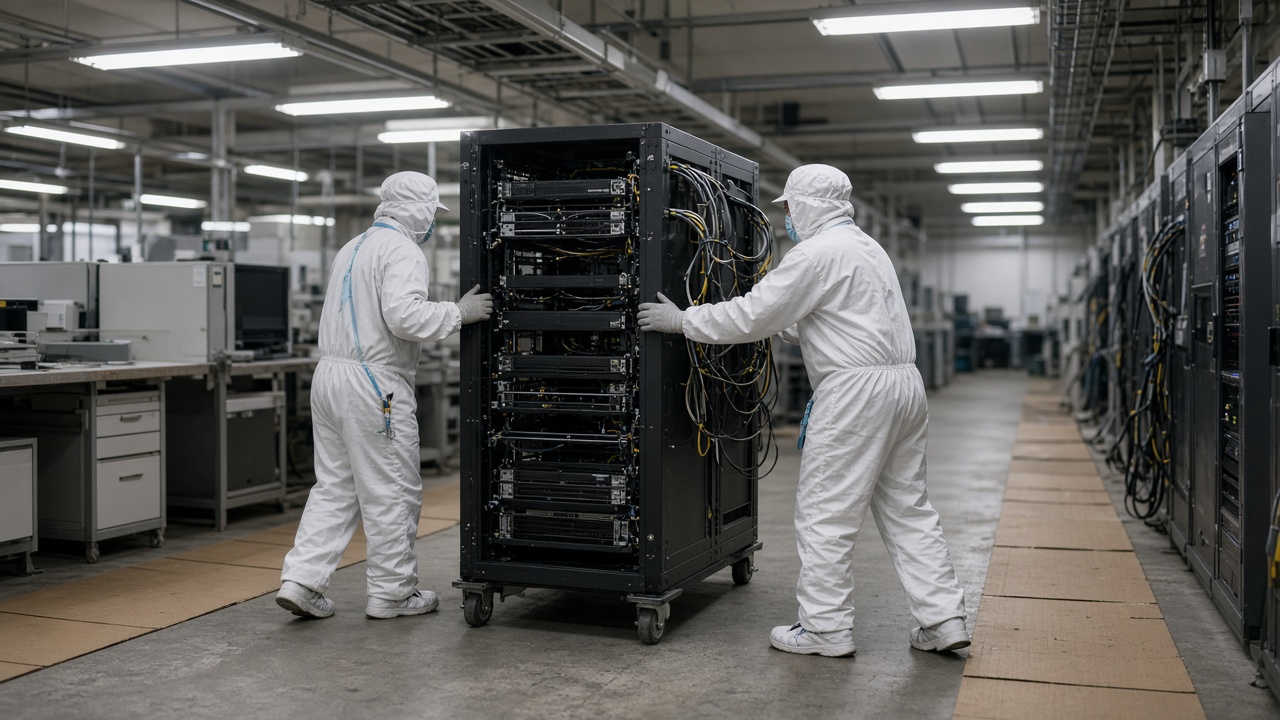
Hon Hai Precision Industry Co., known as Foxconn, qualified a new edge AI server rack program on Taiwanese assembly lines for two semiconductor equipment partners, running domestic burn-in and firmware signing before units ship to fabs and material analysis labs, people familiar with the pilot and an internal qualification memo reviewed by InfoHandle said. The racks are not hyperscale cloud trainers; they are factory-floor and lab neighbors—tighter form factors, redundant power, and filtered intake for particulate-heavy clean zones adjacent to tools.
What shipped to qualification
The pilot builds 2U and 4U variants with NVIDIA-class GPU trays and alternative accelerators where export paperwork allows. Taiwan lines handle mechanical integration, cable routing, and seventy-two-hour thermal cycling; partner engineers supply acceptance scripts that mirror tool-vendor software stacks used for wafer metrology and virtual metrology pipelines.
Hon Hai's memo lists pass criteria: sustained GPU power within three percent of spec, no fan hunting after particulate injection tests, and signed firmware chains stored in a Taiwan key-management appliance for audit. Failures return to a debug cell in Taoyuan rather than shipping to customers for rework.
Claim versus what fabs can check
Marketing slides call the program "edge AI," but evaluators should look for artifacts: burn-in logs with serial correlation, export compliance stamps on GPU lots, and service manuals listing field-replaceable units available from Hon Hai's spare-parts portal. Partners did not grant InfoHandle benchmark scores; public claims stop at qualification dates and line locations.
Government evaluators can cross-check Industrial Development Administration listings on advanced assembly investment; Hon Hai disclosed capex for AI-adjacent server mechanicals in prior investor presentations without naming these customers.
Why Taiwan assembly matters
Tool partners want racks configured near fabs in Hsinchu and Tainan without waiting for cross-border integration floors. Domestic assembly shortens loops when a vibration spec changes or a power shelf revision lands mid-quarter. It also keeps certain configuration data on-island when customers worry about tamper during long ocean transits.
Hon Hai still builds hyperscale trays in Mexico and the Czech Republic; the Taiwan edge line is volume-modest but politically visible as fabs expand locally.
Power and who holds it
GPU vendors control allocation; Hon Hai controls mechanical IP and rack power distribution partnerships. Tool partners hold acceptance authority—without their sign-off, racks do not enter fabs even if GPUs arrive. That triangle means Hon Hai can qualify lines quickly but cannot unilaterally ramp revenue if accelerators stay allocated to larger cloud builders.
Electricity density in Taoyuan test halls required utility upgrades completed in August; Hon Hai pays time-of-use premiums for overnight burn-in to avoid peak tariffs.
What careful readers still will not know
Unit counts per quarter, margin per rack, and customer names beyond the two equipment partners remain undisclosed. Hon Hai may bundle racks with maintenance contracts; pricing is not public. If U.S. export rules tighten on certain GPU classes, the same line could pivot to CPU-only inference boxes without public announcement until customers receive revised BOMs.
Labor and safety
Rack cells use assisted lift rigs; union reps at a Taoyuan campus said Hon Hai added ergonomic training when GPU trays exceeded thirty kilograms. Burn-in aisles run hotter than phone lines; technicians rotate every two hours per internal safety policy.
Next steps
Qualification converts to production POs after partner fabs complete on-site install drills in October. If error rates stay below agreed thresholds, Hon Hai will duplicate cells in Kaohsiung to serve southern tool clusters. The evaluable story is narrow but real: a contract manufacturer moved edge AI racks from slide decks to signed burn-in logs on Taiwan soil—and fabs will judge the program on uptime next to lithography tools, not on keynote adjectives.
Supply-chain auditors said spare GPU trays for the edge SKUs are consigned, not owned by Hon Hai, which limits inventory risk if allocations pause. Competitors Quanta and Wistron pitch similar edge form factors; Hon Hai's win is integration speed with existing tool-partner relationships.
2317.TW traded in line with the electronics sub-index Friday; analysts treat edge AI racks as option value on top of iPhone assembly margins rather than a separate reporting segment.