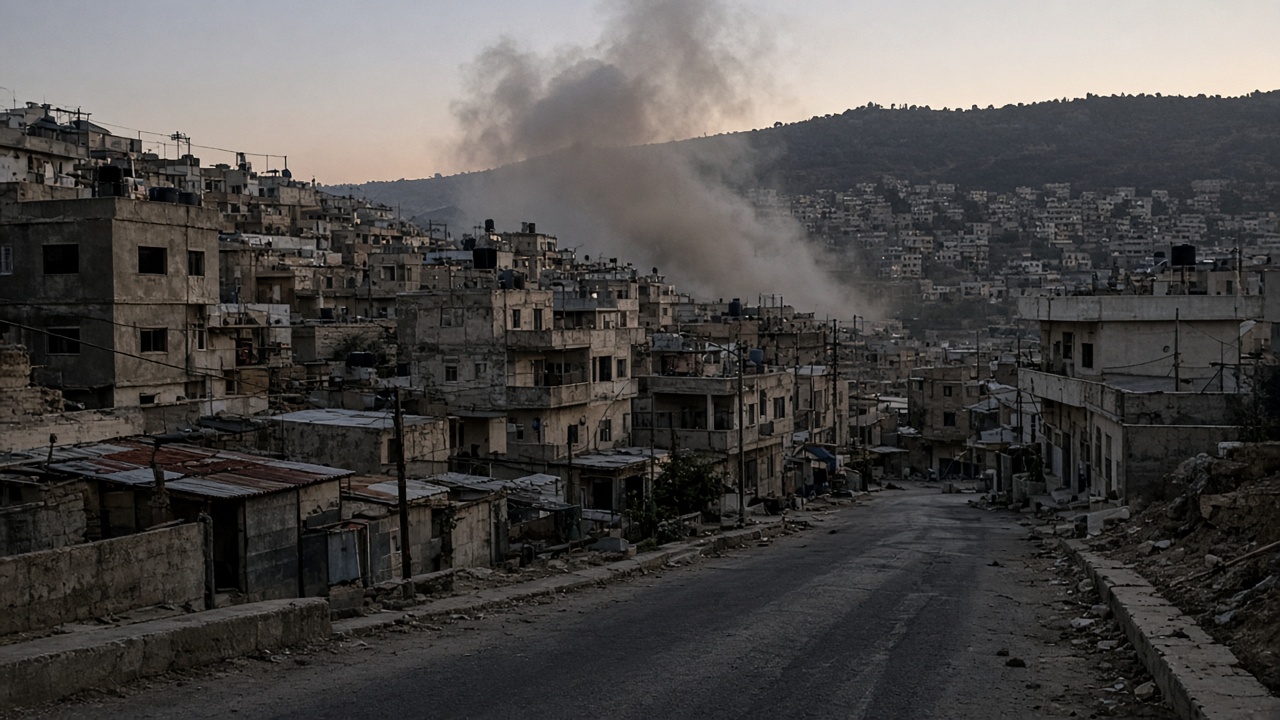
Israeli warplanes carried out two consecutive airstrikes on the Old Square neighborhood of Nabatieh al-Fawqa in southern Lebanon early Saturday, Lebanon’s National News Agency (NNA) reported, and a third strike landed as a medical response team drove toward the earlier blasts. Al Jazeera and Middle East Eye described the same sequence, with Al Jazeera noting that at least 4,386 people have been killed and about 12,400 injured since fighting escalated on 2 March. NNA said the crew from the Islamic Risala Scouts and the Taleb Association ambulance service narrowly escaped and that no injuries were reported from that third hit; broader casualty figures from the square itself were not immediately available in the agency’s bulletin.
What NNA and broadcasters confirmed
The Nabatieh al-Fawqa account is narrow but specific. NNA identified the target as Al-Saha Al-Qadima—the Old Square—and said warplanes struck twice in succession before the third attack on responders in motion. Al Jazeera’s newsfeed item, published 19 September, framed the episode as part of a wider Israeli air campaign in the south and repeated the three-strike pattern without naming the scout and association units. Middle East Eye’s live update on 20 September credited Al Jazeera for the ambulance-team detail and added separate Saturday strikes on Sarbin, near Haris in the Bint Jbeil district, and on a house between Haddatha and Haris. Those additional hits sit outside the Nabatieh al-Fawqa core but show the same operational rhythm: air pressure across multiple villages while Israeli ground units carry out demolitions in towns they already traverse.
Demolitions in Kfar Tabban and Al-Khiam
By Sunday morning, reporting shifted from air bursts to engineered destruction. MTV Lebanon said the Israeli army detonated a massive charge in Kfartebnit, in Nabatieh district, with the blast heard across Marjayoun district villages. Anadolu Agency, citing NNA, tied the weekend air activity to ongoing violations of the U.S.-mediated framework signed 26 June, which is supposed to pair a gradual Israeli withdrawal with deployment of the Lebanese army. NNA had logged large demolition operations in Al-Khiam in the days before the Nabatieh al-Fawqa sorties, and Anadolu noted Israeli forces still holding positions deep inside Lebanese territory in places.
The June 26 framework on the ground
The June agreement is the reference point diplomats cite when they call for de-escalation, but southern Lebanon’s reporting stream treats it as a ceiling that strikes and demolitions repeatedly puncture. Anadolu’s Saturday dispatch quoted Lebanese figures—nearly 4,400 dead, more than 12,300 wounded, and over one million displaced since March—as the human ledger behind each localized bulletin like Nabatieh al-Fawqa’s three-hit sequence. What remains unconfirmed in the chipped accounts is whether Israel issued a fresh warning before the Old Square strikes or whether the ambulance team’s route was visible to observers on the ground; NNA’s text stops at the narrow escape and “no injuries reported” line. None of the sources cited here carry an Israeli military statement tied by name to Nabatieh al-Fawqa or to the scout-linked crew.
UNIFIL’s end-of-year clock
The strikes land as the United Nations Interim Force in Lebanon approaches a fixed mandate end. Security Council resolution 2790 extended UNIFIL for a final time through 31 December 2026 and ordered the mission to cease operations that day, with an orderly drawdown and withdrawal over the following year while Lebanon’s government is meant to become the sole security provider south of the Litani River. Diplomatic reporting in September highlighted Israeli opposition to keeping thousands of foreign troops along the border after UNIFIL exits, French and Italian proposals for a smaller successor force, and the absence of an agreed monitoring arrangement along the Blue Line once the mission scales down—concerns that sit alongside Saturday’s air sorties and Sunday’s demolition clouds in Nabatieh district. For readers tracking exposure, the knowable set is the strike sequence NNA filed, the corroborating broadcast accounts, and MTV’s Kfartebnit blast report; what is not yet knowable is whether any party will treat the ambulance-team hit as a discrete incident for investigation or as one more entry in an uninterrupted campaign.