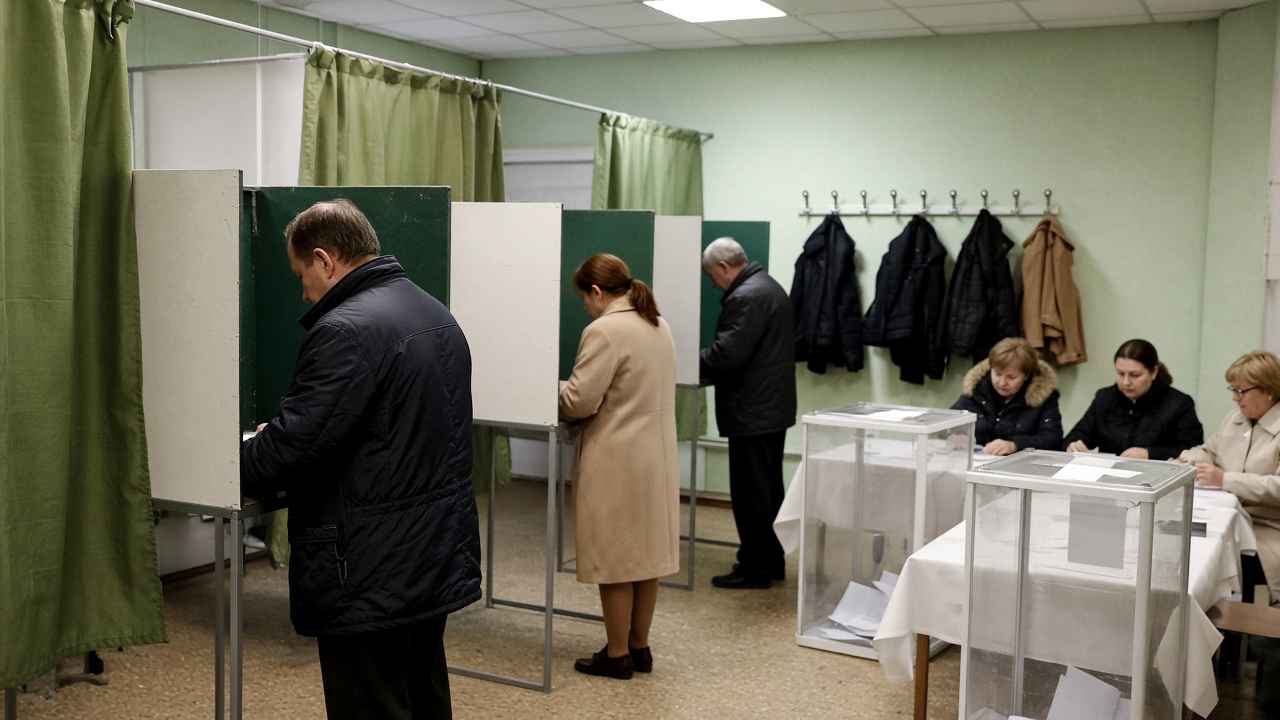
Russia’s ruling United Russia party led partial official returns and exit polls on Sunday as the country’s three-day parliamentary election ended, a vote President Vladimir Putin had framed as a wartime referendum on the invasion of Ukraine. Early figures showed United Russia with about 57.5 percent of the party-list vote, while allied parties that routinely back Kremlin priorities were on track to fill the remaining seats in the State Duma.
What the first numbers show
Central Election Commission chair Ella Pamfilova said turnout for the Duma vote and concurrent regional elections exceeded 45 percent by late morning on the final day. United Russia’s share, if it holds through full counting, would preserve the supermajority the party has used to pass defense budgets and wartime legislation since 2022. Communists, the Liberal Democratic Party, New People, and A Just Russia — all represented in the current Duma — trailed by wide margins but were still projected to cross the threshold for seats.
The commission reported that online voting in Moscow faced cyberattacks on Saturday, without attributing them. Kyiv, which has suspended its own elections under martial law, dismissed the Russian process as a pseudo-election, a line Ukrainian officials have repeated since Moscow began organizing votes in occupied Ukrainian territory.
Violence on the last day of voting
The count unfolded against a backdrop of the largest reported drone barrage on Moscow since the full-scale war began. Moscow Mayor Sergei Sobyanin said more than 1,600 drones were intercepted nationwide, with hundreds aimed at the capital region, and linked the timing to the election. Regional officials reported civilian deaths in the Moscow suburbs and in Russian-held Kherson, including an election worker — figures Russian authorities have used to accuse Ukraine of trying to disrupt the ballot.
Separately, authorities said a facility at the Moscow Oil Refinery was damaged, reviving a target Kyiv has struck repeatedly to squeeze export revenue. Ukrainian President Volodymyr Zelensky praised the long-range campaign in public remarks Sunday, while Russian officials insisted voting proceeded smoothly in most regions.
Putin’s framing
Putin told voters in a televised address before the ballot that the election would demonstrate national support for troops fighting in Ukraine. He also accused Ukraine of interfering after a strike he said killed an election official in Russian-controlled Zaporizhzhia earlier in the week. Reuters could not independently verify that account, and Ukrainian officials did not comment on the specific claim.
With no credible opposition on the ballot, the question for Kremlin watchers is less who wins than how high turnout appears and how quickly full results are certified. Initial totals were expected to begin emerging around 1800 GMT Sunday, with more complete figures on Monday.
What foreign capitals watch
Western governments have already said they will not recognize votes held in occupied Ukrainian regions. For NATO planners, the early United Russia lead confirms continuity in a Duma that has funded the war’s second and third years. For Ukraine’s partners, the simultaneous drone campaign and election messaging underscore Kyiv’s bet that striking inside Russia can impose costs even when Moscow stages a choreographed ballot.
Until the commission publishes final seat allocations, the operative facts are the partial percentage lead, the turnout figure Pamfilova cited, and the parallel violence in Moscow and the south — a wartime election that ended with both ballot boxes and air-defense activations on the same news cycle.