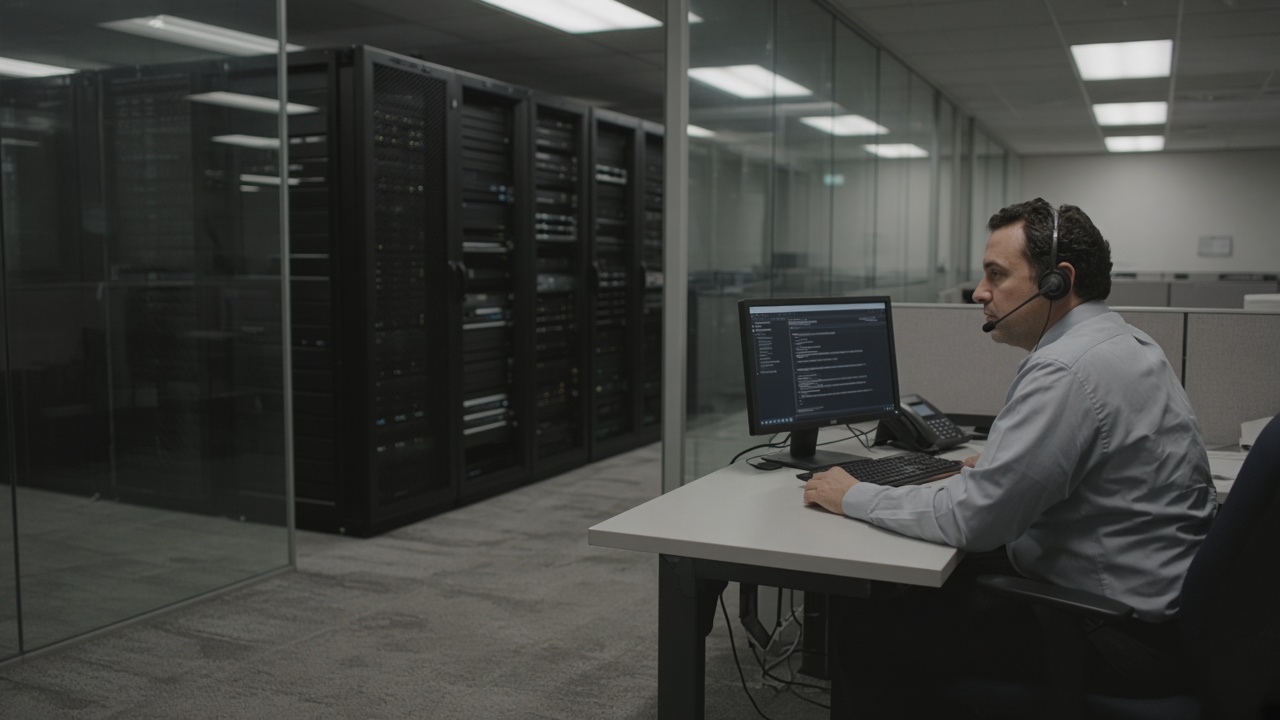
Upstage started delivering rack-scale “Solar” language-model appliances to two Korean lenders this month, systems that transcribe, summarize, and redact multi-year call-center voice archives without sending audio to public hyperscale clouds. The rollout targets compliance teams that stalled generative-AI pilots after regulators clarified that wholesale uploads of customer calls can trip wiretap and credit-information rules even when vendors promise encryption.
What the appliance does
Each unit bundles Upstage’s Solar Pro family—tuned for Korean financial phrasing—with GPUs or AMD accelerators the company has been pairing with domestic cloud partners. Audio ingests over SFTP from legacy tape migrations or live call-recording servers, passes through on-device speaker separation, then produces searchable text with automatic masking of account numbers and national ID fragments. Compliance officers get audit trails showing which model version touched each file, a requirement Personal Information Protection Commission examiners highlighted in 2025 fintech inspections.
Upstage CEO Sung Kim said the design mirrors private LLM deals the company signed with Shinhan Investment & Securities and K Bank, but shrinks the footprint from whole data halls to four-post racks banks can slot into existing disaster-recovery sites. Banks keep keys; Upstage ships signed container images and quarterly security patches rather than hosting inference itself.
Why voice archives are the wedge
Retail banks recorded hundreds of millions of hours during pandemic-era remote sales, much of it sitting on near-line storage because keyword search missed Korean homophones and regional accents. Public cloud speech APIs offered better accuracy but legal teams blocked them, citing the Communications Privacy Act and Financial Supervisory Service guidance on outsourcing customer data. An on-prem appliance lets risk committees approve summarization for dispute investigations—chargeback cases, missold insurance riders—without creating a new off-site data controller.
One participating lender, which Upstage declined to name citing contract confidentiality, said a proof on 120 terabytes of 2019–2022 mortgage calls cut average retrieval time from days to minutes while redaction models caught 94 percent of spoken account digits in manual audits. The remaining errors involved traders spelling numbers too quickly; human reviewers still sign releases.
Regulatory backdrop
The Personal Information Protection Commission has not banned cloud AI outright, but its 2025 checklist asks whether processors can decrypt content—a bar public APIs struggle to clear when vendors hold master keys. Wiretap rules add criminal exposure if third parties listen without customer consent, even for quality assurance. Upstage’s pitch is that appliances stay inside the bank’s security boundary, logging access the same way core banking databases do.
Financial Supervisory Service examiners told InfoHandle they will sample model outputs during onsite reviews, checking for hallucinated policy quotes in scripts supervisors might reuse. Upstage added citation links back to internal policy PDFs ingested through retrieval-augmented generation, though banks must keep those documents current or risk confident wrong answers.
Competitive landscape
Naver Cloud and KT cloud units market sovereign GPU regions, while global vendors pitch confidential computing. Upstage argues finance-specific tuning beats generic Llama deployments for Korean honorifics and loan jargon. Rival AI shops without banking references struggle to pass vendor risk questionnaires that ask for three years of incident history.
Hardware choices matter for procurement: one bank selected AMD-based nodes after Upstage’s March collaboration announcement; another stayed on NVIDIA for spare-parts compatibility with existing HPC clusters. Neither bank plans to retire human quality assurance; appliances handle first-pass transcription so analysts focus on disputes, not typing.
Deployment friction
Tape migrations remain the slow phase—robots pull LTO cartridges while models wait idle. Upstage partners with systems integrators who stage overnight batches so trading-day calls still record to primary servers. Power and cooling in older Seoul back offices required rack upgrades; one site added in-row chillers because legacy CRAC units could not handle 30-kilowatt GPU drawers.
Union works councils asked whether summarization threatens call-center jobs; management responses emphasize shifting staff to complex complaints rather than layoffs, though headcount plans were not shared with InfoHandle.
What success looks like
Upstage targets five more financial installs by year-end, expanding from voice to chat logs and internal email if redaction models pass legal review. Revenue mixes appliance margin with annual support contracts—a steadier line than pure API tokens for a company whose finance vertical already accounts for more than half of sales amid broader Solar adoption in commerce and public sector.
For regulators, the test is whether on-prem boxes actually stay on-prem: banks must block outbound telemetry hooks and prove patch downloads come through approved proxies. Upstage said it will publish a reference architecture with KISA-aligned hardening guides in October. Until then, the shipped racks are a bet that Korean lenders can modernize archives without betting customer voice on someone else’s cloud.