Taiwan will not surrender its democracy or basic freedoms to ease Chinese pressure, Vice President Hsiao Bi-khim said in a Sky News interview aired Monday, as Beijing’s coast guard expands patrols around and east of the island. Hsiao spoke hours before Chinese President Xi Jinping and U.S. President Donald Trump are due to meet this week, a summit Taipei watches for signals on maritime security and arms sales.
“We will not provoke, but at the same time, we will not yield by compromising our basic freedoms and our democracy,” Hsiao said, describing gray-zone coercion as a campaign to normalize advantage without open war. She rejected Beijing’s threat to use force, adding that the Communist Party claims Taiwan and is “coercing us into submission.” China’s foreign ministry countered that patrols east of Taiwan are lawful exercises of jurisdiction under Chinese and international law.
Coast guard numbers
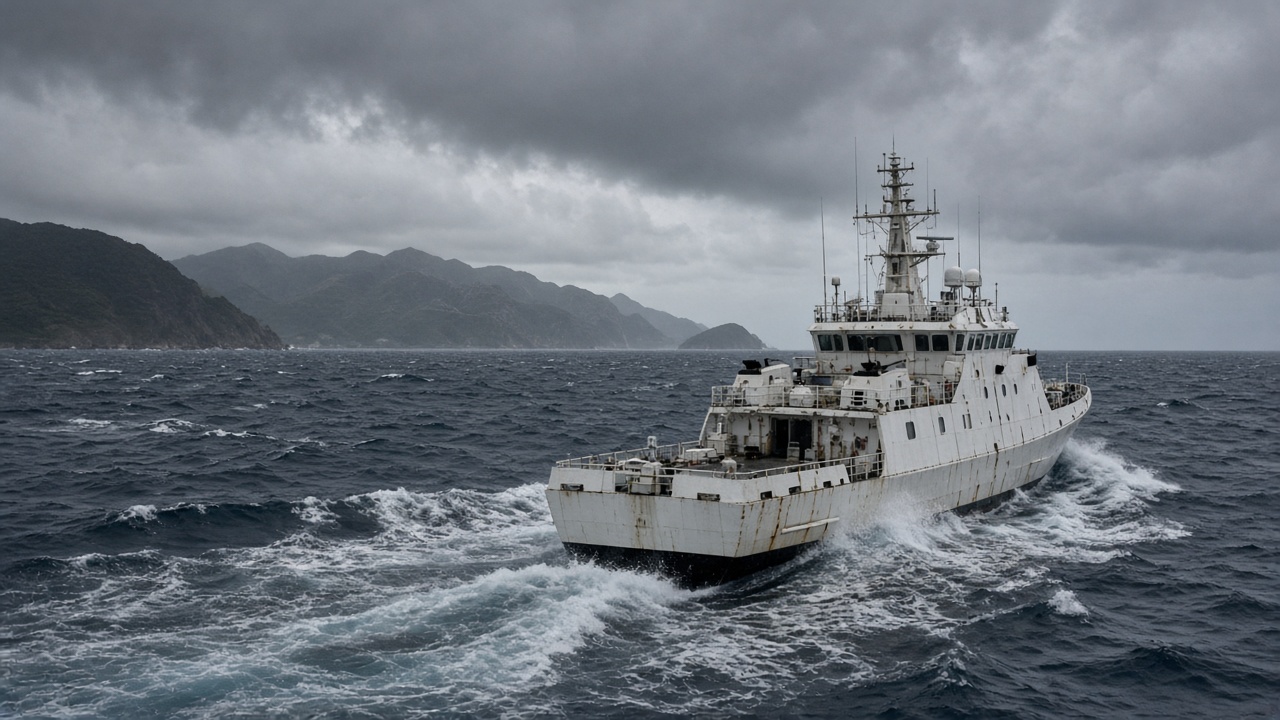
Sky News cited analysis with the Futures Lab at the Center for Strategic and International Studies showing record Chinese coast guard presence near Taiwan’s main island during summer 2026. The estimated daily average of vessels rose 37.5 percent from summer 2025. East of Taiwan—where Chinese coast guard ships began operating this summer—the daily average surged about 3,800 percent year on year, according to the figures aired Monday.
CSIS analysts have warned that semipermanent patrols east of Taiwan could interfere with commercial shipping lanes strategically important in any conflict. Hsiao framed the eastern waters as part of Taiwan’s effort to remain connected to the world despite blockade risks, not merely a military front.
Military movements
Taiwan’s Ministry of National Defense said that from 6 a.m. Sunday to 6 a.m. Monday it detected four People’s Liberation Army aircraft, seven PLAN vessels and four Chinese official ships operating around Taiwan. Three of the aircraft crossed the median line of the Taiwan Strait, entering Taiwan’s central, southwestern and eastern airspace, the ministry said. ROC forces responded with cap aircraft, navy ships and coastal missile systems, according to the daily bulletin.
The mix of air incursions and maritime law-enforcement presence fits Taipei’s description of layered pressure: fighters and drones test air defenses while white-hulled coast guard ships assert administrative control at sea. Hsiao’s interview aimed to pair those statistics with a political message for international audiences ahead of the Trump-Xi talks.
Washington’s week
U.S. officials have deployed additional Coast Guard cutters to the Western Pacific, but Hsiao and CSIS commentators argue allied capacity cannot alone secure busy sea lanes if Chinese patrols harass merchant traffic. Whether maritime security earns a place on the Trump-Xi agenda remains uncertain; Beijing has treated Taiwan as a core sovereignty issue while Washington maintains strategic ambiguity with deepening arms support to Taipei.
For Hsiao, the calendar is crowded: she recently returned from a democracy forum in Italy where she highlighted gray-zone threats, and she now faces questions at home about balancing deterrence with stability. Her Sky News appearance was a bet that voters and partners will accept short-term friction if it preserves democratic institutions—a stance she repeated as coast guard tallies climb off Taiwan’s less militarized east coast.