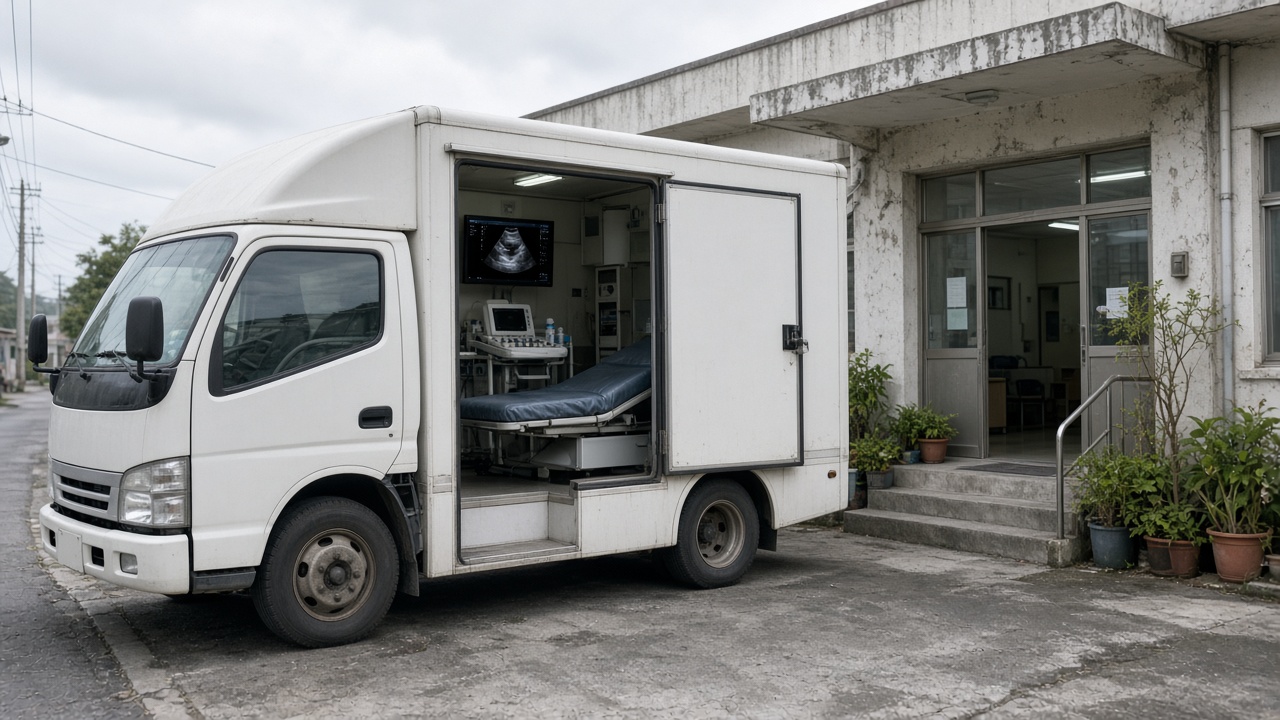
Chang Gung Memorial Hospital's Linkou main campus deployed a liver fibrosis screening model on mobile ultrasound vans that visit northern Taiwan townships where hepatology referrals backlog stretches months, according to a hospital operations bulletin and ethics-board summary for the AI-assisted workflow reviewed by InfoHandle. The system does not diagnose cancer on its own—it quantifies stiffness patterns radiologists use to prioritize chronic hepatitis and fatty-liver patients for hospital slots.
What actually runs in the van
Each van carries a portable elastography ultrasound linked to an edge GPU box running a version of Chang Gung's research model frozen after prospective validation on hospital-held scans. Outputs include a fibrosis score band, image quality flags, and a recommendation for routine follow-up versus expedited hospital intake—always requiring on-site physician sign-off before SMS results leave the van.
Patient data stays on encrypted drives until nightly sync to the hospital PACS over VPN; no public cloud inference in the pilot phase.
Claims agencies can test
Health Promotion Administration reviewers received the validation report with sensitivity and specificity on held-out Taiwanese cohorts, stratified by BMI and hepatitis B carrier status. Independent auditors can replay the published threshold tables on de-identified sample clips the hospital posted to a researcher portal—not full model weights.
What a careful reader still will not know: performance on rare comorbidities and whether family-history fields bias triage when nurses enter them under time pressure.
Who has power
Chang Gung sets clinical protocols; county health bureaus schedule van routes. NHRI funded part of the validation compute but does not operate vans. Patients may opt out of AI-assisted scoring and receive manual radiologist review on the next hospital visit—an option posted in Mandarin and Hakka on clinic bulletin boards in the pilot townships.
Limits the hospital admits
The model is not licensed as a standalone medical device; it is hospital-validated software used under physician supervision. Vans cannot biopsy or prescribe; they route. Ultrasound acoustic windows fail on roughly eight percent of obese patients per internal QA—those cases get paper referrals without scores.
What would falsify usefulness
If edge boxes drift calibration in humid summer heat, scores could mis-rank patients; the ops bulletin mandates daily phantom scans and auto-lock when drift exceeds two percent. If SMS results leak to family members' phones due to clerical errors, trust collapses faster than AUC metrics.
Equity and workforce
Linkou hepatologists remain the bottleneck for treatment; the van program shrinks the guessing game about who should wait in line. Nurse sonographers received forty hours retraining on AI flag interpretation; union reps asked for hazard pay on mountainous routes—negotiations continue.
Next quarter
MOHW may expand reimbursement codes for AI-assisted community screening if van data show reduced late-stage presentations in year-one surveillance. For Priya Sharma's desk, the evaluable story is narrow: a named hospital put frozen-model ultrasound AI on wheels with published thresholds and opt-outs—not a consumer wellness app promising to "detect liver disease from your phone."
County clinics in Taoyuan and Miaoli booked van windows through December; Chang Gung declined to share per-scan cost, citing bundled public-health grants.
Patient advocacy groups asked for English result letters for migrant workers; the pilot prints Mandarin summaries only, with hospital interpreters available on request.
NHRI statisticians will receive quarterly de-identified score distributions to check for demographic skew; Chang Gung committed to pause routing rule changes if disparity metrics exceed pre-set bounds. Hospital lawyers reviewed liability caps for false negatives; informed consent forms spell out that van screening supplements, not replaces, hospital elastography.
Rural township mayors asked for weekend slots; Linkou schedulers prioritized weekday farmer markets first because hepatitis screening uptake was highest when vans parked beside produce stalls.
Hospital IRB reviewers required quarterly safety reports on edge-box overheating; no thermal incidents were logged in the first pilot month. Chang Gung said it will not license the model to third-party van operators until two quarters of township data are published in a peer-reviewed format.
MOHW observers attended one van session as silent monitors; they did not intervene in triage decisions, preserving clinical autonomy while documenting workflow for possible national scale-up.