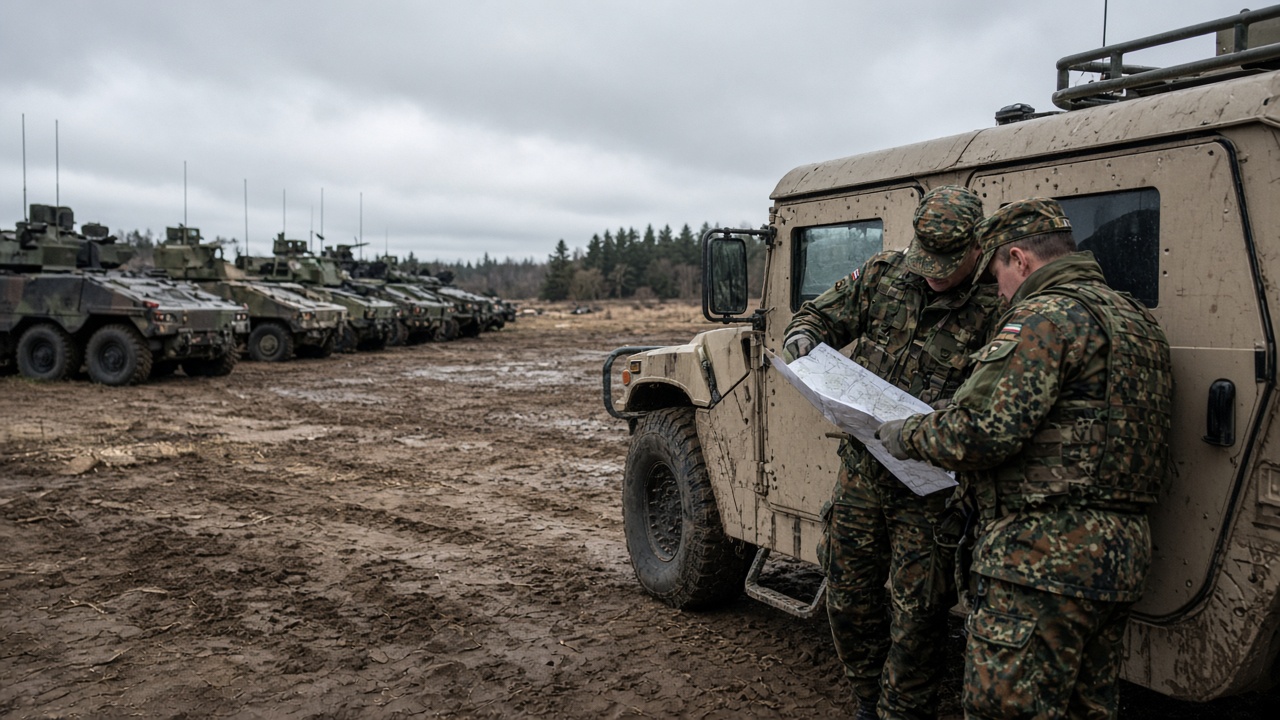
NATO’s top uniformed officer said Monday that allied militaries have drafted roughly 4,000 pages of contingency plans for the alliance’s eastern flank, covering crises short of war as well as scenarios that could lead to invoking Article 5 collective defense. Admiral Giuseppe Cavo Dragone, chairman of the NATO Military Committee, described the documents in Copenhagen as pre-written menus of force movements rather than evidence that an attack is imminent.
Dragone’s remarks landed amid a week of airspace alerts, sabotage investigations and public warnings from front-line governments that Russia is probing NATO resolve while much of the world’s diplomatic attention sits on the war in Ukraine and Middle East flashpoints. NATO’s own statement on Friday listed drone incursions, GPS jamming and hybrid sabotage as examples of “reckless behavior” allies have answered with intercepts and quick-reaction deployments.
Three regional playbooks
According to Dragone, three separate regional plans spell out how land, air and maritime units would shift as threats escalate. The options range from reinforcing a single Baltic state after a border incident to coordinating multi-corps movements if several allies are struck at once. Decision trees are standardized so political leaders can move from intelligence warnings to executable orders without rebuilding staff work from scratch each time.
The admiral stressed that publishing the existence of plans is not the same as announcing new troop surges. Most additional brigades pledged after Russia’s 2022 invasion are still rotating through exercises rather than sitting permanently on the border. What has changed, officers say, is the density of classified connectivity between national headquarters and NATO’s Joint Force Command Brunssum and Naples.
Poland’s warning lens
Polish Prime Minister Donald Tusk told reporters on 17 September that allied intelligence saw signs Moscow might stage hybrid strikes—drones or missiles portrayed as accidents—to test whether NATO would fight as one. That assessment remains Warsaw’s read, not a confirmed Kremlin order, but it shaped weekend consultations among Baltic and Nordic defense ministers.
Britain’s defense ministry separately told Parliament last week that high-readiness U.K. units are earmarked for NATO’s Suwałki Gap plans, the narrow corridor between Poland and Lithuania that would be decisive in any attempt to cut the Baltic states off by land. Minister Louise Sandher-Jones said “almost all” British forces are now assigned to alliance planning, a shift from the pre-2022 era when national expeditionary missions consumed much of the army’s bandwidth.
Civilian resilience on the checklist
Dragone linked the military plans to NATO’s push for resilient power grids, hospitals and undersea cables. Estonia, Latvia, Lithuania and Poland are pouring concrete into new obstacle belts, but think tanks including the International Institute for Strategic Studies caution that bunkers without assigned units and artillery coverage buy only minutes against a mechanized thrust.
For citizens on the eastern flank, Monday’s message was dual: NATO claims it can execute rehearsed responses quickly, yet no alliance leader predicted an immediate Russian invasion. The nearer risk remains ambiguous probes designed to divide public opinion in Germany, France and the United States over how forcefully to respond. Dragone’s 4,000 pages are meant to shrink that ambiguity for generals—even if politicians still have to sell any resulting deployments to weary electorates.