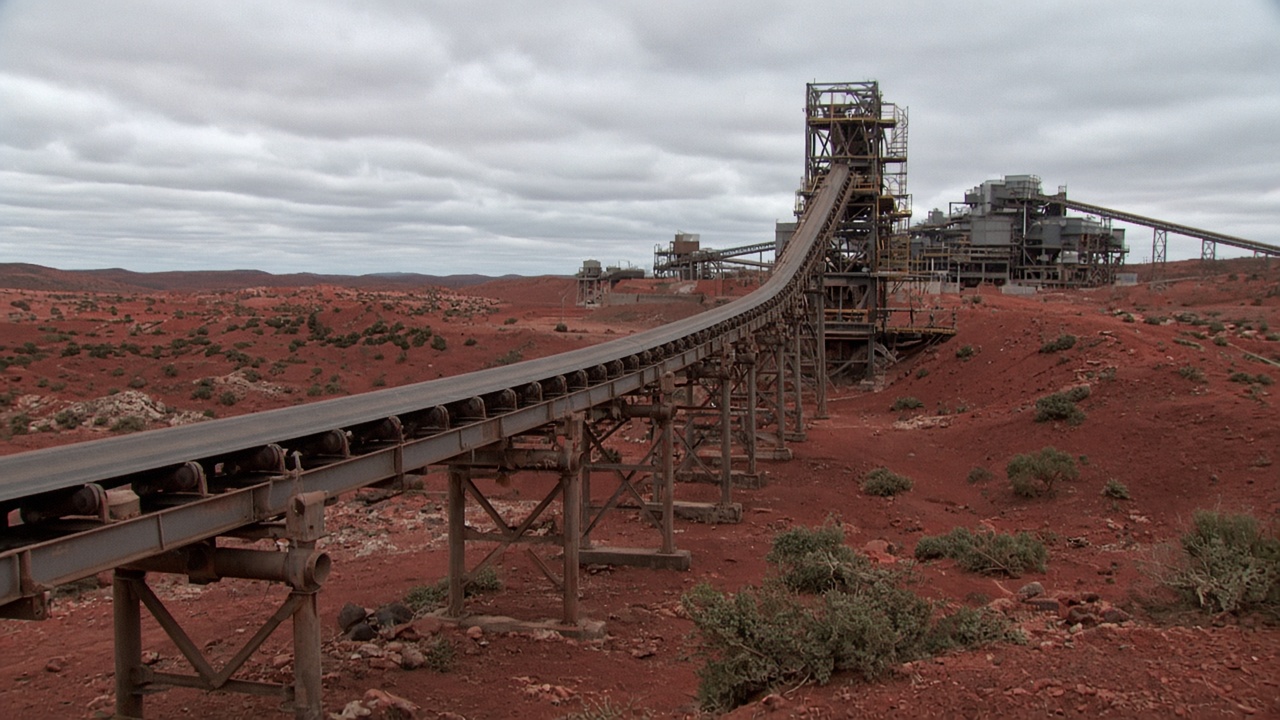
Rio Tinto Ltd slowed the crusher ramp at its Gudai-Darri iron ore hub after alignment checks on coarse-ore feed conveyors showed drift beyond tolerance, according to an internal operations bulletin circulated to Hamersley crews and summarised to investors ahead of September production figures. The mine, which reached its 43 million tonne nameplate in under a year after opening, is pursuing incremental upgrades toward roughly 50 million tonnes through chute extensions and stronger belts rather than a greenfield plant duplicate. Until transfer towers are re-shimmed and belts re-tracked, tonnes through the primary crusher will run below the creep plan, Rio told site supervisors.
What failed the alignment test
Maintenance engineers used laser surveys on the stockpile feed line after vibration monitors flagged uneven wear on idler sets. The fault is not a structural collapse; it is cumulative drift at splice joints and loading skirts that can spill fines and trip belt drift sensors. Rio's environmental licence amendment for higher throughput already contemplates stronger coarse-ore stockpile feed belting and longer discharge chutes to the apron feeder. Those components are installed, but commissioning assumed tighter geometry than the red Pilbara heat and load cycling allowed during the first full summer at elevated rates.
Crusher operators dropped feed rate roughly fifteen percent while crews worked night shifts to adjust frames. The incremental crushing and screening module Rio planned to lean on for extra tonnes remains available, but blending rules require matched particle size into the automated laboratory conveyor. Quality teams did not release off-spec product to Port Hedland blend piles, a constraint that matters for premium lump contracts.
Why the board cares about creep not capex
Rio has marketed Gudai-Darri as proof that technology-heavy mines can add capacity cheaply. Public releases put the creep pathway near A$130 million for roughly seven million extra tonnes, far below a duplicate hub. A prolonged alignment fix does not automatically erase the business case, but it pushes volume into a quarter when Chinese steel mills debate restocking and when rivals report their own maintenance windows. Iron ore analysts said the market treats Gudai-Darri noise as company-specific unless rail out of the Pilbara softens in tandem.
Hamersley iron ore chief Simon Trott's team has emphasised autonomous haulage and robotics in the on-site lab; this episode is mundane mechanical engineering by comparison. Still, ASX investors watch whether Rio can hit group guidance without leaning on price. A September miss at one hub can be recovered if port schedules flex, which Pilbara Ports data so far show as feasible.
Regulatory and community file
Western Australia's environmental regulator approved higher main-plant throughput with conditions on dust suppression at conveyor transfers, including fogging and spray curtains named in licence documents. Rio must demonstrate those systems stay in service while extra maintenance scaffolding sits near walkways. Traditional owners on the Eastern Guruma country agreement receive quarterly production reporting; alignment work does not change the approved 53 million tonne site cap when the build-own-operate module's share shifts, but it does affect timing of royalties-linked targets discussed in community meetings.
Workforce rosters remain FIFO-heavy. Contractor firms in Newman said bearing lead times are manageable; the bottleneck is skilled fitters who can work at height on enclosed galleries. Rio declined to quantify lost tonnes in public remarks reviewed by InfoHandle, but people familiar with the plan said internal targets implied a high-single-digit percentage dip for the month versus creep nameplate.
Competitive lens
BHP and Fortescue investors will compare maintenance stories when quarterly production drops. Gudai-Darri is Rio's newest hub, so early conveyor teething is not unprecedented in the Pilbara, where heat expansion and dust intrusion punish tracking. Wood Mackenzie and other researchers had already noted Rio pushing back larger phase-two expansion dreams in favour of this incremental route. A slower September reinforces that narrative without proving the creep strategy wrong.
Customers buying Pilbara blends care about alumina and silica consistency more than a one-month tonnage wobble. Rio's automated sample cell, fed by conveyor from the stockyard, is a selling point precisely because misalignment spills can poison blend assumptions. That is why quality held throughput back faster than mechanical limits alone.
What happens next
Site managers listed three checkpoints: belt tensioning completion on the coarse feed line, vibration readings back inside OEM bands, and a staged crusher rate test without tripping drift interlocks. Rio said it will update the market with formal quarterly production in October. Until conveyors track true, Gudai-Darri's creep story is less about robots and more about shims, idlers, and the unglamorous work of moving dirt reliably.