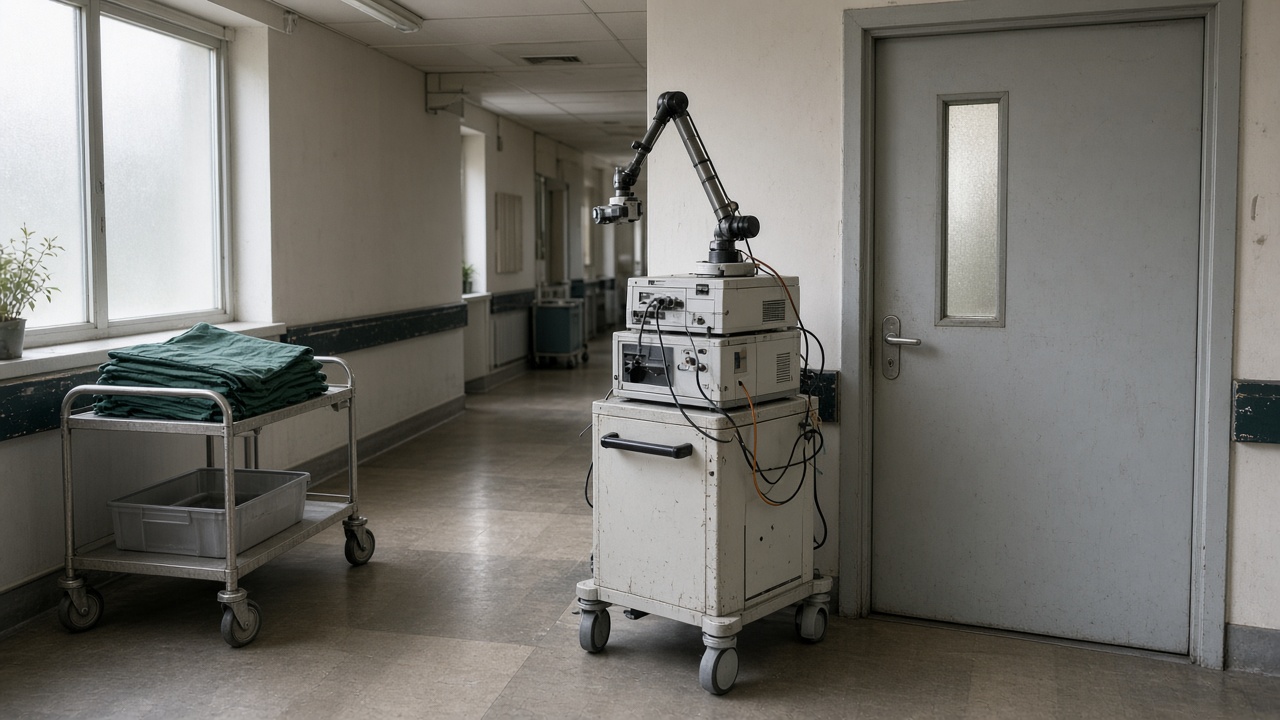
Royal Cornwall Hospitals NHS Trust (RCHT) told consultants it will run extra Saturday ophthalmology laser lists through October after a six-week summer shutdown of two day-case theatres at Royal Cornwall Hospital, Treliske, left a backlog of more than 400 YAG capsulotomy and retinal laser cases that had already breached the 18-week referral-to-treatment standard, according to a theatre scheduling memo circulated Friday and reviewed by InfoHandle. The trust frames the sessions as catch-up, not a permanent expansion—anaesthetic cover and sterile-processing staff were redeployed during the shutdown to finish HVAC filter work that could not wait until winter.
What the shutdown actually closed
Planned maintenance closed one cataract list room and a shared laser suite from mid-August through late September while engineers replaced air-handling units serving ophthalmology day surgery. Elective cases that need only topical anaesthetic were meant to shift to community sites; in practice, Penzance and Bodmin outreach rooms lack the same Nd:YAG laser RCHT uses for posterior capsular opacification after cataract surgery, so those patients accumulated on a single remaining list that could not absorb Cornwall’s summer tourist-season demand.
Trust operational data summarized for divisional leads put the laser backlog at 412 cases as of 18 September, with median wait rising from 15 weeks in June to 22 weeks now. That is a queue metric, not a clinical severity score—retinal teams triage macular oedema and lattice tears ahead of routine YAG—but patients with dense floaters after lens implants are still functionally driving with one good eye while they wait.
How the catch-up lists will run
Saturday lists start 27 September at Treliske, two theatres, four consultant sessions through 25 October. Patients will receive text confirmations rather than paper letters because the trust’s print vendor queue was already saturated by winter flu clinic mailings. Nurses were told to expect 28 laser slots per session with 12-minute turnover targets—tight but achievable if pre-assessment charts are complete.
RCHT is not opening paid private lists on NHS premises; the memo explicitly bars mixing insured cases into the Saturday block. Locum ophthalmologists from Plymouth and Exeter agreed to cover two dates where Cornwall’s own rota had gaps after a consultant left for a mainland fellowship.
What NICE and college guidance imply
NICE technology appraisals treat YAG capsulotomy as a standard outpatient procedure when vision impairment is documented; there is no national urgency tier comparable to cancer pathways. The Royal College of Ophthalmologists’ recovery bulletins nonetheless warn that prolonged waits increase fall risk in older adults who lose contrast sensitivity. For Cornwall’s demography—above-average age and rural driving distances—a three-week slip can mean cancelled shopping trips and delayed licence renewals at DVLA eye-test thresholds.
What patients can verify
If you are on a laser waiting list, check whether your referral sits with RCHT or a subcontractor; community hubs cannot always see the same slot inventory. Bring current glaucoma drops and a list of previous laser dates—duplicate treatment requests slow booking. The trust’s patient advice line publishes which Saturdays still have capacity; it does not publish named clinicians for locum weekends.
What remains uncertain is whether HVAC work finishes on schedule. If filters fail validation, theatres could close again and erase October gains. For now, the actionable fact is dated: extra laser lists are on the calendar, the backlog is counted, and the trust is treating summer theatre downtime as an elective-recovery problem rather than an ophthalmology footnote.