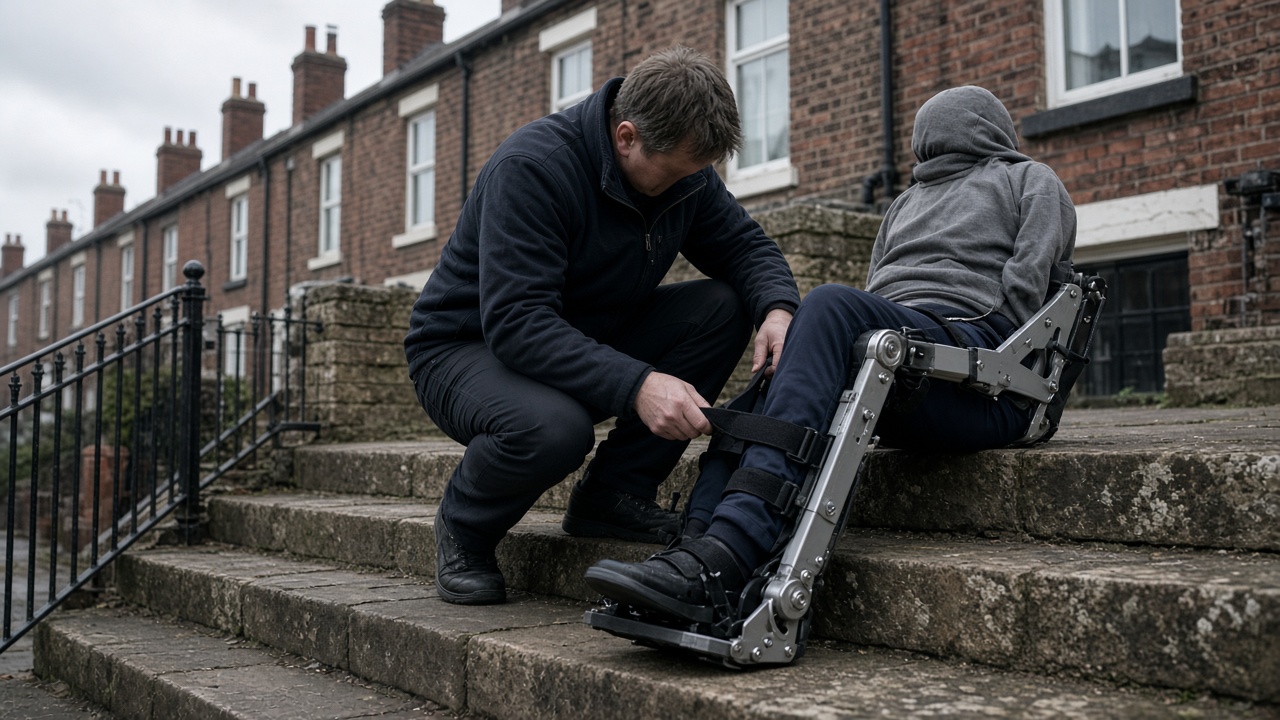
A Sheffield Hallam Advanced Wellbeing Research Centre spinout has opened NHS community physio trials for a stair-climb exoskeleton aimed at patients who fail home discharge because of terraced steps, not because hospital rehab ran out. The device—developed from SEMS engineering work on cable-driven assist limbs—targets South Yorkshire housing stock where indoor stair counts block community therapy routes long after ward stays end.
Device and trial design
The spinout, trading under a working name derived from AWRC accelerator cohort paperwork, mounts a lightweight bilateral leg assist on a hip belt frame. Physios dial assist torque for sit-to-stand and step-over motions on narrow Victorian stairs common in Sheffield and Rotherham terraces. Unlike hospital exoskeletons built for flat gait labs, this unit tolerates uneven treads and tight turn landings measured in pilot home surveys.
Community teams in Sheffield NHS Foundation Trust and Rotherham Doncaster and South Humber areas enrol post-orthopaedic and COPD-deconditioned patients who scored “unsafe stairs” on OT visits. Sessions occur on patients’ own steps with band 6 physios logging cadence, heart rate, and patient confidence scales—primary endpoint is successful ten-step ascent unaided within six weeks, secondary is reduced re-admission for falls anxiety.
Sheffield Hallam lineage
Engineering faculty published cable-pulley arm exoskeleton research in 2021; the spinout repurposed actuation packaging for legs with AWRC human performance labs supplying gait capture. JT Rehab’s S-Press leg strengthener proved NHS appetite for portable rehab kit; this project climbs one rung up complexity into powered assist, sharing AMRC design-for-manufacture mentors.
Innovate UK and regional growth funds co-financed prototypes; the NHS trials run on trust research governance approvals without national tariff yet—devices remain trust property loaned per episode.
Why community routes matter
Delayed discharge dashboards show hundreds of bed days lost across South Yorkshire when patients cannot navigate home stairs safely. Hospital exoskeleton suites exist at major centres, but vans and setup time kill throughput for community caseloads. A backpack-scale unit that fits in a physio estate car shifts therapy to the bottleneck step—the front door—matching NHS England’s shift-left community emphasis.
Housing associations supplied anonymised stair dimensions for digital twin tests in AWRC’s VirtuHub before human trials; narrow width proved the binding constraint earlier hip exoskeleton imports failed.
Safety and training
Each physio completes a two-day AWRC cert covering emergency release, battery swap, and skin integrity checks under orthotic socks. Patients wear hip belts rated for partial weight bearing only—explicit exclusion criteria for unstable fractures or severe cognitive impairment. Trust medico-legal teams signed off incident playbooks including manual strip-down if power fails mid-step.
Data loggers upload anonymised torque profiles for Sheffield Hallam researchers to refine assist algorithms; no cloud processing outside NHS datacentres for trial cohorts.
Commercial path if trials succeed
The spinout seeks CE UKCA marking via notified body routes aligned with Class I assist device expectations—lawyers caution powered exoskeletons attract MHRA attention even without surgical claims. Manufacturing quotes from AMRC partners target sub-£8,000 unit cost at small batch, compared with six-figure hospital systems—critical if ICBs fund devices per postcode rather than regional hubs.
Investors from AWRC angel networks watch trial readouts in December; failure to beat manual stair-training control arms would push the team back to S-Press-style passive devices.
Patient stories the team cites
Early participants include a retired steelworker who refused discharge to a ground-floor temp flat because of pet care upstairs, and a COPD patient relearning stairs after ICU deconditioning. Physios report morale gains when therapy happens at the actual feared step, not a gym box—psychological metrics may matter as much as torque curves.
Limits and next steps
The exoskeleton does not climb external icy steps in winter without extra grip research; trials pause outdoor sessions November–February. Battery life covers roughly forty minutes of intermittent assist—enough for community visits if chargers ride in boot kits.
For Sheffield Hallam, the spinout is a bet that NHS community physio routes need hardware matched to northern housing, not imported flat-land lab kit. September trials are small-N but politically visible as trusts chase discharge backlog wins—success would mean fewer beds held for stairs that terraced Britain never removed.