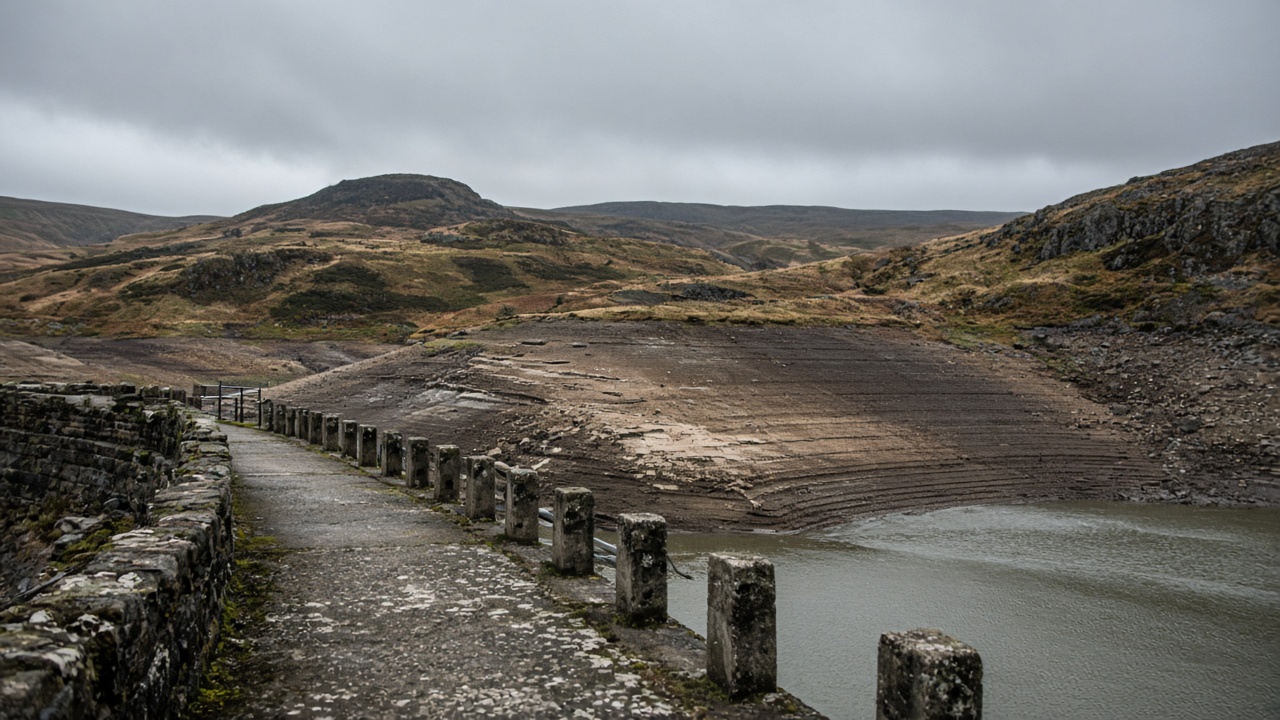
United Utilities has authorised a sharper controlled drawdown at Haweswater and Thirlmere after September rainfall across the Lake District catchments finished well below the company’s planning assumption, leaving the paired reservoirs that feed Manchester and much of Cumbria at levels the board treats as a strategic risk rather than a seasonal blip. The decision, communicated to regulators and local resilience forums over the weekend, does not yet trigger hosepipe bans in Carlisle or the west coast, but it does move more daily supply through the gravity network that normally leans on autumn recharge.
What the filing trail shows
Company telemetry published to the Environment Agency’s drought portal shows Haweswater and Thirlmere combined near forty-one per cent of usable capacity in mid-September 2026, against a long-run September average closer to sixty-two per cent and last year’s reading near forty-eight. United Utilities’ own weekly stock bulletin, which Helen Crowe’s desk tracks against the five-year band, recorded a third consecutive week of net outflow exceeding inflow across the Strategic Grid zone that links the Lake District to the Pennines.
The release is explicit that drawdown is operational, not emergency abstraction. Engineers are lowering controlled outlet levels to keep turbine flows and gravity mains within design limits while preserving a buffer for public health and for industrial contracts on the West Coast Main Line corridor. That distinction matters for Ofwat: the company cannot simply dip into drought permits without a formal EA position, and the September rain deficit has not yet produced a new drought declaration for Cumbria and Lancashire.
Why September mattered
Met Office provisional data for the North West region put September 2026 rainfall at roughly sixty per cent of the 1991–2020 average, with the heaviest deficits in the western fells that recharge Haweswater. After a wet spring that lifted stocks above eighty per cent by late May, operators had eased some Pennine transfers. The reversal in autumn is familiar—2025 saw similar lows near forty-four per cent before Storm Amy—but planners note that recharge events are arriving later and with less snowpack carry-over.
United Utilities told the News and Star in earlier drought cycles that leakage repair and demand management remain the first levers; drawdown is the lever that buys time while pipe crews chase the four-thousand-leak annual target. None of that softens the political optics in Westminster, where water minister Emma Hardy’s office has pressed companies to publish zone-level stocks weekly.
Inside the company decision
People briefed on the operations committee paper said chief executive Louise Beardmore signed off on the drawdown schedule after network modelling showed Pennine stocks could not absorb another dry fortnight without risking enhanced monitoring escalation across Greater Manchester. Customer-facing teams were told to hold off on broad media campaigns until Cumbria’s tourist economy clears the late-September half-term peak, when lake levels are most visible to visitors.
Investors who own the FTSE 100 utility for regulated returns will watch whether the move foreshadows a performance commitment miss on leakage or per capita consumption. United Utilities’ regulatory account already carries elevated capex for Thirlmere pipeline duplication; operating stress does not change the allowance, but it can delay discretionary grid reinforcement if environmental flow rules tighten.
What regulators see
The Environment Agency’s September 2025 summary report—still the template for how officials describe United Utilities’ posture—showed the Strategic Grid in enhanced monitoring and operations while Pennine reservoirs remained “of concern.” EA liaison officers were invited to a joint call on Friday to review the new drawdown curves and the company’s request to keep abstractions from the River Lune within drought-plan thresholds.
Local councils in Eden and Allerdale have not activated drought committees, but resilience officers are updating standpipe protocols used in 2022. United Utilities emphasised that wholesale supplies to United Utilities-adjacent zones remain separate from Haweswater’s Manchester role; the drawdown is about balancing two giant bowls that historically carried the region through dry winters.
What happens next quarter
Met Office long-range outlooks for October point to unsettled Atlantic fronts, which could lift inflow within two weeks if catchments saturate. If recharge stalls, the company’s drought plan moves from controlled drawdown to customer restrictions in defined zones—a sequence the board hopes to avoid before year-end results. For Cumbria households the immediate change is invisible: taps still run, bills still rise with inflation-linked tariffs.
For the business desk, the story is institutional: a listed water company choosing how fast to spend its mountain water when September rain never arrived, with regulators watching every percentage point on Haweswater’s exposed shoreline.