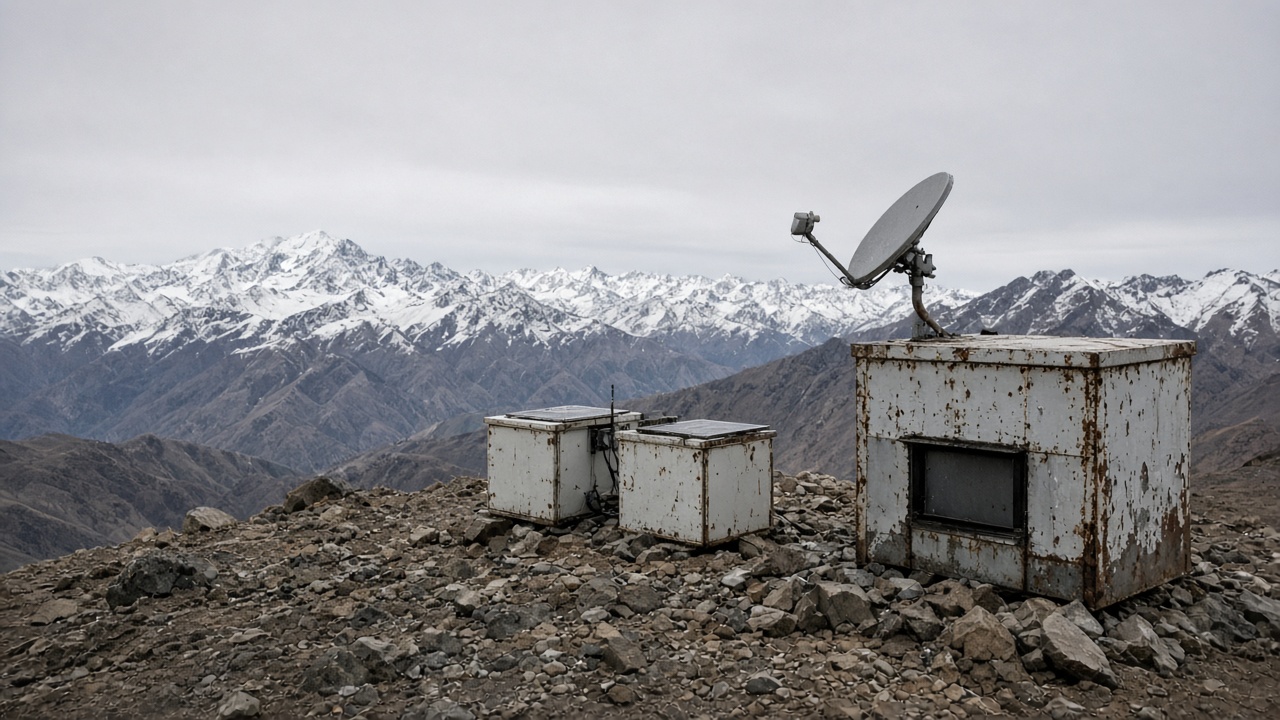
Bharti Airtel has started piloting low-Earth-orbit satellite backhaul to Ladakh outposts that terrestrial microwave cannot reach reliably, wiring commercial terminals to NavIC-disciplined clocks after the government accelerated indigenous navigation in border logistics networks.
Where the trial runs
People familiar with the deployment said three Army-affiliated logistics nodes and two ITBP relay sites above 4,200 metres now terminate on Airtel’s satellite gateway in Manesar, with traffic hairpinned into the operator’s MPLS core before reaching Delhi data centres. Terminals sit beside existing diesel gensets; solar-battery strings sized for winter dark weeks keep modems alive when convoys cannot climb the passes.
NavIC timing feeds come from ISRO’s regional reference stations in Leh and Jammu, not from consumer handsets. That matters because finance and home ministries want audit logs stamped to Indian reference time when patrol units file inventory scans.
Why satellite now
Fibre along the Srinagar–Leh highway remains patchy beyond Kargil, and winter avalanches routinely shear microwave shots across valleys. LEO constellations promise sub-100 millisecond round trips when skies are clear—good enough for encrypted voice, bulk file sync, and the inventory tablets border units adopted after the 2020 infrastructure push.
DoT’s satellite connectivity framework, notified in phases through 2025, finally let licensed telcos lease capacity on foreign LEO systems while reporting gateway locations and lawful-intercept hooks. Airtel had global partnerships ready; the Ladakh pilot is the first India-origin operations playbook regulators asked to see.
NavIC linkage
ISRO’s NavIC programme office published updated interface control documents this summer encouraging telcos to use L1 signals for timing when GPS denial is exercised in exercises. Airtel engineers said they are not replacing GPS fixes in handsets; they are disciplining backhaul routers so log correlation across satellite and fibre paths does not drift.
Defence research labs supplied ruggedised timing modules tested at DRDO’s high-altitude chamber in Chandigarh. Failover reverts to holdover oscillators if NavIC sky view is blocked by blizzards—a scenario field teams simulated in March drills.
Security and compliance
Traffic is encrypted end-to-end on operator-managed keys, with government oversight on gateway mirrors in Manesar. Officials declined to name throughput caps but said bulk surveillance video is still discouraged on satellite hops; patrol units are trained to queue HD clips for fibre descent when convoys return to Leh.
Lawful intercept provisioning follows the same CALEA-style process Airtel uses for mainland cell sites, adapted for satellite latency. Home Ministry reviewers visit quarterly.
Commercial angle
Airtel is not billing the pilot sites commercial rates; it is amortising gear against future enterprise and government SLAs for “always-on Ladakh.” Rivals Jio and Vodafone Idea have filed their own satellite trial notices, but Airtel’s first-mover sites give it field logs competitors lack.
Equipment vendors—terminal makers and gateway integrators—want India assembly mandates if trials scale. Airtel said it sources radomes from domestic plastics shops but still imports phased-array modules subject to import-duty waivers for defence trials.
Limits on the ground
Technicians must fly to sites by helicopter when roads close; spare terminals sit in Leh warehouses with desiccant packs. Rain fade is rare at those latitudes, but heavy snow on radomes triggers automatic beam scans that can drop sessions for minutes.
Local officials asked whether satellite backhaul could extend to panchayat health centres; Airtel said bandwidth budgets this year cover border logistics only, with civilian pilots awaiting USOF funding.
What changes for units on the line
Patrol leaders get predictable nightly sync windows instead of driving memory sticks down the Zoji La. Medical telemetry from high camps can ping district hospitals when doctors authorize it. None of this replaces tactical radios, but clerical load on satellite links frees microwave pairs for command nets.
Next steps
If the six-month pilot meets uptime targets above 99.2 percent, DoT may expand gateway capacity and invite competing constellations to interoperate on NavIC timing. ISRO plans a NavIC L1 civilian signal expansion for 2027; Airtel said routers are firmware-ready.
Failure modes—vendor bankruptcy, export controls on terminals, or spectrum disputes—would push the project back to fibre convoys and high-altitude microwave shots the Army already knows how to nurse through winter.