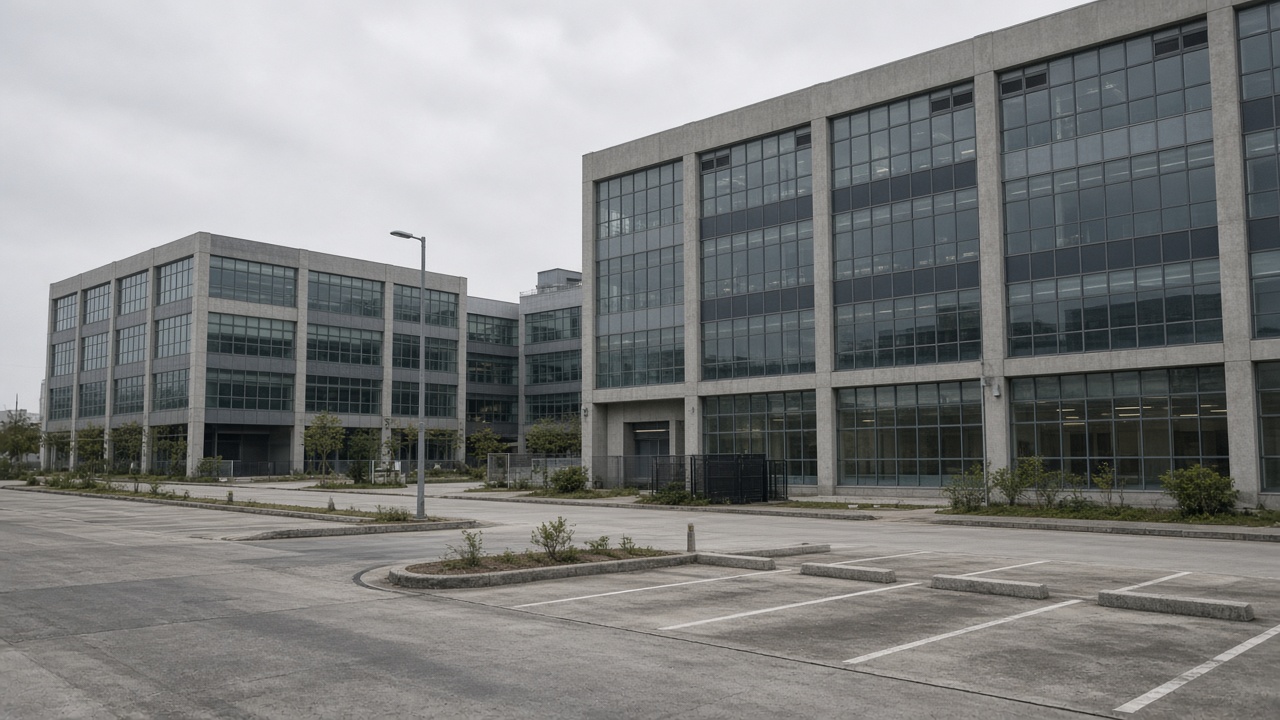
AUO Corp. (2409) spent much of Monday pinned at the Taiwan Stock Exchange’s 10% daily limit, finishing at NT$36.30 on volume that brokers said was the heaviest in the display supply chain. Desk chatter tied the move less to quarterly panel pricing than to reports that Taiwan Semiconductor Manufacturing Co. teams had returned to AUO’s Central Taiwan Science Park campus for another round of site walks at the Gen 5 L5C and Gen 7.5 L7 fabs that sit along Zhongke Road, a short drive from TSMC’s Fab 15 complex.
Why the science-park address matters
AUO’s annual report describes an asset-light pivot: fewer greenfield fabs, more monetization of older lines. The Central Taiwan Science Park trio—L5C, L6A, and L7—dates to the mid-2000s and still carries the certifications you would expect for export manufacturing, but it is no longer where the company’s growth narrative lives. That makes the fabs attractive as real estate and infrastructure, not as LCD capacity.
Market reports this summer suggested TSMC could spend more than NT$30 billion to acquire or repurpose AUO’s L5C and L7 sites for panel-level packaging work, echoing the earlier Innolux collaboration template for fan-out panel-level packaging. Neither company has confirmed a transaction. AUO told reporters it does not comment on speculation; TSMC repeated its policy of not discussing rumors.
What traders think TSMC is measuring
Supply-chain analysts who spoke on background said the latest visits focused on clean-room height, crane loads, and power feeds rather than TFT yields. Panel fabs offer large rectangular floor plates and established utilities—useful if packaging substrates move from round wafers toward square panels for AI accelerators. Chairman C.C. Wei has said publicly that TSMC’s chip-on-panel-on-substrate pilot line is under construction, with customer production still roughly a year away on earlier guidance.
For AUO shareholders, the bull case is straightforward: a deal would convert depreciated glass lines into cash and potentially a long-term service contract. The bear case is dilution of optionality—once a fab is sold, AUO cannot lease it back cheaply if display demand surprises to the upside.
Fab map and adjacency
AUO publishes addresses for L5C, L6A, and L7 at No. 1, JhongKe Road in Taichung’s Xitun District. TSMC’s Fab 15 campus sits across the science park’s road grid, which is why logistics consultants describe the corridor as a potential “one-stop” zone linking front-end wafers and back-end panels. Even without a sale, joint development of glass substrates and through-glass vias could keep both balance sheets busy.
AUO’s board has already approved billions of new Taiwan dollars in capital spending for glass-substrate pilot lines, according to trade press summaries of filings. That spending can coexist with asset sales; the question is whether buyers pay for land and shells or for operating equipment.
Volume and the limit-up session
Brokers said Monday’s limit-up session pulled in local day traders and offshore funds that had been rotating out of pure-play AI foundries. AUO’s market capitalization is a fraction of TSMC’s, so any packaging partnership headline moves the stock harder than it moves the sector leader.
Credit analysts noted AUO returned to profit in 2025 on restructuring gains and tighter capex, but display utilization remains uneven. A fab sale would flatter near-term cash while lowering depreciation—helpful if the company wants to fund vertical solutions and mobility businesses without issuing equity.
What would change for employees and suppliers
Union representatives at display makers have historically pushed for job guarantees when fabs change hands. Any TSMC-linked repurposing would likely retain technicians for retrofit work even if TFT production winds down. Component suppliers along the Zhongke Road cluster would still see traffic, though the mix would shift from color filters toward packaging materials.
Regulatory and competition angles
A large cross-industry land deal would attract scrutiny from the science park administration and fair-trade reviewers, especially if it tightens advanced packaging capacity in central Taiwan. Competitors such as ASE and Amkor are also expanding panel packaging, so exclusivity matters.
What to watch next
Investors should track whether AUO files a material disclosure on asset transactions, whether TSMC mentions panel packaging milestones on its next earnings call, and whether the Financial Supervisory Commission questions broker research citing unnamed site visits. Until a binding announcement lands, the fabs remain AUO’s—and Monday’s limit-up move is a bet that the adjacent foundry giant is still measuring the doorframes.