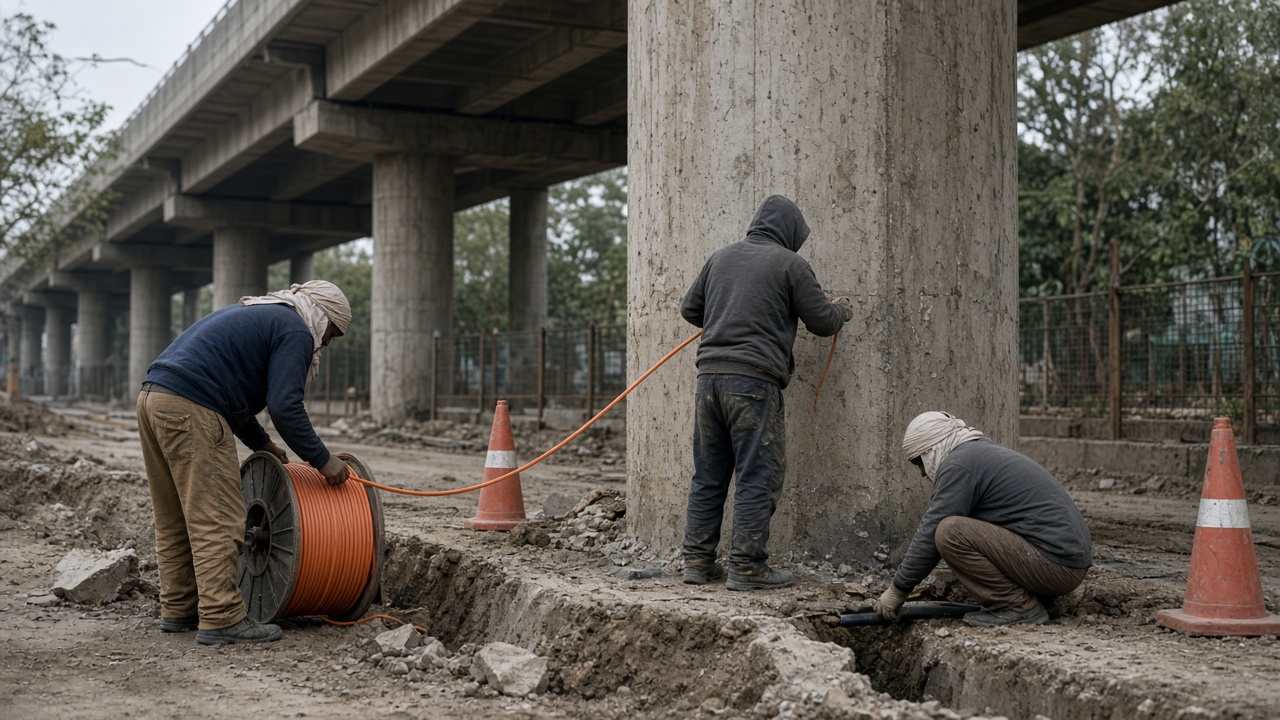
Bharat Sanchar Nigam Ltd. has begun swapping microwave hops for dual-route fibre along Bengaluru Metro’s east–west Purple Line, a backhaul job that ties station Wi-Fi, ticketing VLANs, and operations rooms to the same spine contractors can later extend into Whitefield maintenance yards.
What is being laid
Engineers told BMRCL coordination meetings this month that roughly 37 kilometres of corridor duct—mostly along the elevated viaduct between Baiyappanahalli and Challaghatta—will carry 96-fibre count cable with redundant paths into BSNL’s Peenya and Electronic City exchanges. Splice points sit at every station box so private operators can lease dark fibre without opening fresh trenches along Outer Ring Road.
The work sits inside a broader Ministry of Railways–style utility corridor agreement: metro civil contractors leave capped conduits; BSNL pulls cable during night possession windows when trains are not running acceptance tests. Microwave links that carried CCTV backhaul since 2023 remain as failover until fibre OTDR tests clear.
Why Purple Line first
Purple Line carries the highest passenger load on the network after the Green Line interchange at Majestic, and its elevated alignment avoids the utility-map fights that slowed fibre along underground reaches. Station Wi-Fi usage crossed two terabytes per weekday last quarter, according to slides BMRCL shared with vendors, pushing microwave capacity during cricket nights and festival exits.
BSNL’s Bengaluru unit also needs a showcase: the operator is bidding for smart-city backhaul in Karnataka’s tier-2 municipal tenders and wants a reference route that DoT reviewers can audit without entering private campuses.
Procurement and partners
Cable and closure hardware come from BSNL’s centralised GEM rate contracts; local civil labour is hired through BMRCL’s existing O&M concessionaire. Sterlite and HFCL-class vendors have supplied similar counts on the Chennai Metro spine, and BSNL officials said splice loss targets match those benchmarks—below 0.08 dB per joint on single-mode runs.
Revenue share for dark-fibre leases has not been published, but metro officials said anchor tenants will pay per fibre pair per kilometre, with a floor rate indexed to TRAI’s backhaul consultation paper from 2024.
Operations impact
Until cutover completes in December, some station help desks may see brief Wi-Fi drops during overnight pulls. Operations control rooms will migrate VLAN by VLAN so train signalling circuits—which still ride a separate safety network—never share splice trays with passenger internet.
Maintenance teams gain a single map of pull boxes along the viaduct, reducing the hunt for ad hoc ladder access that delayed CCTV repairs last monsoon.
Policy context
The project aligns with BharatNet’s “fibre along transport corridors” directive, even though Purple Line is urban. DoT officials have urged states to piggyback on metro ducts rather than reopening roads for last-mile gaps. Karnataka’s IT department is watching latency numbers to decide whether government cloud POPs in Whitefield should prefer BSNL’s new path over private carrier rings.
Competition and limits
Airtel and Jio already serve many Bengaluru enterprises on their own rings; they are not blocked from co-laying if they pay duct fees. BSNL’s advantage is incumbency inside government utility maps and the ability to cross-subsidise from USOF mandates. Skeptics note BSNL’s field maintenance backlog in rural exchanges and ask whether night crews can keep splice documentation current when monsoon dust clogs trays.
What riders notice
Passengers may see thicker cable trays along station platforms and occasional taped-off stairwells at night. Download speeds at Challenge Road and Kadugodi should stabilise once traffic shifts off microwave, especially for UPI-heavy commutes. Retailers leasing metro concourse space could get SLA-backed connectivity for POS terminals—a small but real benefit for chai stalls that currently tether to 4G.
Timeline
BSNL targets OTDR sign-off on the Baiyappanahalli–Mahadevapura segment by October, with the western leg following after BMRCL finishes noise-barrier fixes near Kengeri. Full dual-route activation is slated before the state budget session, when officials typically parade infrastructure wins.
If splice losses spike, microwave failover stays live and the public deadline slips—a contingency BMRCL engineers said they would rather disclose than run passenger Wi-Fi on untested spans.