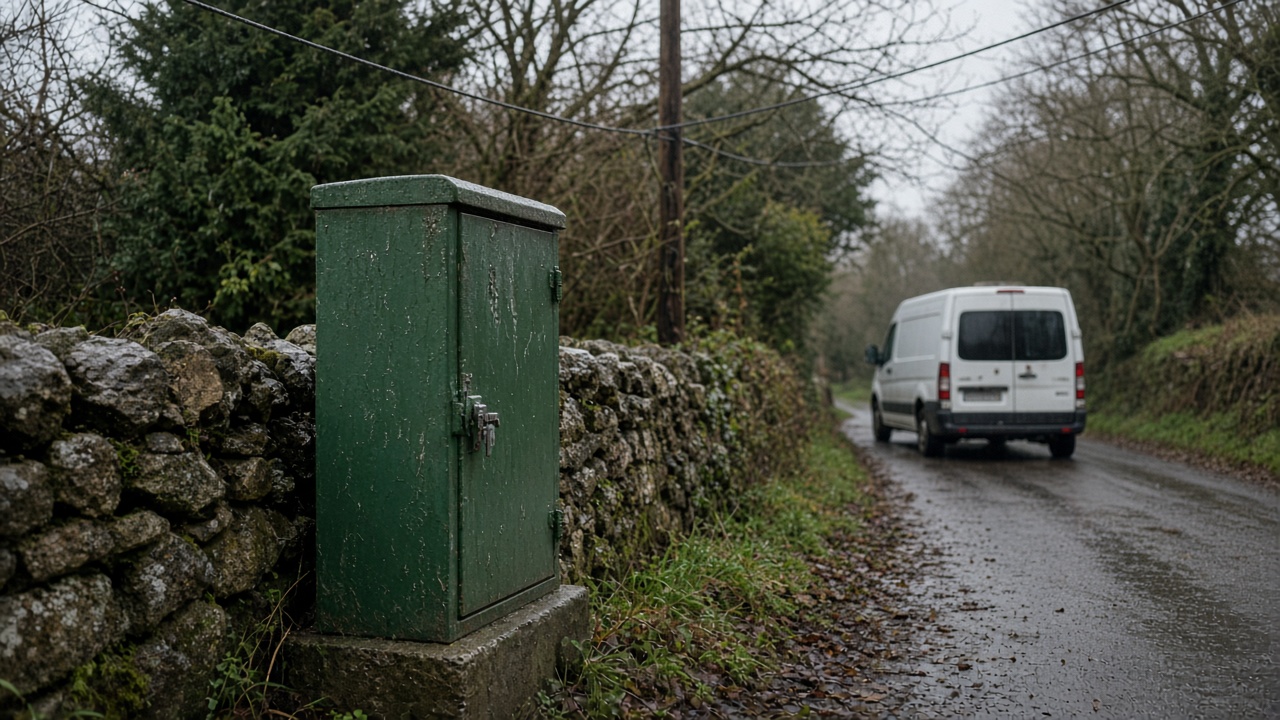
Openreach informed Powys and Ceredigion council broadband leads Friday that it will pause new G.fast cabinet upgrades in six rural exchange footprints from 1 October, shifting field crews toward fibre-to-the-premises builds that can draw Project Gigabit vouchers where premises still depend on copper last legs, according to a supplier liaison note reviewed by InfoHandle. The decision is not a national policy flip—urban G.fast where fibre will not arrive for years can still be ordered—but in these Welsh postcodes Openreach judged that spending on copper-acceleration hardware would duplicate work already mapped for full fibre in 2027–28 delivery windows.
What G.fast was meant to fix
G.fast pushes higher speeds over existing copper pairs from street cabinets, typically landing households between 100 and 300 megabits per second when line quality cooperates. For farms and hamlets beyond cabinet reach, Openreach had been trialling smaller pods on poles. Welsh Government Superfast Cymru statistics show those postcodes already cleared the old 30 Mbps universal service commitment, but upload symmetry and rain-soaked joint faults still push repair trucks weekly.
Council digital officers said the pause affects roughly 14,000 premises that had G.fast on the forward build spreadsheet—not customers live on G.fast today. Anyone already installed keeps service; the change bites on new orders and cabinet refreshes.
Why fibre-only won the argument
Project Gigabit’s Wales intervention map now overlaps three of the six exchanges with subsidised gigabit-capable builds. Openreach’s note said engineering a G.fast pod in the same trench window as fibre splicing wastes capital and confuses take-up marketing—households asked to sign twice in eighteen months churn on installation appointments. Ofcom’s Connected Nations update this month still shows Wales trailing England on full-fibre passings; pausing copper upgrades is a way to protect the fibre curve without admitting the earlier superfast programme overspent on interim tech.
BT Group investors hear the same logic on earnings calls: maintenance on ageing copper pairs rises while revenue per line flatlines. Rural Wales is politically visible—MSs track constituency maps—but the supplier math is national.
What subscribers should expect
If you are on standard FTTC today, nothing changes until fibre planners knock. If you pre-ordered G.fast through a retail ISP, that order should cancel with a written fibre ETA; keep the email for compensation queries under Ofcom’s automatic compensation scheme only if an existing service breaks, not for delayed upgrades. Community voucher schemes through Gigabit Broadband Voucher still require a registered supplier; Openreach listed alternate RSPs in the liaison note but not retail prices.
Local authority role
Powys County Council’s digital inclusion team plans drop-in sessions in Llandrindod Wells and Aberystwyth library to explain the pause—mostly to parish councillors who promised constituents “superfast plus” without reading technology footnotes. Ceredigion will update its public fibre map layers so planning officers see frozen G.fast polygons; that GIS work is mundane but stops estate agents advertising speeds the cabinet will never deliver.
Retail ISP messaging
TalkTalk, Sky, and BT Consumer received the same supplier bulletin; their customer service scripts now steer Welsh rural callers away from G.fast upsell SKUs toward fibre waitlists. That reduces call-centre handle time but risks complaints if marketing emails still mention “ultrafast copper boost.” Ofcom’s voluntary code on contract exit rights may apply if a customer signed for a speed tier that cannot be delivered; lawyers say the pause is a network change, not a price change, so exit fees are contested case by case.
Openreach field managers told contractors to reallocate G.fast pods stockpiled in Merthyr Tydfil warehouse to English exchanges where fibre backhaul is farther out—logistics detail that matters if you track UK broadband industrial policy as inventory, not press releases.
What remains uncertain is winter weather: fibre trenched in waterlogged verges slips schedules even when G.fast is off the table. For rural Wales, the dated fact is operational—no new G.fast from October in six exchange areas, engineers pointed at fibre passes, and about 14,000 premises no longer caught between two upgrade stories.