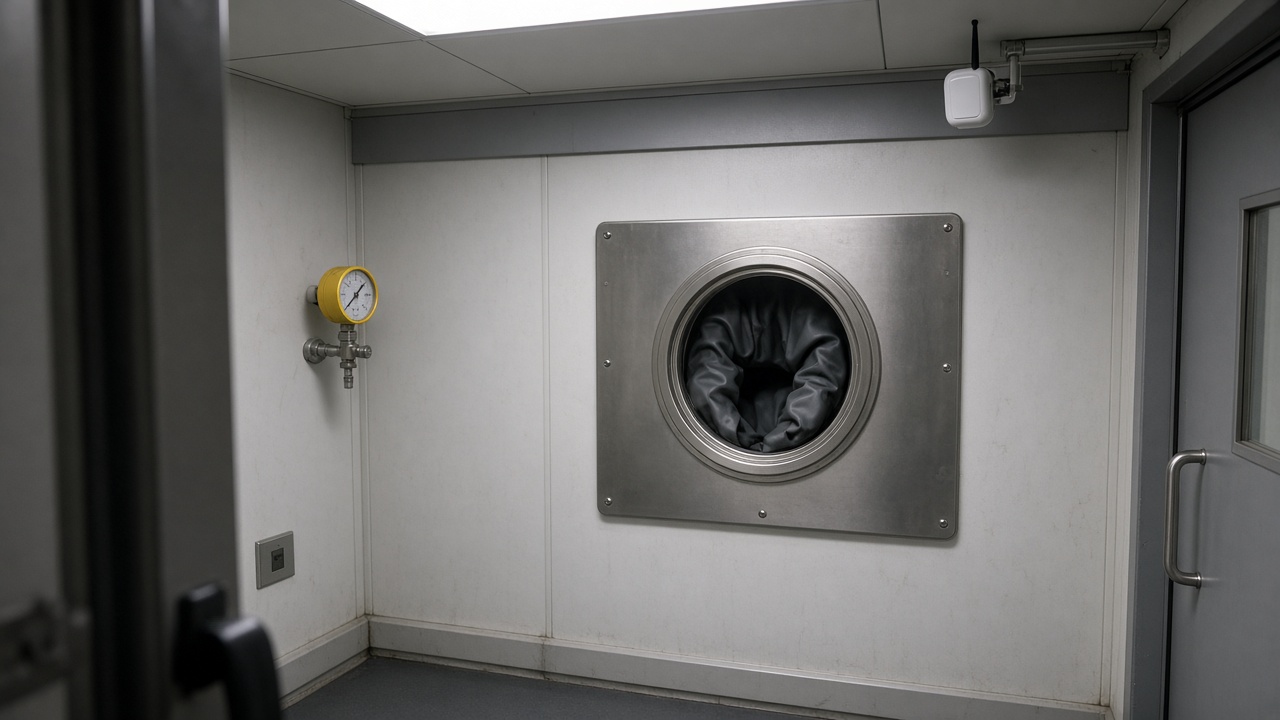
ContainSense, a Cambridge spinout building wireless sensors for negative-pressure lab audits, closed a £4.2 million seed round led by a UK deep-tech fund with participation from Cambridge Enterprise and two angel groups tied to former HSE inspectors, according to filings at Companies House and a term sheet summary InfoHandle reviewed. The company sells clip-on differential-pressure nodes and door-cycle loggers that feed dashboards compliance officers use to prove BSL-2 and BSL-3 rooms stayed within spec—without the manual smoke-pencil walkthroughs that force hour-long shutdowns.
What breaks today
University and contract research labs must document air changes per hour and inward airflow at containment boundaries. Legacy systems hard-wire sensors to building management units that IT teams will not patch; smaller labs still paper logs every shift. When UKHSA or HSE audits fail, remediation can mean closing tissue-culture suites during grant deadlines—a revenue hit ContainSense pitches against hardware subscription fees.
Founders met at Cambridge’s Judge Business School incubator after a 2024 college near-miss where a freezer fault masked a pressure alarm overnight. Their nodes use mesh radios inside the lab VLAN, not consumer Wi-Fi, and store signed readings locally if uplink drops.
Seed terms and ownership
The £4.2 million seed buys roughly 22 percent post-money on a standard SAFE stack, with Cambridge Enterprise taking pro-rata rights on any Series A. Lead investor board seat; founders retain dual CEO/CTO split common in hardware startups. Use of funds: certification testing with a Notified Body, three NHS trust pilots, and hiring two field engineers to install in Oxford and London teaching hospitals already under letter-of-intent.
Regulatory path
ContainSense is not a medical device, but HSE’s biological agents regulations treat continuous monitoring as evidence in incident investigations. UKHSA guidance on high-containment facilities encourages trend data; the startup’s compliance brief maps sensor outputs to audit checklist rows inspectors already use. CE marking for radio equipment cleared in August; intrinsically safe variants for solvent-heavy suites are on the 2027 roadmap.
Competition and risk
Multinational BMS vendors could bundle similar sensors, but retrofit cycles in academia move slowly. If the raise had failed, ContainSense planned to license firmware to integrators—a weaker margin path. Grant dependency is low; Innovate UK awarded a prior £350,000 feasibility grant now complete.
What labs should ask in pilots
Installers need VLAN access and change-control windows; expect night shifts. Dashboard exports must match your electronic lab notebook retention policy. ContainSense does not replace face-fit testing for respirators or autoclave validation—marketing slides that imply one dashboard for all biosafety are wrong.
Cambridge cluster context
The spinout shares incubator space with other wet-lab tooling firms chasing HSE audit budgets; none yet dominate UK universities. ContainSense’s founders licensed background IP from Cambridge’s engineering department under standard revenue-share terms—typical for seed-stage hardware. Angel investors with inspection backgrounds argued that post-COVID biosafety reviews made continuous monitoring politically salable even when day-to-day incident rates are low.
Export controls on dual-use sensors are minimal for pressure nodes, but firmware updates that log pathogen room IDs could trigger review if sold abroad; the company’s data sheet limits cloud regions to UK and EU for now.
Pricing and contracts
Early pilots quote per-room monthly fees below legacy BMS upgrade quotes that require capital works; universities still haggle over who owns sensor data when research collaborations end. ContainSense offers escrow for readings if a lab disputes an HSE audit—niche legal text that nonetheless closed one Oxbridge department deal.
Maintenance contracts include annual sensor swaps because drift in cheap MEMS chips was caught in HSE witness tests; the seed deck budgets spare nodes so labs are not left unmonitored during RMA cycles.
Series A timing hinges on NHS pilot sign-offs by March. For Cambridge’s biosecurity cluster, the dated fact is funding: £4.2 million seed, containment sensors aimed at audit trails without shutting BSL-3 workflows, and pilots queued in teaching hospitals—not a cure for pathogen risk, but a bet that compliance telemetry can be sold like fire monitoring.