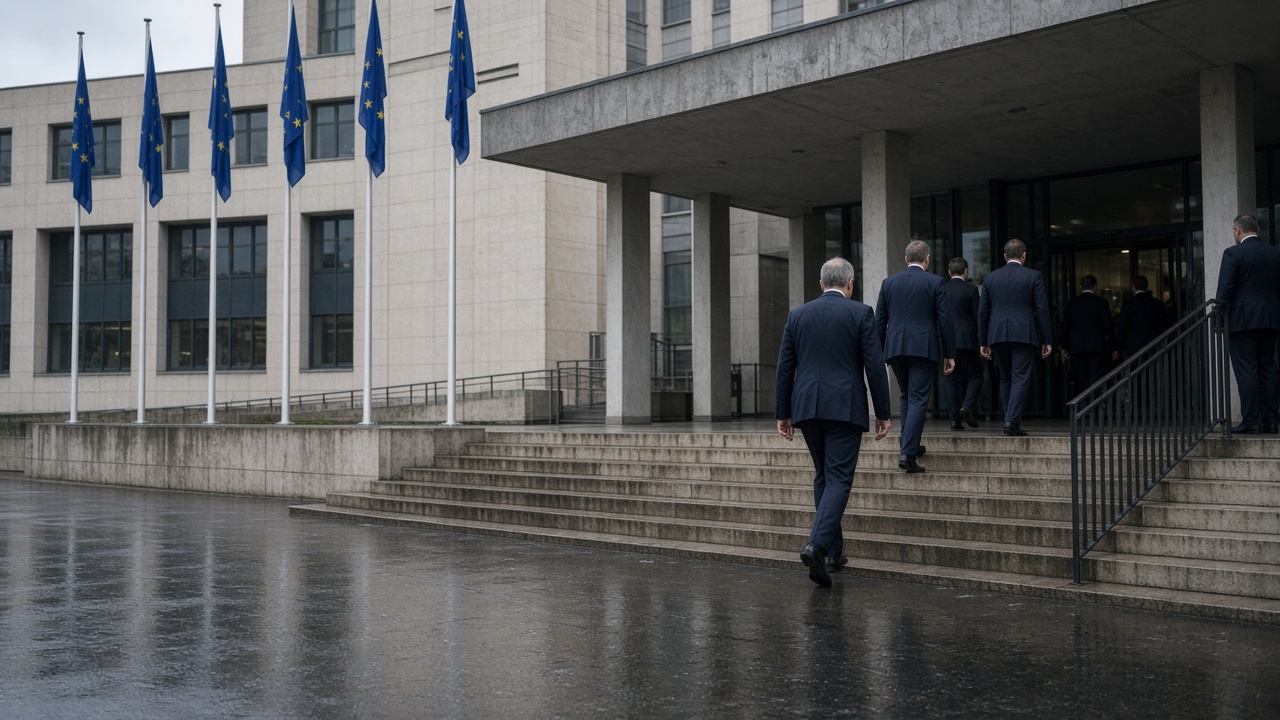
European Union ambassadors failed twice on Monday night to finalize a renewal of personal sanctions on nearly 3,000 Russia-linked individuals and entities, with Latvia withholding the unanimity required to adopt a compromise that would remove billionaires Alisher Usmanov and Mikhail Fridman while extending the rest of the list for 36 months. Talks resumed Tuesday morning in Brussels hours before the measures were due to expire, colliding with a New York calendar dominated by President Volodymyr Zelensky’s bilateral with U.S. President Donald Trump and the opening of the UN General Debate.
The compromise on the table
Ireland, which holds the EU Council presidency, proposed Monday that Usmanov and Fridman be delisted in exchange for a three-year roll-over of asset freezes and travel bans on roughly 3,000 other names, according to diplomats who spoke with the Kyiv Independent and France 24. France, Slovakia and Luxembourg backed the trade, arguing that a longer extension period would reduce the quarterly veto dramas that have paralyzed the bloc’s Russia policy. Sectoral economic sanctions on Moscow are on a separate track and were not part of Monday’s dispute.
Usmanov, an Uzbek-born metals and telecoms investor, was sanctioned in 2022 for close ties to the Kremlin and revenue flows to the Russian state. Fridman, a founder of Alfa Group, was listed for similar reasons. Paris has pressed for Usmanov’s removal for months; Bloomberg reported Tuesday that the stalemate now puts the entire personal sanctions architecture at risk of expiring at midnight Brussels time if no deal emerges.
Latvia’s veto
Latvia was the sole member state still opposing the package late Monday, three national diplomats told the Kyiv Independent. Prime Minister Andris Kulbergs said Tuesday his government could not accept delisting the two oligarchs even to preserve sanctions on everyone else, and Foreign Minister Baiba Braže urged other capitals to explain their positions in an emergency cabinet session. Euronews reported envoys met again Tuesday morning without France or Latvia shifting, with afternoon talks scheduled.
Failure would not automatically erase sectoral restrictions on Russian banks, energy technology and dual-use goods, but it would dissolve the curated blacklist that includes President Vladimir Putin and hundreds of military commanders. Lawyers warn that asset freezes could become legally contested overnight, complicating enforcement cases already before EU courts.
Why timing collides with UNGA
EU foreign-policy chief Kaja Kallas, speaking on the sidelines of the General Assembly, urged member states Monday to keep pressure on Moscow and said officials aimed to close the roll-over “swiftly” with a longer renewal horizon. Her message landed as Zelensky arrived in Manhattan for a Trump Tower meeting focused on energy strikes and air-defense deliveries—issues that depend on sustained European unity on sanctions and export controls.
A lapse in personal listings would not directly block U.S. aid shipments, but it would hand the Kremlin a propaganda win on the same day Trump addresses the General Assembly. Ukrainian negotiators worry Moscow could portray disunity in Brussels as proof that Western coalitions fracture before winter heating season.
Seven-day bridge
The bloc adopted a short-term extension last week to keep existing measures alive only through Tuesday, meaning diplomats are negotiating under a hard midnight deadline for completing legal procedures. Coreper II, the ambassadors’ committee, said talks would resume at 8 a.m. Brussels time Tuesday “with the aim of finalising agreement.”
Alternative paths include delisting only one name, shortening the proposed 36-month window, or offering Latvia side letters on enforcement assistance. None of those options had secured consensus by late morning.
What investors watch
European banks with compliance teams monitoring EU listings prepared contingency notices to clients holding frozen securities tied to sanctioned oligarchs. Hedge funds that had bet on eventual delistings saw spreads widen on Russian-linked debt proxies Tuesday, though primary sanctions on sovereign issuance remain untouched.
For the politics desk, the through-line is procedural: unanimity, a French push to spare two billionaires, a Baltic holdout, and a clock that runs out as Zelensky sits down with Trump. The sanctions fight is in Brussels, but the audience is the same UN week trying to broker energy quiet on the battlefield.