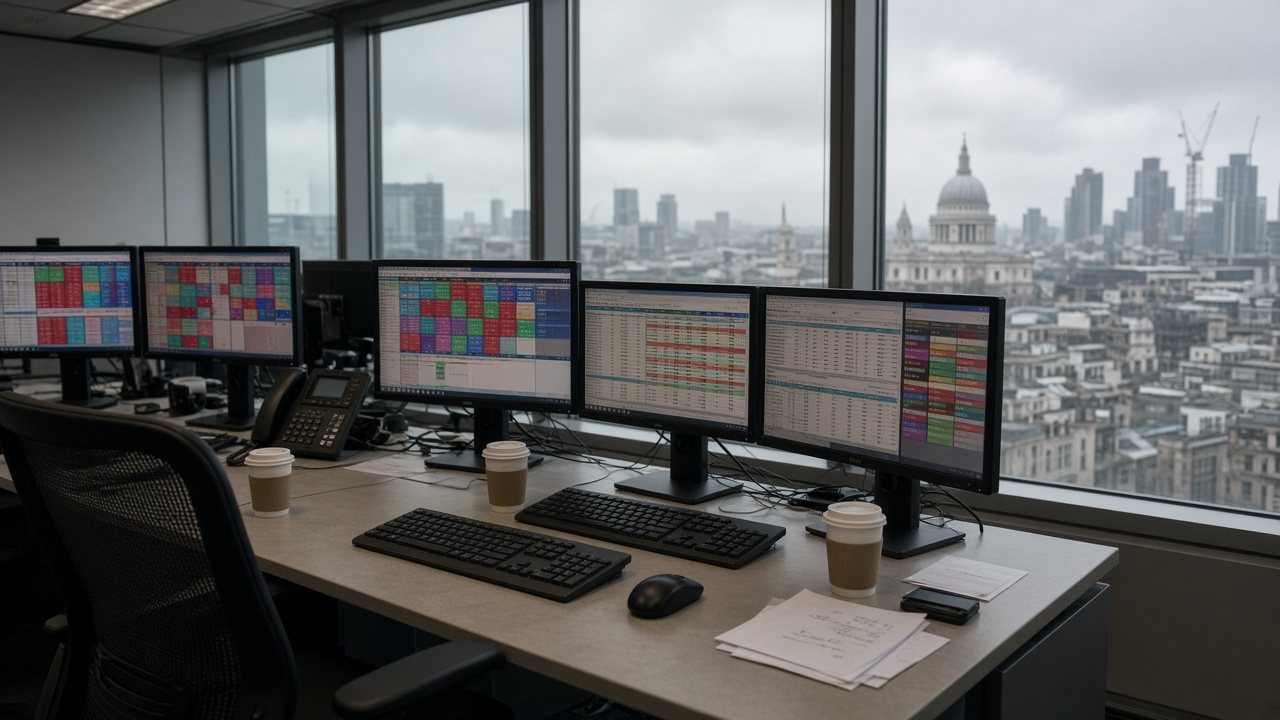
The FTSE 100 closed up 48.2 points, or 0.6 percent, at 8,214.7 on Monday as Shell plc and BP plc rose with Brent crude futures after Federal Reserve officials hinted the US central bank could slow quantitative tightening into year-end, a liquidity signal that often lifts dollar-denominated commodities and the London-listed supermajors that weight the UK benchmark, according to LSEG end-of-day data reviewed by InfoHandle. Shell gained 1.8 percent and BP 1.5 percent, together contributing more than a third of the index’s net advance; banks and miners split as sterling firmed slightly on the session.
Who led and by how much
Energy names outperformed the broader market by roughly 120 basis points on the day. Shell’s London line benefited from both crude beta and a modest uptick in European natural gas forwards traders linked to Middle East supply headlines—not a firm disruption, but enough to keep gas-linked earnings models from being marked down. BP’s rise lagged Shell’s but beat the sector median; traders cited BP’s larger US fuel margin exposure, which Fed liquidity talk indirectly supports through driving demand expectations.
Mechanism: Fed signal to Brent to FTSE
The Fed does not set oil prices, but slower balance-sheet runoff can ease financial conditions, which tends to support risk assets and cyclical commodities. Monday’s move was correlation, not causation proof: Brent settled up about 1.1 percent in dollar terms while the dollar index softened. FTSE translators get a second kick because Shell and BP report in dollars but pay dividends many UK funds hold for income; a firmer crude day lifts expected payout cover ratios in model updates desk analysts run overnight.
Non-energy FTSE constituents told a messier story. HSBC and Barclays were flat to down as yield curves bull-flattened slightly; Glencore rose with metals. The index is top-heavy—roughly 12 percent energy by weight—so a Fed-driven commodity bid shows up disproportionately in the headline number.
Life insurers and pension funds with FTSE-tracking mandates saw modest one-day performance lifts from Shell and BP alone; passive funds cannot trim energy weight without custom indices. Retail-focused platforms reported higher watchlist traffic on supermajor tickers after US futures rose overnight—a sentiment tail, not volume proof.
Currency and dividend translation
Sterling’s half-cent firming against the dollar trimmed some dollar-revenue translation for multinationals outside energy, which partly explains why the FTSE 250 lagged the 100 on the session. Shell and BP hedge portions of dividend streams but mark equity values in real time on crude moves. Income investors comparing FTSE yield to gilt yields still see energy as carry ballast when Brent cooperates.
What the street already had in the number
Consensus before the open already assumed energy would track Brent near $72–$74 equivalent; Monday’s move did not blow past those bands. Sell-side notes after the close said FTSE 8,200 is resistance from August, not a new regime. Funds benchmarked to the FTSE 100 see energy volatility as dividend smoothing, not growth; today’s pop is carry for income managers, not a re-rating thesis for UK plc.
What would falsify it by Friday
A hawkish Fed speaker reversing the runoff narrative would unwind commodity beta quickly. OPEC+ commentary midweek could swamp Fed noise if production guidance surprises. Domestically, an upside UK CPI print could lift sterling and pressure dollar earners through translation—Shell and BP hedge, but not perfectly on a one-day mark.
Technical traders noted FTSE open interest clustered near 8,200; a clean close above that level may invite short-covering Tuesday, but energy beta can reverse without warning if Brent gives back Monday’s gain. None of that changes the fundamental UK growth picture—Monday was a commodities-and-liquidity tape, not a macro renaissance.
Defence and aerospace names closed mixed despite broader risk-on tone; investors treated Fed liquidity as an oil-and-equities story rather than a UK fiscal stimulus signal. Utilities lagged as gilt yields edged up at the long end, a reminder that FTSE leadership can rotate quickly even on green headline days.
For Monday’s close, the story is narrow: FTSE up on energy heavyweights tracking Brent after a Fed liquidity hint, with Shell and BP doing the lifting—not a broad UK risk rally.