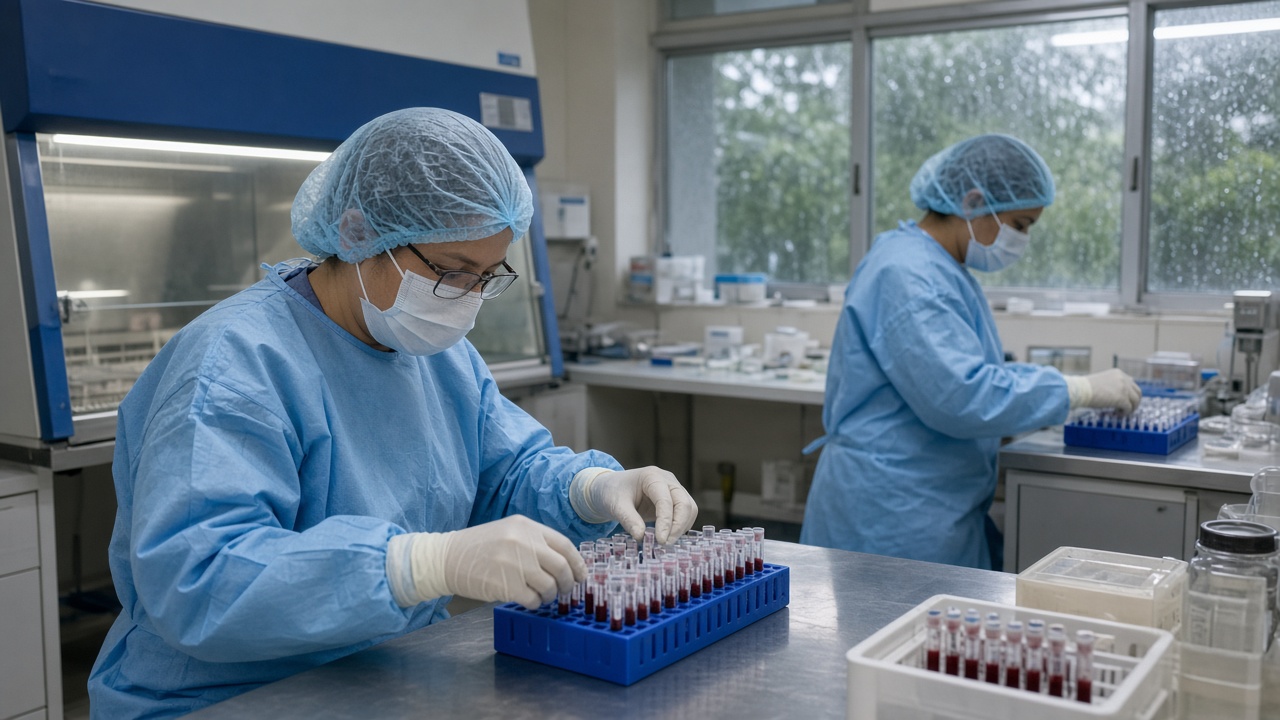
The Indian Council of Medical Research approved six additional Viral Research and Diagnostic Laboratory (VRDL) nodes for Kerala on Monday, routing samples from district hospitals that reported a post-monsoon jump in dengue admissions through ICMR-National Institute of Malaria Research protocols. State health officials said confirmed cases in the week ending Sept 20 reached roughly 4,800 statewide—about 38 percent above the same window in 2025—though they cautioned that wider lab access can inflate counts by catching milder infections earlier.
What ICMR actually added
Under a standing call for VRDL expansion in medical colleges, ICMR listed new capacity at Kozhikode, Thrissur, Kottayam, Palakkad, Kannur and Wayanad, each expected to run NS1 antigen and RT-PCR panels with same-day or next-morning reporting once staff complete a two-week calibration at the regional hub in Alappuzha. The council’s public dashboard already tracks 163 VRDL sites nationally; Kerala will move from nine to fifteen ICMR-linked nodes, not counting private chains.
Director General Dr. Rajiv Bahl’s office said the surge allocation is tied to serotype surveillance, not just case counts. Kerala’s last major DENV-2–heavy season strained ICU beds in 2023; this year’s early samples show mixed DENV-1 and DENV-3, which matters for clinicians watching for severe plasma leakage in repeat infections.
Absolute risk in the waiting room
For patients, the practical change is faster typing when fever crosses day three. Without serotype data, doctors often treat empirically; with it, high-risk groups—pregnant women, the elderly, those with uncontrolled diabetes—can be flagged for closer platelet and hydration monitoring. ICMR does not claim the expansion prevents outbreaks; it shortens the lag between a positive rapid test and a typed result that guides referral.
State response and limits
Kerala Health Minister Veena George told the assembly that fogging and source-reduction teams were redeployed to coastal wards where Aedes breeding spiked after intermittent rains. Municipal workers cleared 12,000 household containers in Thiruvananthapuram corporation limits alone last week. Officials nonetheless admitted that private hospitals in Kochi still send some samples to Bengaluru when local VRDL benches are full—a bottleneck ICMR hopes the new nodes will ease by October.
What to watch next
ICMR will publish a fortnightly serotype bulletin for Kerala starting Oct 1. If DENV-2 share rises above 40 percent, the state may reopen dedicated dengue wards shuttered after the 2024 dip. For now, the story is infrastructure: more typed viruses, clearer denominators, and fewer families waiting three days to learn whether a fever is “dengue” in the abstract or a specific strain with known severe patterns.