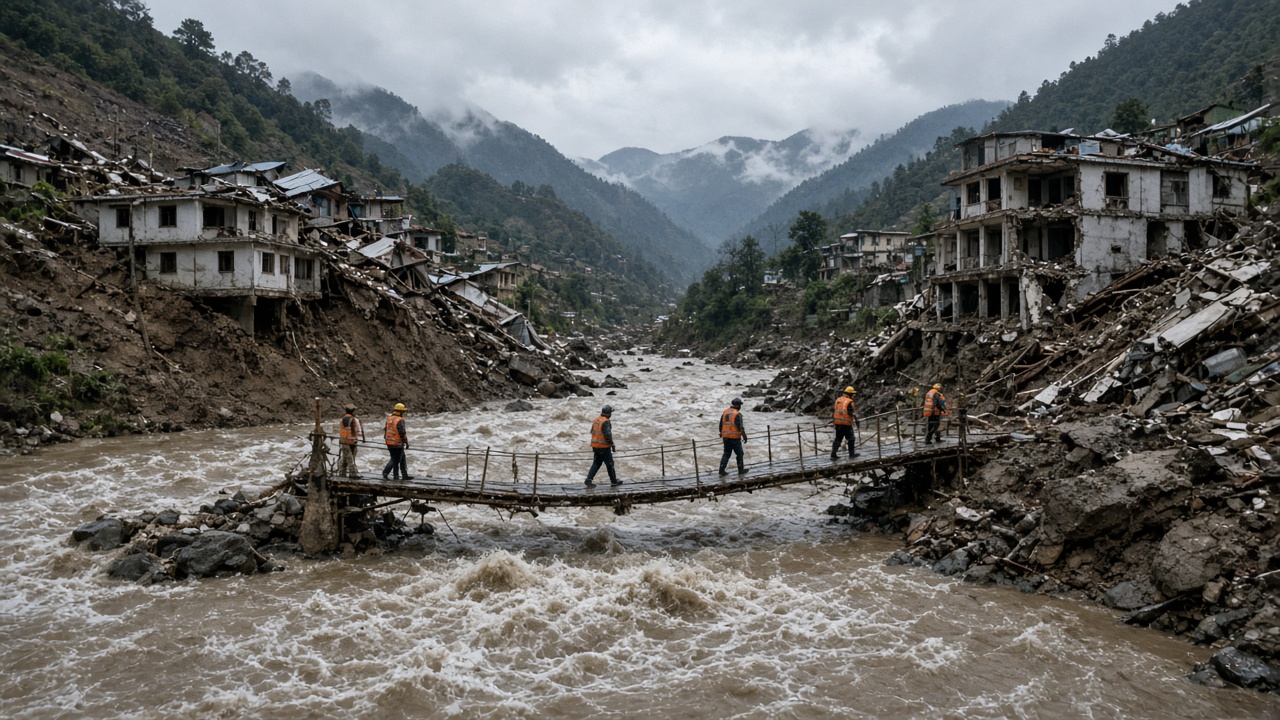
Nepal’s disaster-management agencies said Tuesday that 1,451 bodies have been recovered since catastrophic flash floods surged down the Bhotekoshi river system on August 26, with search teams still hunting for 4,718 people listed as missing across multiple districts. The toll, updated through mid-afternoon local time, makes the event one of the deadliest hydrological disasters in South Asia’s recent history and has strained Kathmandu’s forensic capacity weeks after the initial surge.
Recovery across eight districts
Police figures published by Nepali outlets show bodies recovered in Rasuwa, Nuwakot, Dhading, Chitwan, Gorkha, Tanahun, and both Nawalparasi districts, with two additional deaths recorded among patients evacuated to Kathmandu hospitals. Of the recovered dead, authorities said 1,333 bodies have been managed after DNA sampling and identification procedures, while details on 1,424 unidentified victims have been uploaded to a Nepal Police portal so families can search records.
Khabarhub reported that 3,345 DNA samples have been collected, including 1,329 from the deceased and 2,016 from relatives. Rising Nepal Daily said forensic teams are using government laboratories supplemented by technical assistance from India, South Korea, Singapore, and China as families wait for definitive matches.
Search teams and shelters
About 7,975 police personnel remain deployed for rescue, relief distribution, and body management, according to Tuesday’s update. Holding centres in several districts were sheltering 1,347 people who could not return to damaged settlements along the river corridor, which cuts from the Tibet border toward the Terai plains.
Helicopter sorties have continued in steep terrain where road access was washed away. Nepal’s National Disaster Risk Reduction and Management Authority previously said more than 13,000 people had been rescued, but the missing-persons ledger underscores how much of the disaster’s scale is still unaccounted for.
Climate attribution and cross-border context
A World Weather Attribution study released Tuesday said atmospheric warming driven by fossil-fuel burning played a key role in triggering and intensifying the Nepal–Tibet flash floods that killed more than 1,400 people. Scientists cautioned that glacial lake outbursts and extreme rainfall events are becoming more likely as Himalayan ice retreats, raising the stakes for early-warning systems that must cover remote construction camps as well as villages.
On the Chinese side of the border, official Tibet region figures have remained far lower, with state media reporting 16 confirmed dead and hundreds missing—a discrepancy that has complicated cross-border relief coordination and drawn scrutiny from humanitarian groups monitoring information controls.
What comes next
Prime Minister Sushila Karki’s government faces pressure to publish clearer lists of who received evacuation notices and which hydropower tunnel sites still hold unrecovered workers. Donor governments have pledged helicopters and forensic kits, but identifications will pace burials for weeks.
For the wire, the new fact is the count crossing 1,450 recovered bodies with more than 4,700 still missing—a disaster that began in August but whose accounting is still moving daily as monsoon runoff and forensic science intersect on the Bhotekoshi.