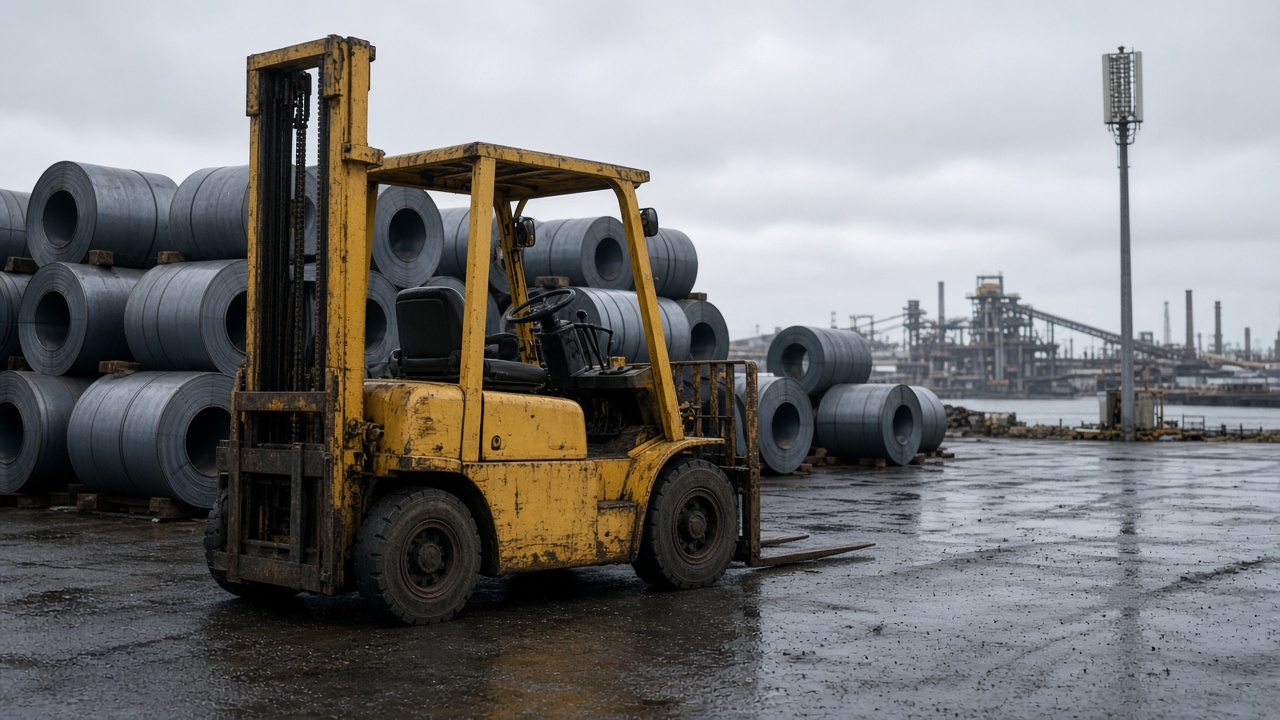
POSCO DX, the systems arm formerly marketed as POSCO ICT, has begun a roaming test on its Pohang steelworks private 5G network so forklift fleets can keep one continuous session as drivers move between outdoor slab yards and indoor coil storage. The trial, described to plant safety teams last week, targets a failure mode that showed up in audit logs this summer: telemetry and collision-avoidance feeds dropping whenever handsets fell back to public LTE at the yard perimeter.
Why forklifts were losing the link
Pohang already carries a POSCO-operated Ieum 5G footprint across major process lines, following the nationwide private-network registry that lists the plant as live since August 2024. Forklift tablets and rear-facing cameras, however, were provisioned like visitor handsets. Each time a unit crossed the mesh edge toward the No. 2 coil warehouse, sessions reattached to commercial carriers where latency spiked above the 80-millisecond threshold set for proximity alerts.
Maintenance leads counted 140 forced reconnects across twelve night shifts in July, enough to pause autonomous speed caps while drivers rebooted apps. None of the incidents caused a reported collision, but the logs triggered a review under the mill's digital twin program, which feeds crane and vehicle positions into a control room wall.
What roaming means on a private core
Roaming here is not consumer tower hopping. POSCO DX engineers stitched the outdoor 4.7-gigahertz sector with an indoor distributed antenna string so the same subscriber identity stays anchored on the on-prem core. SIM profiles issued to forklifts now carry a priority slice for telemetry, while voice push-to-talk stays on a separate quality-of-service class.
The vendor stack remains Samsung radio access, consistent with the company's Gwangyang deployment that linked autonomous locomotives to rail control in 2023. Pohang differs in topology: shorter moves, more steel clutter, and salt air corrosion on antenna mounts along the quay-side yard.
Pilot scope and metrics
Eighteen electric forklifts in the hot-rolled coil loop are in scope for the six-week pilot that started Sept. 8. Success criteria are blunt: fewer than two session drops per shift, sub-50-millisecond round trip for lidar-backed proximity warnings, and uninterrupted upload of 1080p rear camera buffers during handoff.
POSCO DX declined to publish throughput numbers ahead of the mid-October readout, but planners said they would share shift-level drop counts with the Ministry of Employment and Labor's smart-factory safety forum if the pilot clears internal targets.
Link to wider smart-mill investments
The forklift test sits beside longer-running work on digital twins and remote crane monitoring that POSCO DX outlined when it received Ieum 5G spectrum for Gwangyang. Pohang managers want the same playbook—high-definition video and robot patrols—but on tighter aisles where Wi-Fi mesh proved unreliable near molten-slag heat shields.
Private 5G regulators at the Ministry of Science and ICT have encouraged steelmakers to self-operate cores so production data never transits public internet backhaul. POSCO DX holds a dedicated telecommunications business registration, one of roughly a dozen enterprise operators on the national private-5G roster.
Competing approaches in Korean plants
Other heavy industry sites mix carrier-managed private networks with public 5G slicing. Hyundai's Ulsan campuses and Samsung's device fabs run their own cores with similar roaming headaches between outdoor logistics and clean rooms. POSCO's twist is treating forklifts as first-class industrial endpoints rather than repurposed phones.
Union safety stewards at Pohang asked for a kill-switch that reverts to manual horn signals if telemetry fails twice in ten minutes. Engineers agreed to wire that rule into the fleet management layer regardless of pilot outcome.
Security and vendor lock-in questions
Because the core is on-premise, encryption keys for camera streams never leave the mill firewall during normal operation. IT auditors still want a documented path for firmware updates on Samsung radios without taking the coil loop offline—a maintenance window is scheduled for the Chuseok holiday lull.
Smaller steel service centers watch POSCO's capex closely. If roaming templates ship as a software kit, mid-tier processors could license the same handoff profiles without building a nationwide operator team.
What happens after the pilot
If metrics hold, POSCO DX plans to extend profiles to reach stackers serving the plate mill and to test whether augmented-reality maintenance glasses can share the same slice. Failure would push the yard back to Wi-Fi 6 with localized edge caches, a fallback planners call acceptable but slower for video analytics.
For now, night-shift drivers report fewer blank screens when entering the warehouse ramp—a small UX gain that safety officers say matters when pedestrians share the same aisles as twelve-ton loads.