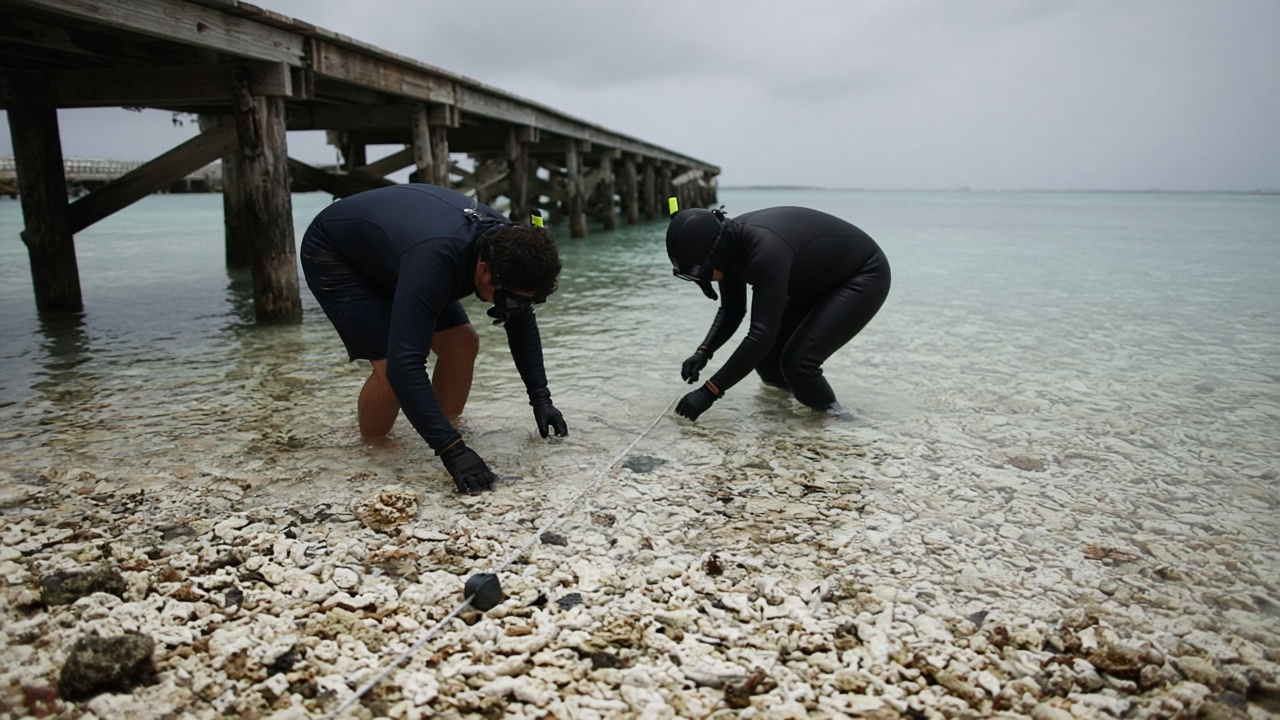
Academia Sinica biodiversity researchers on Monday published an updated Dongsha Atoll coral bleaching survey after September marine heat anomalies, documenting partial mortality on lagoon patch reefs while pairing diver photo transects with Central Weather Administration buoy feeds reviewed by InfoHandle. The release does not declare reef-wide collapse—it quantifies bleaching extent on sampled lines and lists what satellite and buoy layers still miss.
What was measured
Teams resurveyed fixed transects on lagoon patch reefs and outer rim sites last visited in July, scoring bleaching and partial mortality under standardized photo quadrats. CWA buoys recorded multi-day sea-surface temperature anomalies above the administration's marine heatwave threshold at one-meter depth; researchers matched anomaly windows to diver visit dates. Salinity and turbidity notes accompany temperature plots because freshwater lenses after squalls can mimic stress unrelated to heat alone.
Effect size and limits
Preliminary totals show bleaching on a majority of quadrats along two lagoon lines, with partial mortality concentrated on branching genera—not uniform across the atoll. Outer rim transects exhibited lower bleaching fractions in this pass, but sample effort was reduced when swells exceeded safe diving limits. Kuan-Yu Yang's desk emphasizes the gap: pier-adjacent sensors and open-water buoys under-sample shallow microhabitats tens of meters from moorings.
What authors do not claim
The update does not attribute mortality to a single climate driver, predict fishery closures, or extrapolate to reefs without transect coverage. Ocean Affairs Council management rules still govern diving and anchoring; survey results do not automatically trigger restrictions.
What happens next
Collaborators at the National Museum of Marine Science and Technology will cross-validate photo scores with bleaching probability models through December. If anomaly persistence exceeds six weeks on buoy feeds, OAC may brief cabinet on expanded no-anchor buffers—contingent on patrol capacity, not algorithm output alone.
Dongsha science is incremental observation with explicit uncertainty: useful for agencies coordinating heat-stress response, not a headline claiming reefs are "saved" or "lost." The honest read is tighter ground truth where Taiwan maintains a staffed station—with published error bars when biofouling or typhoon gaps interrupt feeds.
Methods transparency
Academia Sinica uploaded transect metadata and quality flags when turbidity exceeded camera thresholds, avoiding smoothed dashboards that hide bad dives. Comparison with July scores uses the same random-point protocol so bleaching deltas are not artifacts of repositioned tapes.
CWA engineers documented post-typhoon recalibration windows; anomaly plots mark those gaps rather than interpolating—a choice researchers requested after prior seasons misread fouling spikes as heatwaves.
Regional context
Other Pacific administrations run parallel heatwave buoy programs; Taiwan's contribution is continuity beside a research pier where diver photos can ground-truth models. Interoperable JSON exports help regional climate centers test whether anomalies align across the South China Sea, but cross-basin comparison is research infrastructure—not a fishing quota.
Patrol teams will schedule boat visits when buoy persistence flags align with diver availability, conserving fuel versus fixed-calendar surveys that miss heat peaks—a logistics detail that matters as fuel costs rise for remote atoll runs.