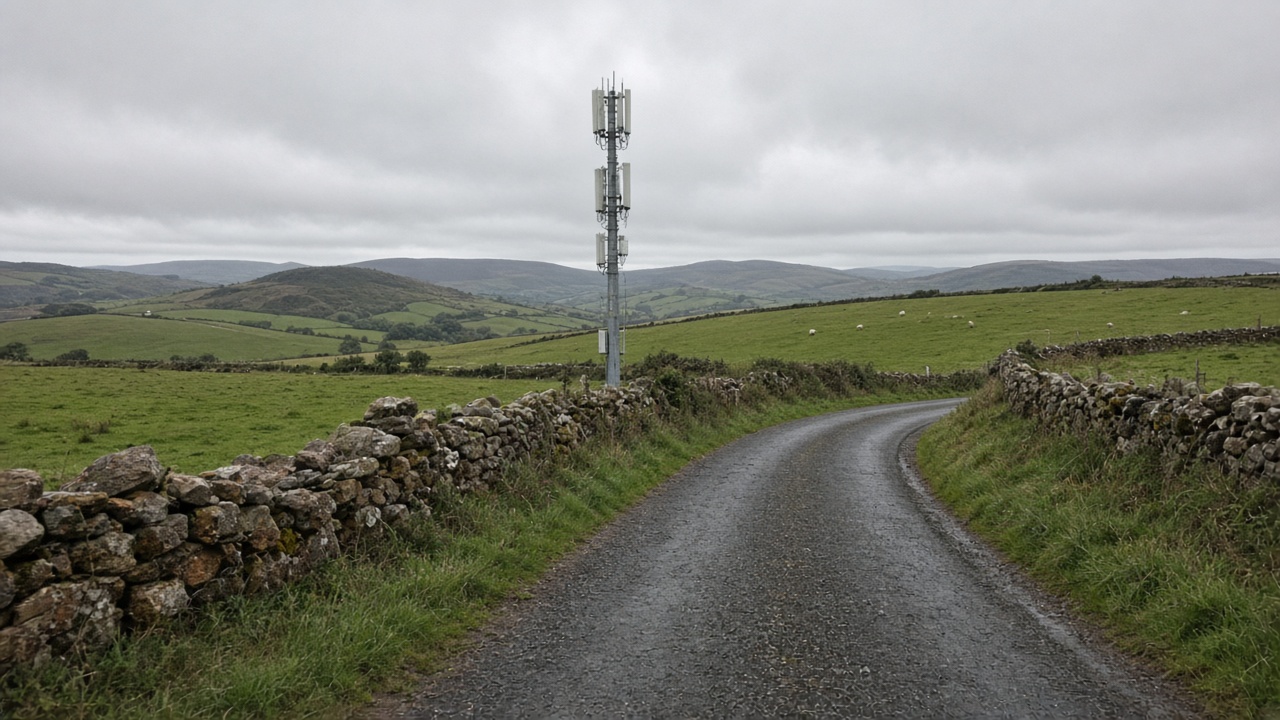
Ofcom set a consultation timetable Tuesday for a rural 5G coverage auction after a Devon and Cornwall shared-infrastructure pilot showed two mobile networks could co-locate radios on the same mast without breaching competition safeguards in postcodes where a single operator build would never pay back, according to a policy note and pilot close-out report reviewed by InfoHandle. The regulator’s draft calendar would open applications in January 2027 for low-band and mid-band packages tied to geographic lots spanning moorland, coastal cliffs and market towns that still show patchy outdoor 5G in Ofcom’s latest Connected Nations tables.
What the pilot tested
From March through August, EE and Vodafone shared three greenfield sites near Bodmin, Okehampton and Launceston under a time-limited waiver. Each site carried both operators’ 5G sectors from one lattice mast with separate backhaul fibres into Openreach exchange points. Field teams logged signal surveys at 214 drive-route checkpoints; indoor premises were out of scope because the auction lots target outdoor not-spots along tourist corridors and farm access roads.
Competition economists on Ofcom’s advisory panel watched whether shared builds let rivals undercut retail prices by avoiding duplicate rental fees. Early data suggested wholesale access terms—not retail tariffs—moved, which is what regulators wanted before baking co-location into auction rules.
Auction design on the table
The draft timetable proposes four Cornwall lots and six Devon lots where winners must reach 90 percent outdoor 5G availability within thirty-six months or forfeit spectrum instalments. Bidders could partner on masts but must file separate coverage attestations; Ofcom would publish quarterly drive-test summaries rather than rely on operator self-reporting alone.
Low-band 700 MHz extensions are bundled with 3.5 GHz rural caps so winners cannot hoard capacity in Exeter and Plymouth while ignoring hinterland lanes. DSIT officials said the design aligns with Shared Rural Network obligations already funded by industry levies, but the auction adds competitive pressure where SRN masts have not yet been switched on.
Local planning friction
Cornwall Council planners reported twelve parish councils asked for mast height limits below the 25-metre templates operators prefer on rolling terrain. The pilot used 18-metre monopoles with camouflage panels on one Bodmin approach road; appeal timelines still ran eight weeks despite permitted-development tweaks for rural connectivity. National park officers in Dartmoor fringe zones want seasonal tourism overlays so construction does not clash with peak hiking months.
Farmers on shared tracks demanded wayleave payments beyond standard telecom rates; the pilot’s legal team said auction winners inherit those negotiations, not Ofcom. Electricity Western Power Distribution flagged three sites where grid upgrades lag mast energisation—coverage maps mean little if breakers cannot feed active antennas.
Retail and handset reality
Consumer groups noted many rural handsets still drop to LTE indoors even when outdoor 5G passes drive tests. Ofcom’s consultation asks whether auction credits should include indoor small-cell rights in village halls and GP surgeries; operators argued that would explode cost models. Charity Good Things Foundation said library Wi-Fi remains the practical fallback for households that cannot afford 5G plans even if masts go live.
What happens before January
Stakeholders have until late November to comment on lot boundaries drawn from pilot heat maps. Ofcom will run a second technical workshop with Openreach on backhaul diversity—single-fibre routes into Bodmin exchange became a talking point after a contractor cut a duct in July. HM Treasury sign-off is required before reservation prices are published; officials would not confirm figures Tuesday.
Competing operators Three and O2 told investors they may bid jointly on backhaul but not on spectrum lots, a structure Ofcom has not ruled in or out. Rural MPs from Devon and Cornwall welcomed the timetable but pressed for interim LTE fill-ins on roads still below the universal service obligation upload targets.
Industry economics
Mobile network executives model rural 5G as insurance against fixed-wireless substitution on farm broadband vouchers, not as a standalone profit centre. Shared masts cut rental and security costs roughly a third in the pilot accounts, but maintenance callouts rose when two vendors blamed each other for power alarms. Ofcom’s close-out report recommends a single on-site neutral host technician funded by both tenants—a detail bidders will price into lot strategies.
For Devon and Cornwall residents, the dated facts are regulatory: a published auction calendar, pilot evidence that co-location can work, and lot maps tied to 214 measured checkpoints—not yet new bars on phones, but a clearer path than ad hoc mast disputes in every parish.