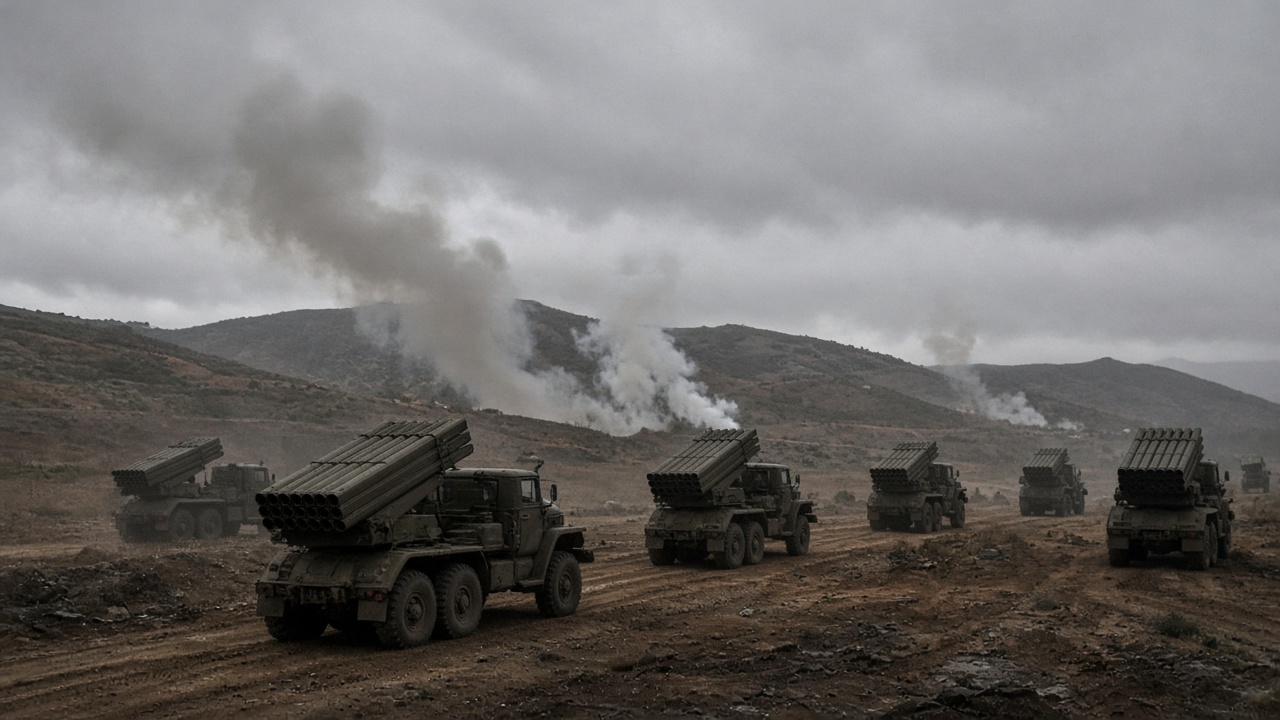
North Korea said Thursday it successfully test-fired shells for an upgraded 240mm multiple rocket launcher system, claiming new range and guidance modes that could place more South Korean population centers under artillery-style saturation fire without resorting to strategic missiles that trigger sharper U.S. responses.
What KCNA reported
Yonhap News Agency, citing the Korean Central News Agency, said the Tuesday test occurred under Pyongyang’s five-year plan to modernize artillery and missile forces. State media photos showed launcher tubes elevated on a wheeled platform and impacts on a hillside range, though outside analysts cannot independently verify the guidance package from imagery alone.
KCNA said the rockets can strike targets roughly 100 kilometers away in trajectory flight and up to 115 kilometers in a combined glide mode when equipped with what it called an “autonomous pinpoint guide system.” Pak Jong Chon, vice chairman of the ruling Workers’ Party Central Military Commission, attended the test and urged commanders to concentrate “the deadliest and destructive attack forces on the southern border,” language Seoul reads as aimed at frontline garrisons and logistics hubs rather than symbolic launches.
Artillery politics after the “two states” line
Since Kim Jong Un declared inter-Korean relations those of “two states hostile to each other” in 2023, North Korea has emphasized conventional systems that can harass the South without crossing thresholds that invite U.S. bomber patrols. Upgrading 240mm rockets—already a staple of DPRK fires drills—lets Pyongyang advertise technological progress to domestic audiences while keeping export-controlled components out of the headlines that follow long-range missile tests.
South Korea’s Joint Chiefs of Staff typically confirm launches within hours when sensors pick up firings, and the presidential office in Seoul coordinates statements with U.S. Forces Korea when trajectories approach the maritime border. Thursday’s KCNA release arrived after business hours in Seoul, a timing pattern North Korea has used to dominate morning broadcasts without giving Blue House aides a same-day rebuttal window.
Alliance readouts expected Friday
U.S. and South Korean officials meeting on UN General Assembly sidelines this week have focused on extended deterrence and semiconductor supply chains, not artillery duels, but any guidance upgrade that compresses time-on-target for border units feeds into ongoing debates about counter-battery radars and preemptive strike doctrines in the National Assembly.
Japanese officials watch 240mm developments too because Okinawa-based assets would support a contingency, even though Thursday’s test was land-based and directed south.
What the test changes tactically
For the security desk in Seoul, the new fact is materiel, not diplomacy: Pyongyang claims a guided 240mm shell with materially longer glide range than prior generations, paired with explicit orders to stack fires along the Military Demarcation Line. That does not by itself alter armistice mechanics, but it gives defense planners another data point as they budget for interceptor drones and hardened ammunition depots north of the capital region.
Until open-source trackers spot deployment exercises outside the test range, the announcement remains a messaging volley—but on the Korean peninsula, artillery upgrades are never treated as laboratory curiosities alone.