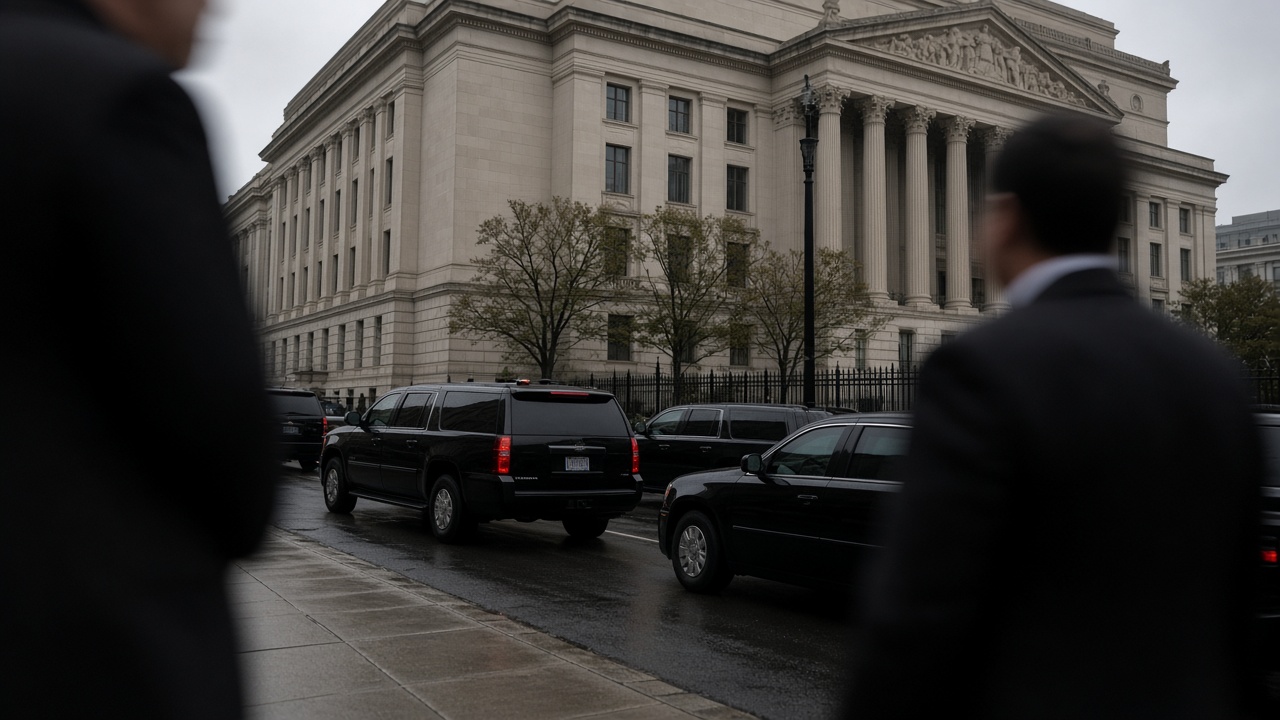
President Donald Trump walked Xi Jinping through the National Archives on Friday morning, showing the Chinese president the Declaration of Independence, the Constitution and the Bill of Rights before Xi's motorcade left for Andrews Air Force Base. The tour closed a three-day state visit that produced no new trade or artificial-intelligence agreement on paper and left one dated deliverable: a two-month extension of the tariff truce that Washington and Beijing had already announced before Xi's plane landed.
The only date that moved
Treasury Secretary Scott Bessent told reporters on the eve of the visit that the two sides would hold their tariff pause in place for two more months. The truce was struck by Trump and Xi in Busan last October, cut tariffs and lifted Chinese export controls on rare earths and permanent magnets; it had been due to lapse on Nov. 10.
The short runway pushes the hard bargaining onto two summits: the Asia-Pacific leaders' meeting in Shenzhen in November and the G20 in Miami in December. No joint communique, purchase commitments or new sectoral tariff relief were announced at the White House.
Pomp, and no paper
Thursday night ran on ceremony. Apple's Tim Cook, Nvidia's Jensen Huang, OpenAI's Sam Altman, Amazon's Jeff Bezos and JPMorgan's Jamie Dimon were among the East Room guests; no Chinese business leaders attended. Trump gave Xi a bald eagle sculpture. Xi called the moment a "historic juncture" and said both countries must act as "responsible major countries"; Trump said they had "never gotten along better" despite "different systems."
The readouts diverged on artificial intelligence. Trump posted that both leaders wanted to leave AI regulation where it stands; the White House said they agreed on a hotline for AI risks and emergencies. Xi's account put guardrails at the center:
"Human control over AI technology must be maintained."
— Xi Jinping, Chinese government readout of the bilateral meeting, Sept. 24, 2026
Taiwan stayed mostly off the podium. Chinese state media reported that Xi urged Trump behind closed doors to oppose independence for the island; Taiwan's government rejected that readout, and a $14 billion arms package approved by Congress remains paused on Trump's desk.
Who controls the trade calendar
The extension changed a deadline, not a statute. The pause rests on executive-branch tariff actions and administrative export-control decisions, so nothing in the rollforward requires a floor vote or rewrites the tariff schedule Congress has delegated to the president. What members control is the money around it: the frozen Taiwan package originated in Congress, export-credit and procurement programs run through appropriations, and farm-state and China-hawk Republicans both want purchase commitments written down.
The political clock is the other half of this calendar. Republicans defend narrow majorities in November, with a nearly seven-month war in Iran pushing up gasoline prices and Trump's approval ratings under pressure. The two-month runway lets both capitals clear the midterms without a tariff cliff at home and defers the purchase-commitment fight to the fall summit schedule.
For exporters, the concrete change is the shape of the cliff. Growers who depend on Chinese buying, and auto and electronics manufacturers that consume rare-earth inputs, face a later deadline rather than a settled policy: the same exposure, pushed two months out, with the next decisions landing after Election Day.
What is still on the table
Both sides say more announcements could follow. The near-term tests are procedural: do the Shenzhen and Miami summits produce implementing texts, or another short rollover, and does the arms package move or stay parked as a bargaining chip?
For Trump, the Archives stop was the closing frame: the leader of the world's most powerful communist state studying the founding documents in America's 250th anniversary year. The paper record is thinner than the pictures — a pause with a new expiration date, and two summits left to fill in the rest.