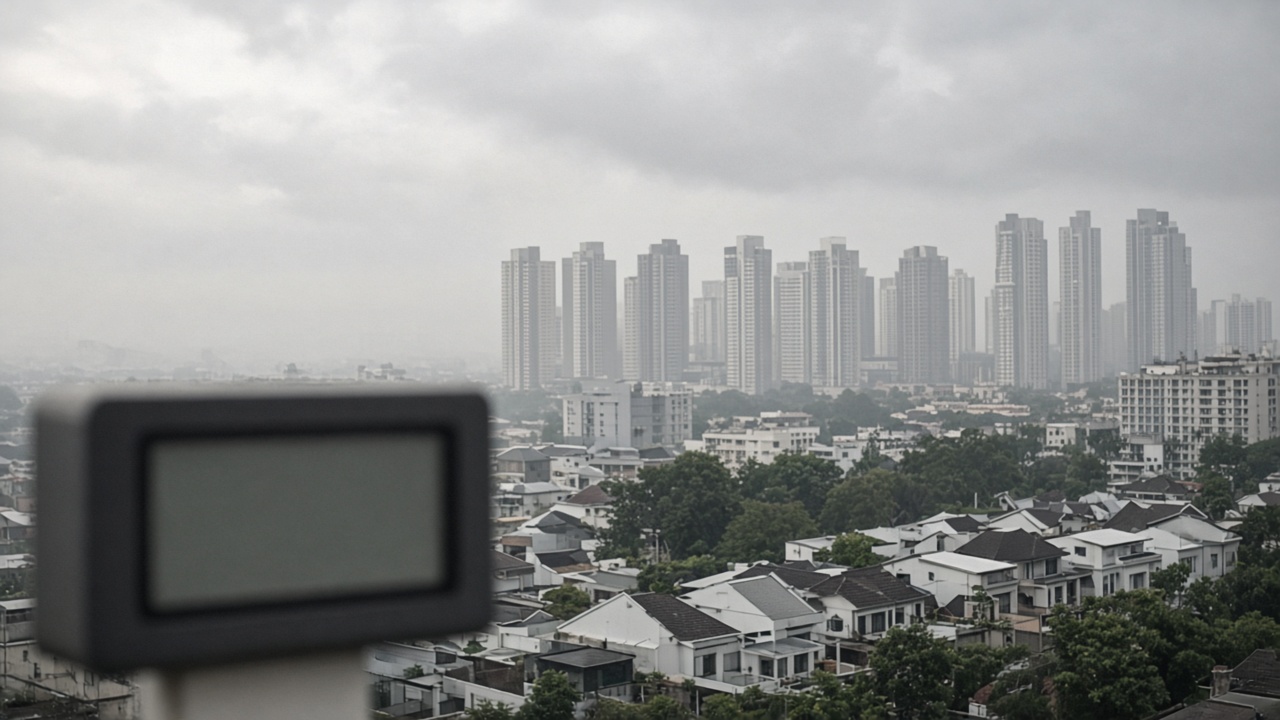
Singapore’s haze dashboard and its dengue map told different stories on Thursday: the National Environment Agency kept one-hour PM2.5 in Band 1 (Normal) across all regions even as 24-hour PSI sat in the Moderate range, while the sprawling Lentor and Countryside Road dengue cluster still listed 258 cases—the largest active outbreak on NEA’s surveillance table. Households in Yio Chu Kang and Ang Mo Kio therefore juggled two routines at once: check PM2.5 before strenuous outdoor exercise, and clear stagnant water while inspectors continue gridding the red-alert estate.
Haze readings versus forecasts
By Thursday evening, 24-hour PSI ranged from 62 to 76, classified as Moderate, with central Singapore at the top of that band. NEA’s daily update warned that east-southeast winds could still deliver smoke from Kalimantan and southern Sumatra, pushing the next-day PSI forecast toward the low end of the Unhealthy range even though immediate one-hour PM2.5 readings stayed between 17 and 27 micrograms per cubic metre—well inside Band 1’s 0–55 threshold on the haze microsite.
Hotspot counts in Kalimantan jumped sharply mid-week, reinforcing why NEA separates short-horizon PM2.5 guidance from 24-hour PSI planning. Parents scheduling PSLE-year outdoor drills and condo managers planning rooftop events were told to rely on the one-hour band for same-day decisions and PSI forecasts for tomorrow’s planning.
Lentor cluster pressure
NEA classifies clusters with ten or more cases as red-alert zones; the Lentor footprint—Countryside Road, Florissa Park, Lentor Avenue and adjoining streets—has carried triple-digit counts for months, growing from the 135 cases reported in early July when CNA flagged 86 breeding habitats, mostly in residential premises. Gravitating cases in Seletar and Luxus Hill add parallel yellow and red zones, but none match the Lentor cumulative tally on the 18 September surveillance snapshot.
Vector teams continue source reduction and ULV fogging; residents still find breeding in flowerpot plates and domestic containers despite repeated advisories. Dengue serotypes circulating this year keep clinicians alert for hospital capacity even as weekly case counts eased slightly toward August’s end.
Practical steps this week
Polyclinics near Lentor continue to triage fever cases with rapid dengue tests; GPs remind patients that haze masks do not replace mosquito precautions. Employers with outdoor sites should monitor both NEA dashboards—construction firms already juggling haze stop-work thresholds cannot ignore NEA officers inspecting site drains for larvae.
For haze, keep the myENV app handy and favour indoor alternatives if one-hour PM2.5 crosses into Band 2 (Elevated). For dengue, break the breeding cycle daily—one forgotten saucer under a balcony plant can feed the cluster map your neighbour sees online. NEA’s dual message on Thursday was not contradictory: air quality was manageable hour by hour, smoke risk remained on the forecast, and Lentor’s 258-case cluster still demanded household action regardless of what the skyline looked like at dusk.