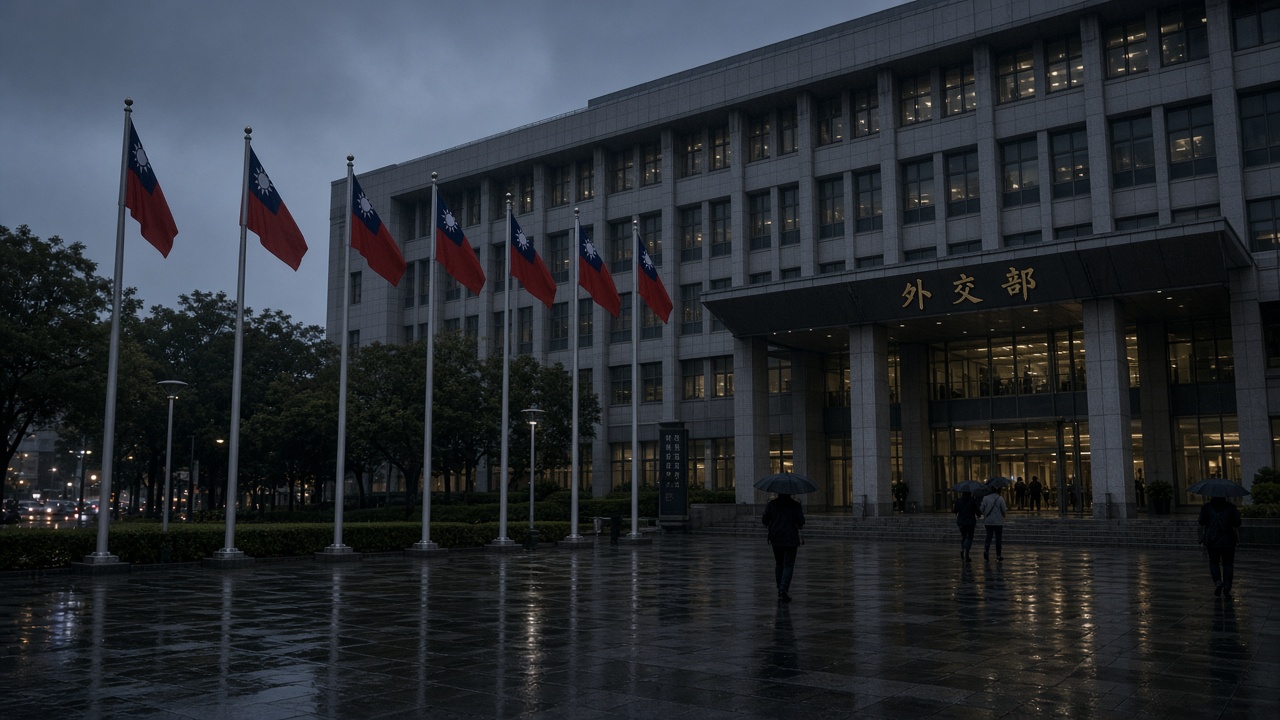
Taiwan's Ministry of Foreign Affairs on Friday rejected Beijing's account of this week's U.S.–China summit, saying President Xi Jinping's published remarks on the island's future "distort facts" and that only the people of Taiwan can decide it. The same-day statement was issued in Taipei a day after Xi told President Donald Trump at the White House that Washington should adopt the "correct position" of opposing Taiwan independence and handle the Taiwan issue prudently, according to the readout carried by China's official Xinhua News Agency.
In response, the ministry described Xi's remarks as "the consistent Chinese approach of distorting facts and unilaterally conveying its position and claims." It restated Taipei's standing position that the Republic of China (Taiwan) and the People's Republic of China "are not subordinate to each other," adding: "Taiwan's sovereignty belongs to all the people of Taiwan. The Chinese Communist Party has no right to represent the Taiwanese people, and Taiwan's future can only be determined by the Taiwanese people through democratic means."
The wording at issue
Xi's call for Washington to "oppose" Taiwan independence goes further than the phrasing U.S. officials have used for years. Washington has long said it does "not support" Taiwan independence without committing to actively work against it. Taipei reads any change in that language as a move to bend U.S. policy wording toward Beijing, and has handled the summit's Taiwan lines with care.
Xinhua published Xi's Taiwan remarks before a fuller summary of the roughly two-hour meeting. The White House did not issue its own account of whether Taiwan came up. Asked afterwards about the talks, Trump called it a "great meeting" and gave no public Taiwan commitment comparable to Xi's.
Arms, partners and next steps
The statement fixes the ministry's line on the record at a set point in the diplomatic calendar: the summit has ended, the readouts are out, and Taipei's answer now travels to partners and back to the island's own agenda. Taiwan "will continue to work closely with the United States and other like-minded partners to jointly safeguard peace and stability in the Taiwan Strait," the ministry said. It called Beijing the "true disruptor" of regional peace and stability, citing military pressure around the island and in the East and South China Seas, and said President Lai Ching-te's pledge to maintain the cross-strait status quo would hold.
The practical question — the one that has trailed the summit since May — is whether a proposed U.S. arms package worth about US$14 billion reaches Congress. Trump paused the sale earlier this year and called it a "very good negotiating chip." In Taipei on Friday, retired U.S. Navy Rear Adm. Mark Montgomery urged Washington to send the notifications to lawmakers, suggesting the package could be broken into smaller tranches announced over several weeks, and said delivery constraints should not delay the paperwork.
As of Friday morning Taiwan time, neither government had published a full joint readout, leaving the two leaders' separate accounts — and Taipei's reply to them — as the operative record. The ministry said the island would keep deepening cooperation with the United States, a line it has repeated after each round of cross-strait friction this year.