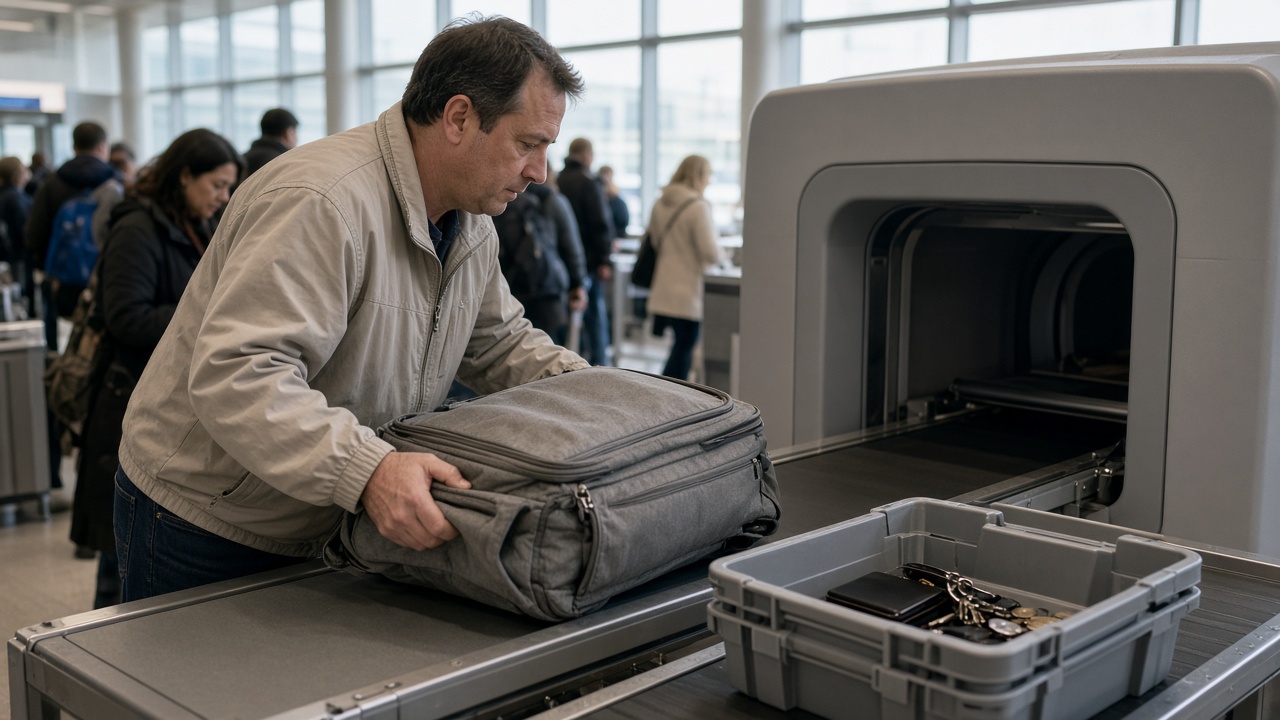
At the front of the security line, the belt stops being a belt and becomes a tunnel: a gray arch with a mouth roughly two feet wide, sitting where the old X-ray machine used to sit. Shoes off, tray stacked, phone in the bin — and then the pause. Your bag reaches the mouth of the machine and stops. Not because an officer pulled it. Because it doesn't fit.
Across a growing share of US checkpoints, the flat X-ray belt has been replaced by a computed tomography (CT) scanner. The machine spins an X-ray source around each bag and builds a three-dimensional image an officer can rotate on a screen. TSA says the technology cuts the number of bags that must be opened by hand and lets travelers leave laptops and most other electronics packed. What it does not do is stretch. The lane opening on the CT units in service measures about 24.5 inches wide by 16.5 inches tall — and that measurement, more than any airline's published limit, is what a full carry-on now has to clear.
The number at the mouth of the machine
Airline carry-on limits are usually quoted as 22 by 14 by 9 inches, and that number already counts wheels and the telescoping handle. In practice it is a guideline. Soft-sided bags bulge. A jacket shoved into the front pocket, a water bottle in the side sleeve, a pair of shoes pressed on top, and a bag that measured 22 inches on the showroom floor presents itself closer to 23 or 24 across its widest edge, with a shell that rounds outward instead of lying flat.
Whether a bag clears that opening depends on how it is loaded and how it is placed on the belt. Laid flat on its back — the way most rollaboards travel through a scanner — a 22-by-14 bag presents its 14-inch depth and clears the 16.5-inch opening with room left over. Set down upright, or shoved in at an angle when the line is moving fast, a full bag can catch the lip of the tunnel. Then the lane stops for everyone behind you.
Bins still exist. Laptops still stay inside.
The CT lane is not a free-for-all. Loose items — keys, phones, coins, wallets, belts — still go in a bin, and the bins are not optional. Small objects riding bare on the belt are how jams start, and a jam in a CT lane takes the whole lane down, not just one traveler. Jackets generally come off and go in a bin as well.
The change travelers notice most is what stays in the bag. TSA says that at CT lanes laptops and most other electronics can remain packed, which retires the old routine of digging a laptop out of a sleeve, stacking it in its own bin, and reassembling everything on the far side. Rules for liquids vary by lane and airport, so read the signs above the belt — and if you are unsure, ask the officer before the tray goes through.
If the bag does not fit, the clock starts
A carry-on that will not go through the CT lane becomes a different kind of problem. Depending on the checkpoint and how crowded the lane is, an officer may hand-screen the bag on the spot, or the traveler may be sent out of the security queue and back to the airline counter to check it. Either way the cost is time — the one thing no traveler can pack — and it is paid at the point in the terminal where the line behind you is longest.
That arithmetic is why the next few months matter. Holiday travel begins in earnest with Thanksgiving on November 26, and the days around it are when checkpoint volumes at major airports push toward their yearly peak. A bag that squeaks through a quiet Tuesday lane in September is the same bag that can wedge on the Wednesday before Thanksgiving.
Five minutes at home, before the trip
Measure the bag loaded, not empty. If it is at or over 22 inches across the long edge with the pockets full, either pack it lighter or plan to check it. Leave the exterior pockets flat and put soft goods inside the main compartment, where they compress instead of pushing the shell outward. Consolidate small items into one pouch that goes straight from your pocket into a bin, so nothing rides loose on the belt. And when you reach the machine, lay the bag flat on its back and let it feed in square rather than sideways.
None of that is exotic advice. It is the same packing discipline that gets a bag into an overhead bin on a full flight, applied fifteen feet earlier at the mouth of a different machine. The distance between the belt and the tunnel is short. The line behind you, on a holiday morning, is not.