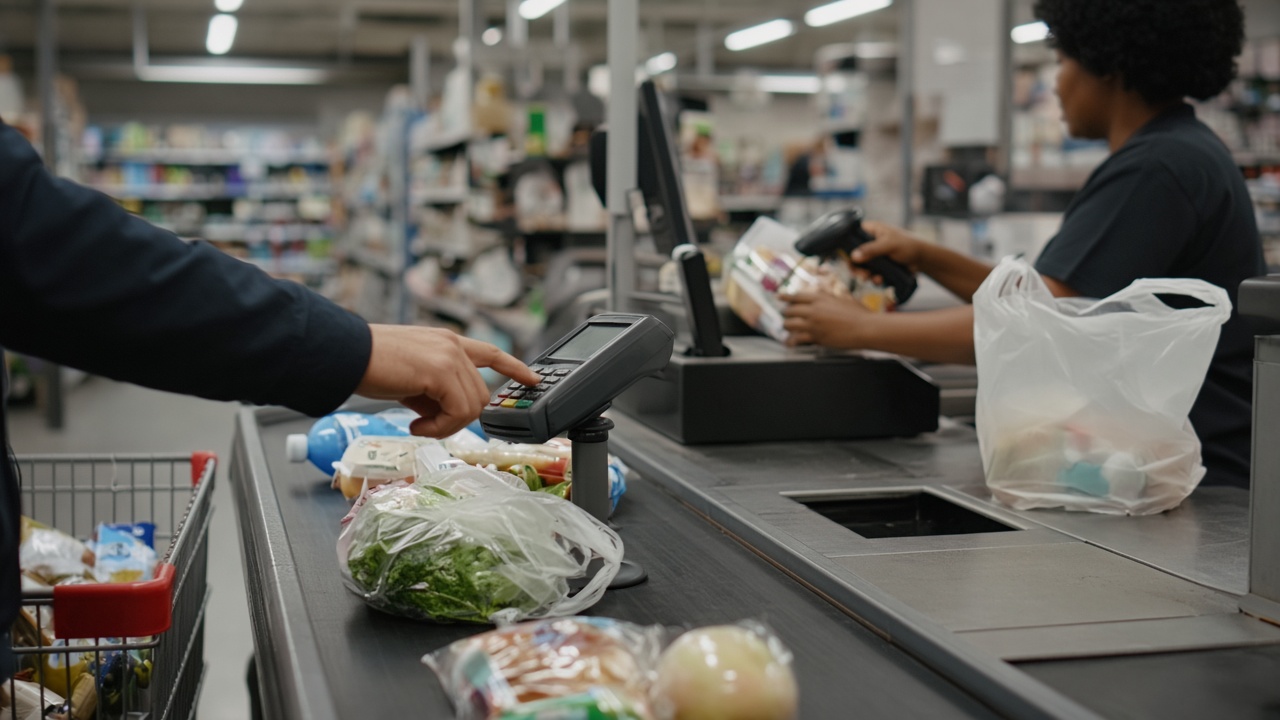
The supermarket line moves the same way for everyone. The shopper ahead of you taps a debit card, the terminal chirps, the drawer opens. You tap a credit card that pays 2 percent back on groceries. Same beep, same total on the screen, same bags going into the cart.
Behind the register, those two taps cost the store very different amounts. Your credit card skims more off the sale than her debit card does — usually several times more — and that gap is the raw material for your cash back, your sign-up bonus and your airline miles.
It is also where she comes in. Congress capped debit swipe fees to make checkout cheaper. The cap worked on the fee line and misfired on everything downstream: it pushed spending toward credit cards, whose richer fees fund richer rewards, while most stores kept charging one price to everybody. The shopper paying with debit pays for miles other people fly.
The Invisible Price Tag
When you tap a card, the money does not move in a straight line. The store's bank hands most of the sale over to your bank and keeps a slice. That slice is the merchant discount rate, and its biggest piece is interchange — a fee paid from the merchant's side of the transaction to the cardholder's side.
Interchange is not one number. It varies by card type, merchant category and transaction size, and Visa and Mastercard publish schedules of default rates that apply unless a merchant is large enough to negotiate something else. A national supermarket chain has bargaining power. The corner store does not.
Run a $100 grocery basket through both payment rails and the spread is stark. A debit transaction from a large bank runs the merchant roughly 27 cents: a 21-cent base, about a nickel for the percentage piece and a penny for fraud prevention. A typical rewards credit card runs closer to $2. Same groceries, same register, same cashier, roughly seven times the cost.
That difference has to land somewhere, and it does not land on the receipt. Stores almost never post two prices, one for cards and one for cash. Card network rules historically barred surcharging, most states still restrict it, and while a merchant can legally offer a cash discount, few bother. The fee gets blended into the shelf price instead — which means the customer paying with five twenties pays it too.
This is the part of the system that stays invisible. You can see your rewards balance. You cannot see the 2 percent embedded in the price of the milk, and you cannot see who funded it.
Rewards Are Not Free Money
A cash-back card is a product with a business model, and the model starts with the merchant discount rate. Issuers collect on several lines at once: interchange on every transaction, interest on revolving balances, annual fees, late fees, foreign transaction fees and the float on money in transit. Rewards are paid mostly out of the interchange line. That is why card tiers track fee tiers so closely.
A no-fee card paying 1.5 percent is priced to a lower interchange rate than a premium travel card that charges several hundred dollars a year and pays triple points on dining. The more the issuer can collect from the merchant's side, the more it can hand back to you — and the more aggressively it can chase what the industry calls top of wallet. Issuers do not want to be a card in your drawer. They want to be the card you reach for without thinking.
Airline and hotel co-brands run on the same math. The loyalty currency you earn is bought largely out of interchange, which is why co-brand cards tend to carry higher merchant fees than plain vanilla cards and why the issuer and the airline split the economics so carefully.
There is a second transfer running inside the credit portfolio itself. If you pay your statement in full every month, you are a transactor: the issuer earns mostly interchange on you, plus maybe an annual fee. If you revolve a balance, you are paying an interest rate that runs into the twenties. Part of what you pay in interest helps fund the rewards collected by the person who never carries a balance. The advertised 2 percent is not a gift from the bank. It is a redistribution, and the bank keeps a cut of the proceeds.
The Durbin Shock
Debit used to look more like credit. Banks paid rewards on debit cards, sometimes generously, because debit interchange was rich enough to fund them. That changed with the Durbin Amendment, attached to the Dodd-Frank Act in 2010, which directed the Federal Reserve to write rules on debit interchange fees.
The Board shall prescribe regulations ... to ensure that any interchange transaction fee received or charged by an issuer with respect to an electronic debit transaction is reasonable and proportional to the cost incurred by the issuer with respect to the transaction.
The Fed's answer, Regulation II, was a hard cap: 21 cents plus 0.05 percent of the transaction, plus a penny for fraud-prevention costs, effective in October 2011. It applied to issuers with more than $10 billion in assets; smaller banks and credit unions were exempted, on the theory that they needed the revenue more. The Congressional Research Service report on the rulemaking documents how narrow the final number was compared with what the Fed first proposed.
Big banks lost a revenue line worth billions. They replaced some of it the way banks usually do. Monthly maintenance fees appeared or rose. Minimum balance requirements for free checking went up. Debit rewards at large institutions mostly disappeared, because the fee that paid for them had been cut by roughly half or more.
The bigger shift was behavioral. Once the rewards went away, debit stopped being the obvious way to pay for a household that wanted something back. Research on the aftermath, summarized by Kellogg Insight, puts the decline in debit volume at roughly 30 percent where rewards were removed. Spending did not vanish. It moved to credit — where interchange was never capped, and where the rewards were waiting.

Who Actually Pays
If the debit cap had worked the way it was sold, the savings would have shown up in prices. The evidence on that is thin. A merchant survey cited by the Cato Institute found that about 1 percent of merchants lowered prices after the cap took effect, 22 percent raised them, and 77 percent left them unchanged. The fee relief largely stopped at the register, not at the shelf.
Retail trade groups read the same record differently, and it is worth saying so plainly. The Merchants Payments Coalition and the National Retail Federation argue that card fees remain one of their fastest-growing costs, that grocery margins are thin enough that savings get competed away rather than pocketed, and that the counterfactual — what prices would have been without the cap — is not something a survey can measure. Both readings are live. What is not in dispute is where the rewards went.
Debit rewards shrank. Credit rewards grew. And the households on the losing end of that swap are not hard to identify. Millions of Americans have no bank account at all and pay in cash by necessity. Many more use debit because they do not want to carry a balance or cannot qualify for the cards that pay the best rates. Both groups pay the same posted price at the register, which carries the same embedded fee, and neither collects a point for it. The debit customer who kept the card but lost the rewards got hit twice: no rewards, and higher account fees to replace the bank's lost interchange.
The winners are the households with the credit score, the premium card and the discipline to pay in full. They capture the rewards, pay no interest, and let the fee sit in the price everyone else pays. It is a regressive transfer running through the produce aisle, and it is almost perfectly invisible from the outside.
What Congress Is Debating Now
The live version of this fight is the Credit Card Competition Act, reintroduced across successive Congresses. It would require the largest credit card issuers to enable at least two unaffiliated networks on every card, so a merchant can route a transaction over the cheaper rail. Backers describe it as doing for credit routing what Durbin did for debit routing. Critics describe it as a price control on a product that consumers like.
The Durbin record is the strongest argument each side has, which is why both sides keep citing it. Supporters say competition on routing will lower merchant costs and that price relief will follow, just as it was supposed to after 2011. Opponents say the debit cap proved the opposite: fees fell, prices did not, and banks rebuilt the lost revenue through account fees and by pulling rewards. They also raise routing security and cardholder-protection questions, which supporters call a scare tactic rather than an engineering problem.
Set the lobbying aside and the mechanics are simple enough to predict. If routing competition meaningfully lowers credit interchange, three things follow. Rewards get less generous at the top of the market, because the revenue funding them shrinks. Account fees and balance minimums get more aggressive at the bottom, because banks protect their margins. And whether any of it reaches the shelf is an open question that the debit experience does not answer optimistically.
That is the honest shape of the debate: not whether merchants save money, but whether shoppers ever see it. Anyone who wants to check how the current debit cap actually works can read the Fed's plain-language Regulation II FAQ, which lays out the 21-cent base, the percentage piece and the fraud adjustment without any of the surrounding argument.
The Tap and the Price
You cannot opt out of the embedded fee by paying cash. It is already in the price, set by a merchant who cannot tell which card you will pull out and who has no practical way to charge you less if you pull out none.
What you can do is read the lines that are visible. Check what your bank charges monthly for the account your debit card draws on, and whether a minimum balance would erase it. Check the rewards rate on the card you actually carry, not the one advertised at you. Check the interest rate you would pay if a bad month turned you into a revolver, because that rate is what funds the rewards for someone else.
The 2 percent at the top of your statement is real money. So is the 27 cents the store paid on the debit card behind you in line. One of them shows up on a statement. The other one is folded into the price of the milk, and the person paying it has no way to know.