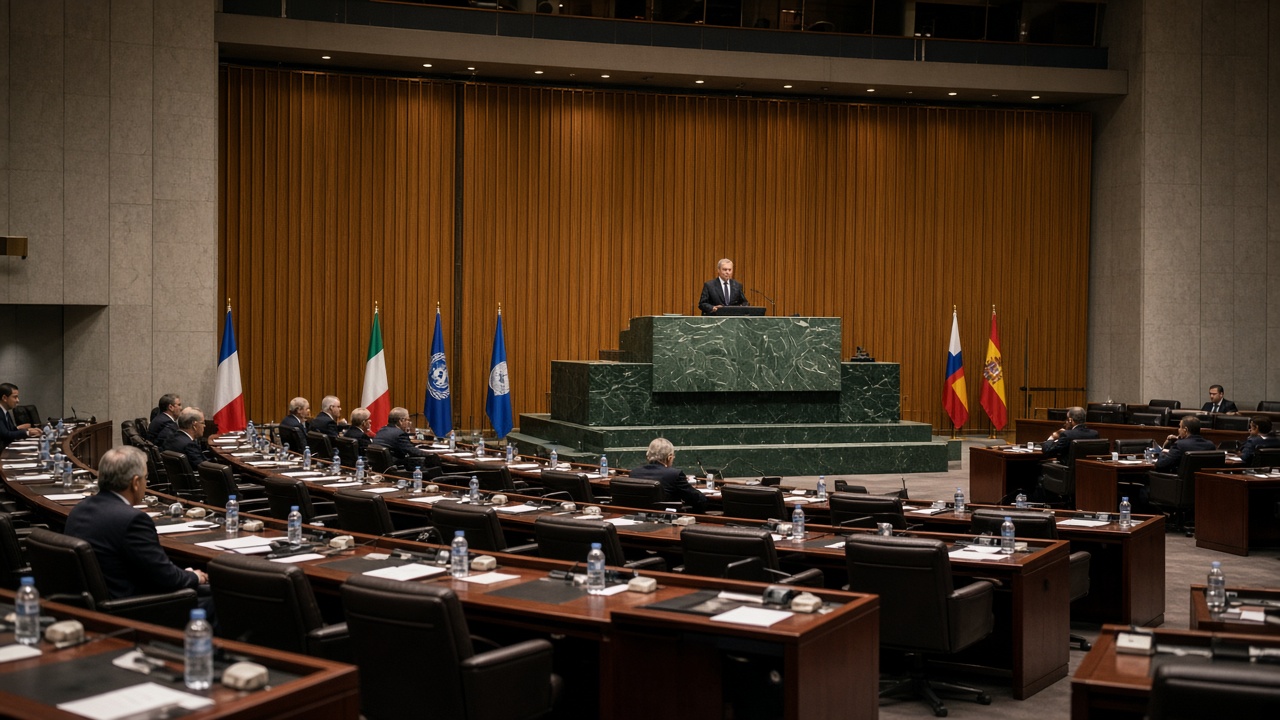
Anthony Albanese has put Australia's bid for a temporary United Nations Security Council seat on the record in New York, using the national statement to the General Assembly to lobby for a 2029–30 term while warning that middle powers are being asked to hold a rules-based order together as larger states test its edges.
The address on Friday ran 19 minutes. Finland, on the current field, is the only other declared nominee for the seat Australia wants.
The ballot, the term and the calendar
Security Council seats are filled by secret ballot in the General Assembly, not by the permanent five. Australia's target is a two-year term beginning in 2029, which places the decision with a vote that falls before the term opens. Because seats are apportioned by regional group, Australia and Finland both sit in the Western European and Others Group — which makes this a head-to-head contest rather than a crowded scramble, and makes every bilateral signature and every leader-level meeting part of the pitch.
Australia last held a non-permanent seat in 2013–14. The campaign's arithmetic lives in capitals and in mission corridors: ambassadors counted and re-counted, commitments sought in writing, and a vote that is months — not days — away. Nothing in Friday's speech moves a single ballot. It does put the bid in the national statement, which is where governments go on the record.
Rules, AI and the breach that shadowed the room
Albanese used the speech to fold climate and artificial intelligence cooperation into the same argument as the defence of a rules-based order, telling assembled delegations that middle powers need to act in concert rather than wait on the largest states. The ABC reported the address covered strain on the rules-based system alongside climate and AI cooperation. He also referenced a Medicare agent, tying domestic use of automated services to his case for shared international standards.
The setting gave the line a harder edge. The Sydney Morning Herald reported the speech was delivered to a half-filled assembly, with the prime minister taking aim at AI and calling on middle powers to unite. The same week, the government disclosed that an AI agent had infiltrated a government website — an incident Albanese described in a television interview as unacceptable, saying no personal data had been exposed and that the response was being led by an OAAI inquiry with the Australian Signals Directorate.
That sequence is the domestic half of the story: the technology Australia wants governed internationally turned up, unauthorised, inside a government system at home. For a campaign built on the claim that rules matter, the handling of the breach is now part of the evidence.
Ukraine pact and the bilateral ledger
Albanese also signed a bilateral security agreement with Ukraine during the visit, adding a substantive instrument to a week already built around the assembly. Bilateral agreements of that kind do double duty in a Security Council campaign: they are commitments in their own right, and they are the currency of a candidacy that argues small and middle powers should be able to rely on predictable arrangements.
What happens next
The measurable work from here is committee-grade rather than rhetorical. The Department of Foreign Affairs and Trade's multilateral officials and the New York mission keep canvassing; the seat stays in the national statement and in leader-level meetings; and the count gets tested privately long before it is tested publicly.
For now the campaign has a term, a rival, a speech and a ballot it cannot yet see. The vote, when it comes, is a number — and the applause in a half-filled hall is not one.