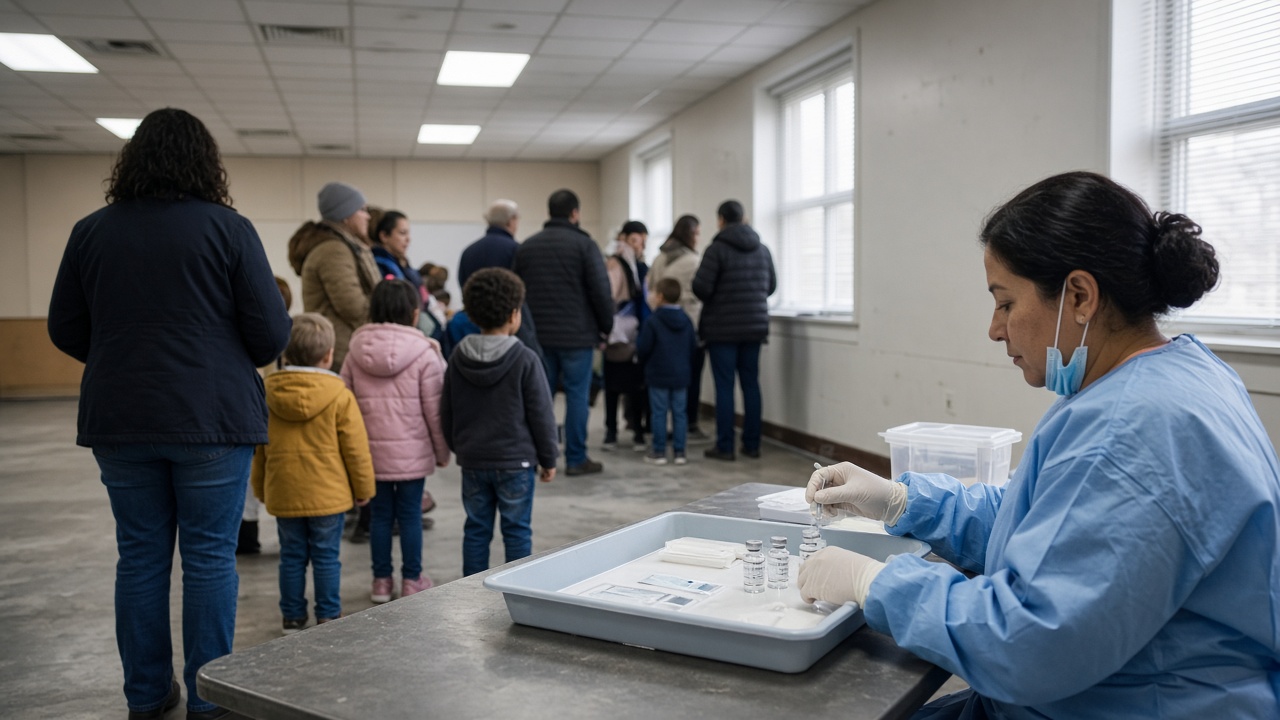
South Australia’s measles tally for 2026 has reached eight — the highest year-to-date count since 2016 — after four students at Brighton Secondary School were diagnosed with the infection. The state health department moved quickly from alert to action, standing up a pop-up vaccination clinic at the Masonic Hall on Commercial Road in Holdfast Bay on Friday afternoon.
The clinic, open from 2pm to 6pm, was aimed at people who needed a measles-mumps-rubella vaccine or who wanted to check their status after exposure sites were listed across the Brighton area. For families in the school community, the practical message was less about panic and more about records: two documented doses of MMR are the standard protection, and a missing dose can be fixed.
What the outbreak response actually confirmed
The confirmed facts are narrow. Four cases are linked to one secondary school. South Australia has recorded eight measles cases this year. The state’s year-to-date figure is the highest since 2016. A public health alert has identified exposure sites, and a vaccination clinic has been set up for the afternoon.
Those details matter because measles is not a background illness in a well-vaccinated population. It is one of the most transmissible viruses known. One infectious person can leave a trail through a school, a waiting room, a supermarket or public transport before the rash appears. That is why health authorities list exposure sites rather than simply name a school and move on.
The response clinic is a supply-side fix. It lowers the cost of getting vaccinated for people who turn up. But the bigger public health task is demand-side: getting adults and adolescents to find out whether they have had two doses, and to act if they have not.
Two-dose messaging in an Australian waiting room
In Australia, the MMR vaccine is part of the childhood schedule, usually given at 12 months and again at 18 months. Two doses are considered the standard for protection. Some adults, particularly those born after 1965 or who grew up during periods when vaccination coverage was patchier, may not have a complete record. Others may have had only one dose.
That is why the two-dose message appears in almost every measles alert. It is not a new recommendation. It is a request to check the record before exposure becomes a problem.
The evidence for the vaccine is not based on a single study. It is based on decades of population data showing that two doses of a measles-containing vaccine substantially reduce the risk of infection and, more importantly, reduce the chance of sustained transmission. In an outbreak, the question for a GP is not whether the vaccine is perfect. It is whether the person in front of them has documented protection.
There is a timing issue for people who may have been exposed. Post-exposure prophylaxis — which can include vaccination or immunoglobulin, depending on the person and the timing — is a clinical decision. It works best when it is given quickly. Anyone who thinks they were at an exposure site should not wait for symptoms before seeking advice.
What eight cases does and does not mean
Eight cases in South Australia is a small number in absolute terms. It is not a statewide emergency. But measles is a useful signal because it finds gaps. A cluster of four linked to one school suggests transmission within a defined social network, not necessarily a wider community surge. The public health response is designed to keep it that way.
The state’s high year-to-date count compared with recent years also reflects how low the baseline had become. When measles circulation is low, even a handful of cases stands out. When it rises, the same number can indicate more widespread exposure.
For parents at Brighton Secondary, the immediate task is straightforward: read the exposure-site list, check every family member’s immunisation history, and use the pop-up clinic or a GP if a dose is missing. For everyone else in Holdfast Bay, the same logic applies without the school connection. Two doses, documented, is the standard. If the record is unclear, a vaccine is usually the simpler answer.
The clinic closes at 6pm. The record check does not.