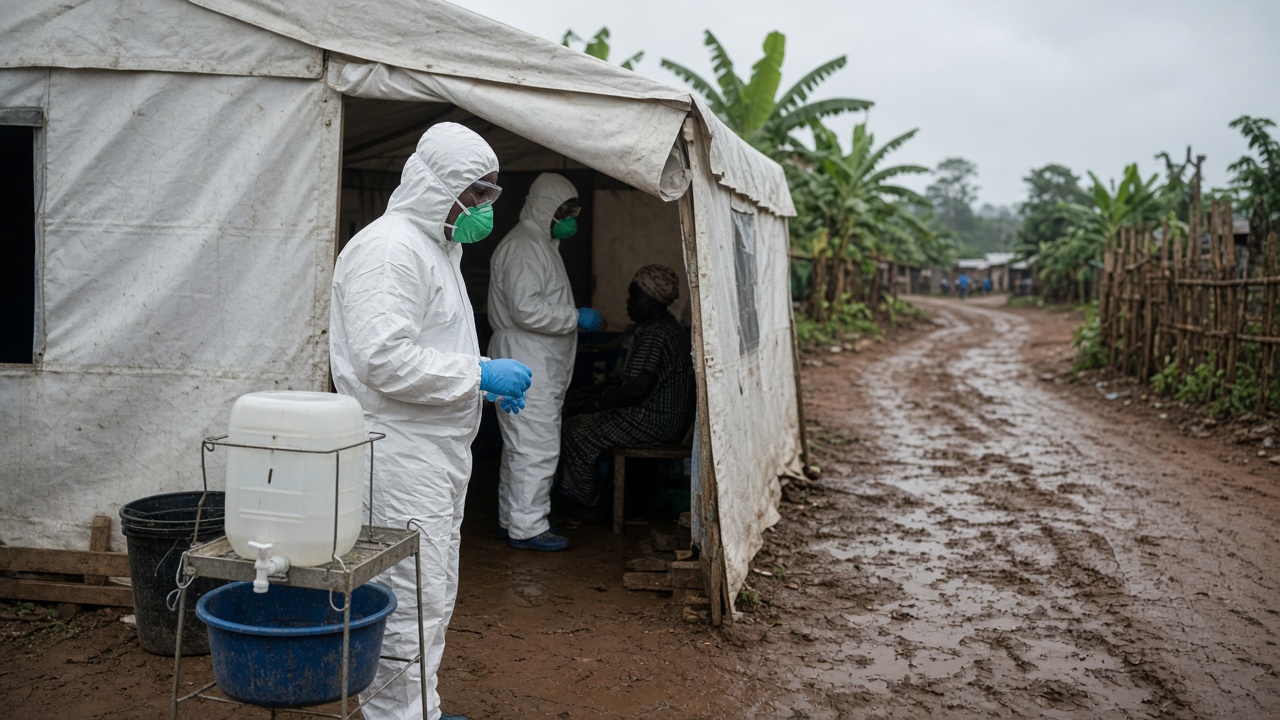
Breaking — The World Health Organization has widened the map of the Democratic Republic of the Congo’s Bundibugyo Ebola outbreak, confirming cases in Sud Ubangi province for the first time and adding Dungu in Haut-Uélé to the affected zones. The expansion comes as the confirmed tally nears 7,900.
In its Sept. 25 disease outbreak notice, WHO said the outbreak now spans 63 health zones. As of Sept. 23, DRC had reported 7,890 confirmed cases and 3,799 deaths, a case fatality rate of 48.1%. The new geography is the immediate news: Bulu zone in Sud Ubangi marks a new province in the northwest, while Dungu extends the outbreak’s reach in Haut-Uélé.
An outbreak moving in opposite directions
The aggregate numbers hide two different trends. WHO describes a decline of roughly 26% in Ituri, the province that has carried much of the response burden. At the same time, weekly cases in North Kivu have doubled, keeping national transmission elevated. Director-General Tedros Adhanom Ghebreyesus called the Ituri signal “encouraging signs” while warning that the “epidemic continues to grow.”
That combination matters for how readers rank the news. A falling curve in one province is not containment if another province is accelerating. The Sud Ubangi and Haut-Uélé additions also mean the virus is being detected across a wider set of health zones, each with its own surveillance capacity, laboratory links, and contact-tracing teams.
Why Bundibugyo changes the tools
This is not the Zaire ebolavirus that has driven most recent DRC outbreaks and for which vaccines and treatments have been deployed. Bundibugyo has no licensed vaccine, according to WHO. That limits the standard ring-vaccination strategy and shifts the response toward isolation, safe burials, contact tracing, and supportive care. Health workers and affected families bear the highest exposure risk.
Sud Ubangi’s location in northwestern DRC raises cross-border surveillance concerns. Movement across international boundaries can seed new chains of transmission before symptoms are recognized. The same is true in Haut-Uélé, where the outbreak’s eastern geography already connects to busy trade and travel routes.
What the evidence supports
The 48.1% case fatality rate is an absolute measure among confirmed cases reported so far, not a forecast. It can rise or fall as patients recover and as reporting catches up. The confirmed-case count also reflects testing: zones with stronger laboratory access may detect more cases, while areas with weaker access may undercount.
Readers should not treat the Ituri decline as a national all-clear, nor should they assume the outbreak is confined to the provinces named in earlier bulletins. They also should not use unproven remedies or delay care for Ebola-compatible symptoms. Early isolation and official contact tracing remain the interventions with the clearest evidence behind them.
What to watch next
Three signals will show whether this expansion is contained. First, whether the new zones report linked transmission or separate introductions. Second, whether North Kivu’s weekly increase continues. Third, whether cross-border alerts produce rapid testing and isolation outside DRC. WHO’s next outbreak notice will update the tally, the case fatality rate, and the list of affected health zones.
For now, the outbreak is both improving in one pocket and widening in others. The near-7,900 confirmed cases and the new Sud Ubangi province are the clearest evidence that the response is not yet ahead of the virus.