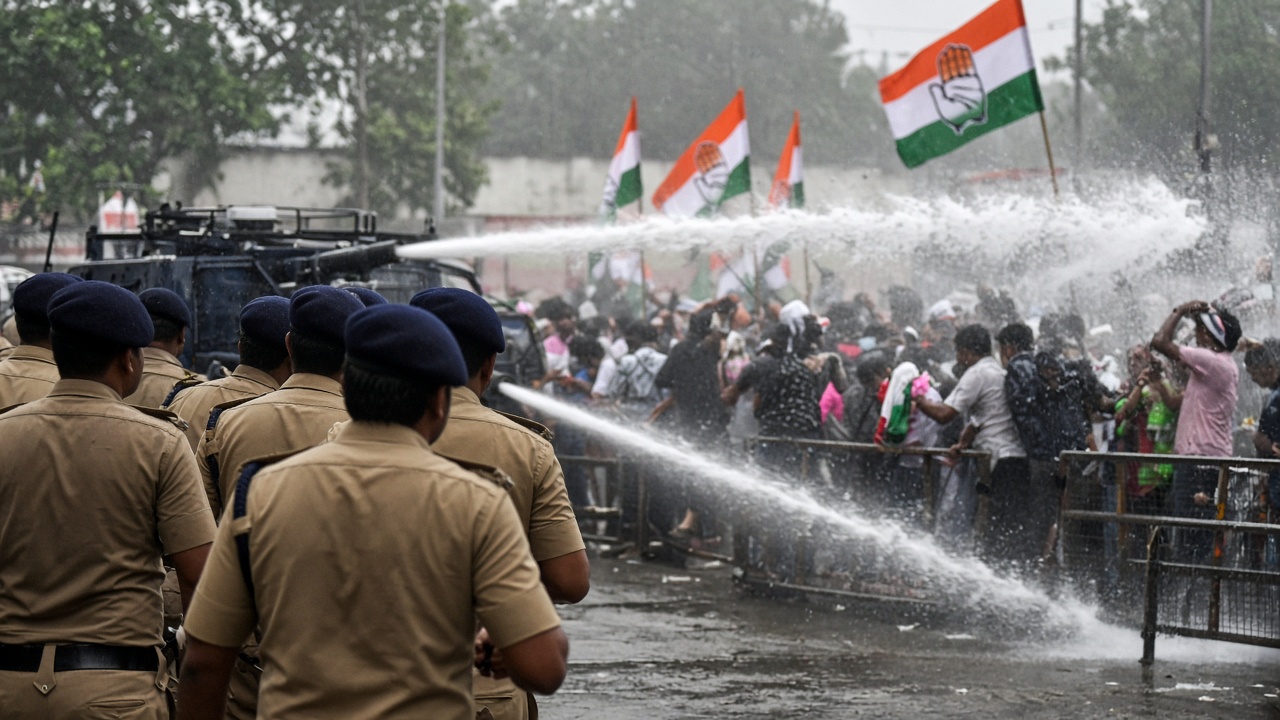
New Delhi: Police used water cannons and detained Congress workers in the capital on Saturday as the party demanded Chief Election Commissioner Kumar resign over the Election Commission’s revision of electoral rolls, turning a routine administrative calendar into the sharpest political confrontation of the week.
The protest was not about a bill in Parliament. It was about a list. Electoral rolls are the basic document of Indian democracy: they decide who can vote, where they vote, and whether a claim survives scrutiny. When that list is revised, every deletion or addition becomes a political fact. Congress has seized on that fact, arguing that the current revision is being run in a way that risks disenfranchisement. The party wants Kumar to step down. The Commission has not publicly accepted that demand, and no resignation has followed.
What is on the list?
The roll revision follows a fixed administrative sequence: draft publication, claims and objections, disposal of those claims, and final publication. Each stage has a date. Each date has a consequence. For political parties, the arithmetic is direct: a deleted name is a vote at risk; an added name is a vote to bank. For the Election Commission, the test is procedural: whether every deletion was notified, every objection heard, and every decision recorded.
That is why the Congress demand is not just about one official. It is about control of the process. The party says the revision is being used to reshape the electorate before the next test at the polls. The Commission’s public position, repeated in earlier roll exercises, is that revision is a continuous and lawful exercise, open to claims and appeals. Both sides are talking past each other because they are answering different questions. Congress is asking who benefits. The Commission is answering whether the file is in order.
Who has the numbers?
In Parliament, the government has the numbers. That matters because the Chief Election Commissioner is not removed by a simple opposition motion. The removal process is deliberately insulated: it follows the same route as a Supreme Court judge, requiring a presidential reference and a parliamentary process on grounds of proved misbehaviour or incapacity. No such motion has been moved in this dispute. The Congress can raise the demand, force a debate, and use its MPs to keep the issue alive. It cannot, with its current strength, remove the CEC.
That gap between political demand and legal remedy is the core of the story. The protest outside the Commission or the government’s offices is a pressure tactic, not a constitutional procedure. Water cannons and detentions shift the immediate focus from the rolls to the right to protest. They also give the opposition a new grievance: not only that the roll revision is flawed, but that the state’s response to dissent was heavy-handed. There was no immediate detailed public account from police of the detentions.
The calendar ahead
The next moves will be procedural. The Commission can continue the revision on its published schedule. Congress can file objections, move the courts, or take the demand to Parliament when the House meets. The government can defend the Commission and ignore the resignation call. The opposition can try to build a larger alliance around the issue, but that takes time and numbers.
What happens in committee may matter more than what happens on the street. The parliamentary standing committee on law and justice, or any ad hoc committee the House creates, can call for records, seek explanations, and publish a report. That is where a political charge becomes a paper trail. If the Congress wants the demand to survive beyond a news cycle, it will need documents: deletion lists, objection records, and evidence that the process departed from the law. Without those, the demand remains a slogan.
The Commission, for its part, has an interest in showing that the calendar is being followed. Roll revision is routine until it is not. Once it becomes a street confrontation, every future publication of the rolls will be read as a political event. For now, the immediate facts are narrow: protests, water cannons, detentions, and a demand for resignation. The larger question is the one this beat always returns to: what is on the list, who has the numbers, and what happens when the file reaches the committee.