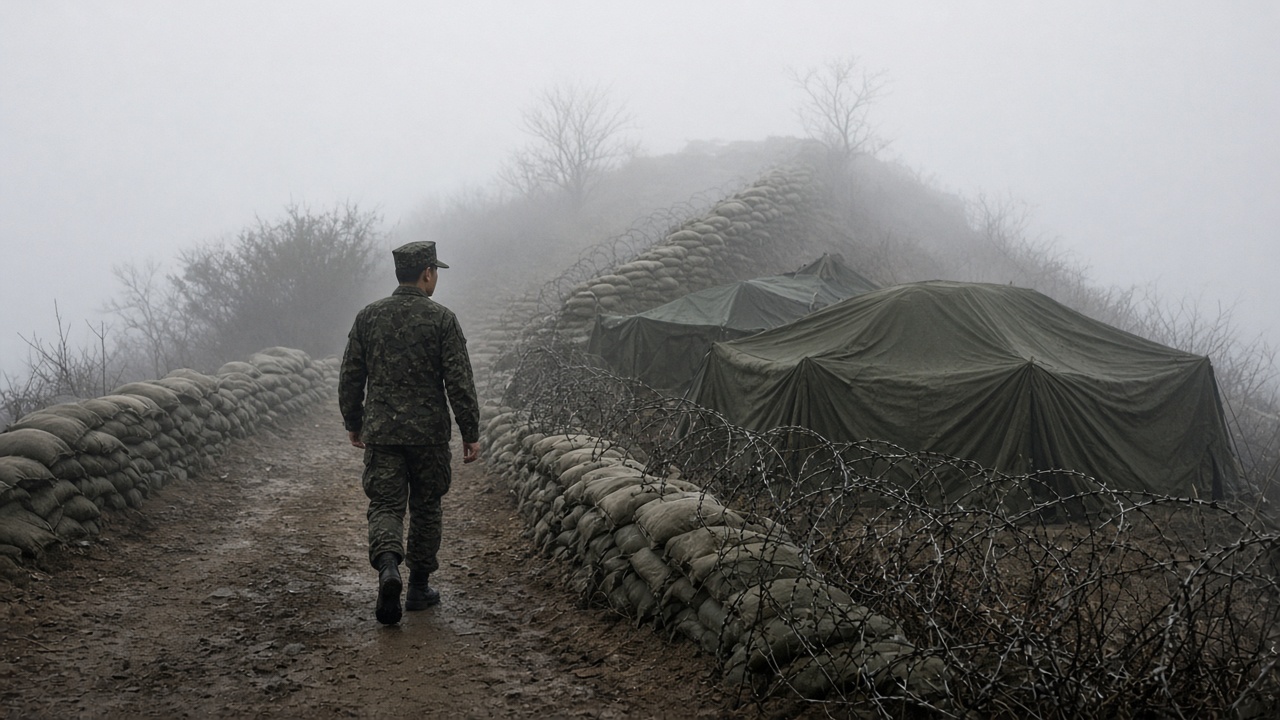
SEOUL — The chairman of the Joint Chiefs of Staff, Jin Yeong-seung, visited the Army's 25th Division in Paju on Friday, four days after two explosions in the Demilitarized Zone sector injured three people, among them a battalion commander.
The timing matters. Blasts in the DMZ strip are not treated as a routine safety accident. They fall at the seam between the Armistice Agreement, the U.N. Command's mandate and the South Korean military chain of command — which is why a division-level incident has drawn the JCS chairman and a joint field team.
What is confirmed
Two blasts occurred Monday in the Paju area of the DMZ. Three people were hurt, including a battalion commander. The JCS chairman inspected the 25th Division, the unit holding that sector, on Friday. Those four points are the firm floor of what is known. Almost everything about what caused the detonations, and who is answerable for them, remains open.
U.N. Command joins the field investigation
The presidential office said the U.N. Command has joined the on-site investigation, putting the probe under mixed ROK–UNC handling rather than a purely national military channel. That structure is significant for the legal question underneath the casualty count: depending on what forensic work concludes, the file could run through the Armistice framework, the Military Armistice Commission machinery, or a South Korean military justice track. None of those routes has been publicly confirmed as the lead.
Investigators are expected to work through the Chuseok holiday period, according to the field schedule reported so far — a signal that authorities do not expect a same-week finding and are treating the site as evidence that must be examined rather than cleared quickly.
Fragment analysis
Fragments recovered from the scene have been sent for analysis at the National Forensic Service. The forensic question is narrow and consequential: what the recovered material is, and whether it points to a specific device or a specific placement. Until that result lands, descriptions of the cause should be read as working assessments, not conclusions.
What is still unknown
Three things are unresolved and worth tracking separately.
First, cause. No NFS determination has been released on what produced the detonations.
Second, responsibility. If the forensic finding points to a device deliberately placed across the line, the accountability question moves from safety to the Armistice regime, which is a diplomatic file, not a unit-level one. No such finding exists yet.
Third, procedure. It is not yet public which Korean agency holds the primary file — military police, the JCS inspection apparatus, or a UNC-led channel — nor how the joint team's findings will be split between Seoul and the U.N. Command when the field work concludes.
For the 25th Division, the practical near-term effect is a sector operating under heightened caution through the holiday, with an investigation that has moved past the first 72 hours without a public answer on cause.