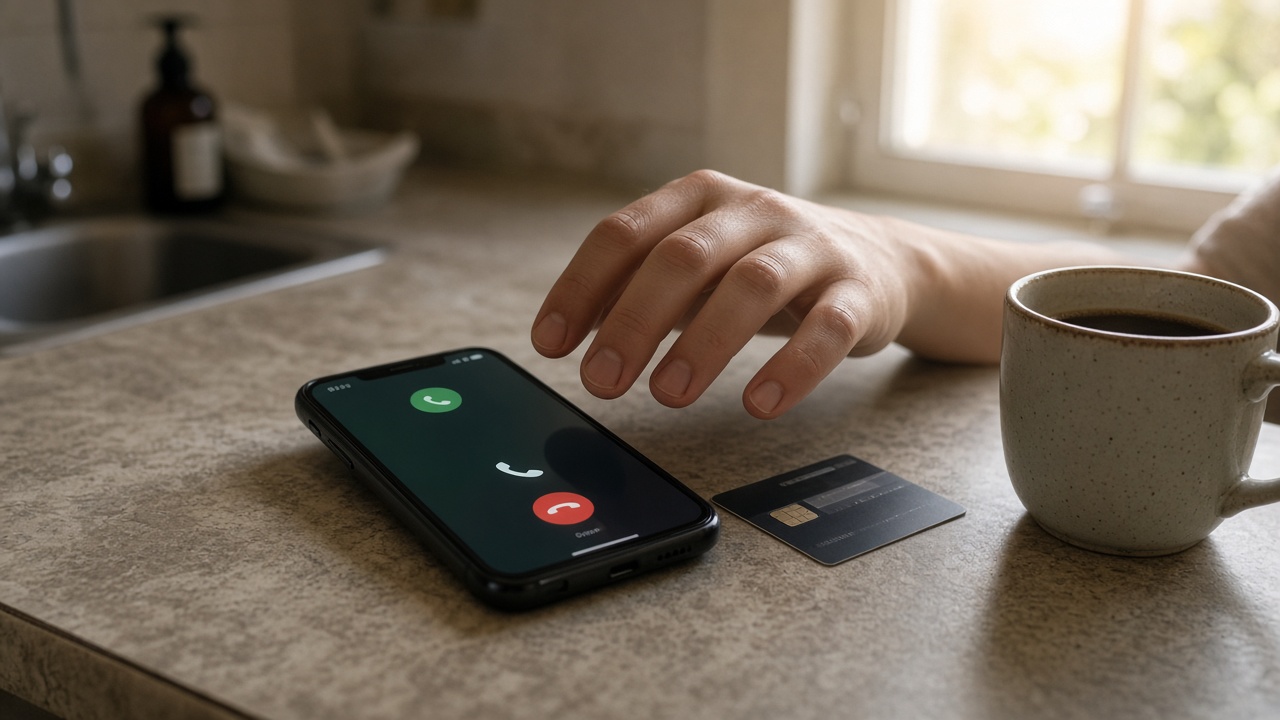
The Federal Communications Commission is telling consumers to treat any unsolicited call that asks them to move money as fraud, no matter what the caller ID says. In a consumer advisory, the agency said banks never ask customers to transfer funds into a "safe account" to protect them, never ask them to buy gift cards, and never ask for a one-time passcode to be read back over the phone.
The safe-account script works because it borrows real procedures. Caller ID shows the bank's real published number because the caller is spoofing it. The person on the line knows the last four digits of the account, mentions a pending charge that sounds plausible, and offers to hold the balance somewhere protected while an investigation runs. The bank is invented. The transfer is real, and it lands in an account the caller controls.
Anyone with a checking account can be targeted. The heaviest losses tend to fall on people holding larger balances and on small-business owners whose payroll and deposits run through a single account, because the ask scales with what the impostor can see.
"Never move money to protect it."
— Federal Trade Commission, consumer scam guidance
Hang up, then dial the number on your card
The single rule that breaks this scam is a callback you initiate. Hang up. Do not stay on the line to verify an account number, a code, or an employee ID, and do not call back the number the caller gives you or the one a voicemail leaves. Dial the customer service number printed on the back of your card, or open the bank's app and call from there.
Two other habits matter. Refuse the transfer out loud and hang up — the script depends on keeping you in the conversation, and a real fraud desk will not consider a hang-up rude. And agree on a code phrase with family members, because impostors frequently extend the call to a "supervisor" or a "family member" to keep the pressure on.
If the money already moved
Zelle's own guidance says to contact your bank or credit union first, because the receiving bank controls the account where the money landed. Call your bank's fraud line, ask them to open a recovery request, and write down the reference number. Once a Zelle payment is complete, the sender cannot pull it back unilaterally; how much returns depends on how fast the report is filed and whether the receiving bank freezes the funds.
A wire runs on a different clock. Skip the general customer-service queue and ask for the wire desk, then request a recall on the specific transfer. In the first hours, the receiving bank may not have released the funds and a recall has a chance. File with the FBI's Internet Crime Complaint Center as well; it creates a federal record and feeds the pattern data banks use.
What the banks and carriers still have to fix
Two systems are supposed to make these calls harder. Carriers are required under the FCC's caller ID authentication rules to sign call traffic, the framework known as STIR/SHAKEN, so a spoofed number can be flagged before it reaches a handset. Enforcement against voice gateway providers that pass unsigned traffic is part of the context around the advisory.
On the bank side, who absorbs the loss turns on authorization. Federal rules generally protect consumers against electronic transfers they did not authorize, but a payment a customer was tricked into approving is typically treated as authorized, which pushes the loss toward the customer unless the institution's own policy is more generous. That is the part worth asking about in writing: what the bank's reimbursement policy says for impersonation fraud, not just for unauthorized transactions.
The paper trail
Save the call log with the caller ID name and number, the exact times, and any texts or voicemails. Send the bank a written complaint and keep the ticket number. File with the FTC's consumer reporting system, which feeds the complaint database that state attorneys general and law enforcement query. If the bank will not resolve the dispute, the Consumer Financial Protection Bureau takes complaints against financial institutions and forwards them for a response.
The FCC's advice is narrow and it holds up: no bank asks you to move money to keep it safe. If a caller does, the call is not from your bank, whatever the screen says.